

In 2026 Utah began requiring that every customer’s ID be electronically scanned at every alcohol purchase. The law does not say what the scanning is for. The closest thing to a statement of purpose anywhere in the enactment is the title of the bill.
The equipment it mandates is defined, by administrative rule, as technology that verifies proof of age. That rule never mentions interdicted persons — the people the law was about. The check for them is still a human being looking at a red banner on a license, exactly as it was before the law passed.
A year later the legislature scaled the law back. It did so on burden, because burden was the only signal the system could produce. The sponsor of the rollback said of the original: “This was never the intent of the bill.”
Nobody ever had to show that the mandated design served the purpose the law was for, because no purpose was stated to show it against.
That is not an unusual law. It is an ordinary one.
The failure mode
Every law contains three decisions. They are usually made by the same people, at the same time, and recorded as one thing.
The mandate — what outcome is sought. A values question, and the legislature’s. The architecture — the design intended to achieve it, which can be checked against the mandate. The execution — whether what was built matches what was designed.
American statutes are written as procedures: what shall be done. They rarely state what doing it should achieve, in terms that would let anyone determine afterward whether it worked. When a procedure occupies the mandate slot, only compliance and burden are measurable, and whether the law achieved anything becomes unanswerable by construction — not because the question is hard, but because nothing was written down to answer it against.
And when something does fail, the failure cannot be located. Everyone points at everyone else, and nobody is definitionally wrong, because no one’s responsibility was ever established.
What this specification proposes
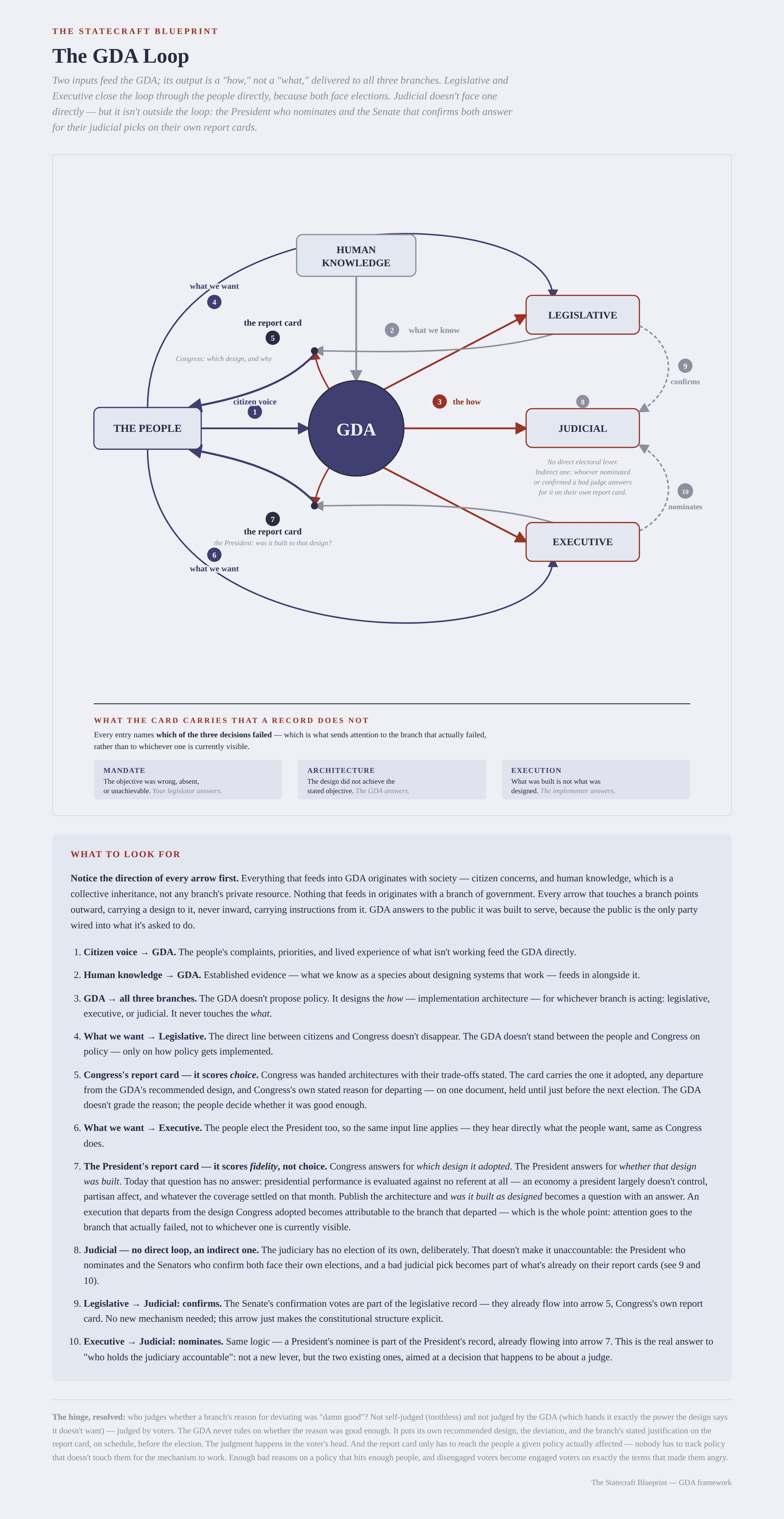
Not, in the first instance, an agency. A function that no institution currently performs: converting a democratic mandate into implementation architecture, and then evaluating the result against that mandate.
Pieces of it already exist. Performance-based building codes have separated the objective from the means, in binding law, for decades. Switzerland’s constitution carries a duty to evaluate whether federal measures work. New Zealand made the separation nationally in 1991, did not build the verification loop, and got the leaky homes crisis — remediation in the billions. Three of the four existing attempts skip the same half.
The Governance Design Agency — a professional body that designs the how while elected officials decide the what — is one way to house that function. It is not the only way, and this document says so. Moe and Howell reach the same diagnosis about congressional capacity and propose routing the design function to the presidency instead. That is a rival architecture with different trade-offs, not an opponent, and the specification states both sides of the comparison.
What the body cannot do is the part most often misread. A published design has no legal force. Any institution may decline it, in full, without penalty, and owes no one a legal explanation. It binds only where a legislature chooses to reference a specification in a statute — per statute, revocably, never forced. The single enforceable duty runs the other way: any person may report that something in government is not working, and the body must receive that report, classify it, and account for it on a public record.
Every legal obligation runs toward citizens. None runs from this body to compel any branch.
What this document does about its own weaknesses
It states its own mandate first, so that whether the design satisfies it is something a reader can check rather than take on trust.
Then it fails one of its own criteria in public. The funding arrangement it derives cannot satisfy the constraint that mandate sets — and neither can any other option, at the statutory stage. That is stated rather than managed, because it is the argument for the constitutional endpoint rather than a defect hidden inside it.
It names five findings that would show the framework is wrong.
It marks which of its own sections have been derived from the mandate and which are still positions inherited from earlier work, because a reader should be able to tell the difference without being told.
And the mandate itself is a candidate — the text a legislature would adopt, amend, or reject. Written by a citizen, published for contest. Contest is the point rather than a courtesy.
The full specification follows. Part 0 states the mandate. Part I is the distinction everything else depends on. Parts II and III are the diagnosis; IV through VI the institution and the derivations behind it; VII the boundaries, including what the framework does not fix; VIII adoption, on an honest timeline; and IX the list of what remains unsolved, sorted by the kind of work each item needs.
Earlier published work on the GDA describes a body that certifies architectures. That mechanism was dropped in July 2026. This is the current model, and it is the first version of this specification to be published.
