

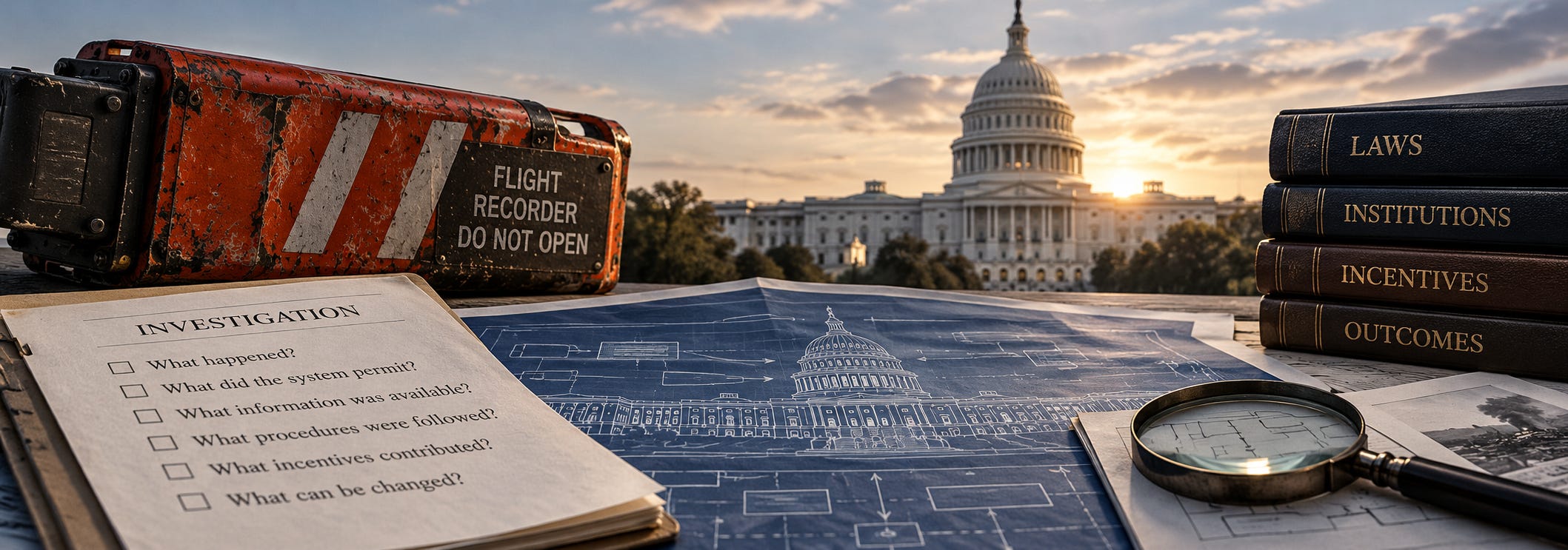
The National Transportation Safety Board doesn’t simply investigate whether a pilot made a mistake. It investigates why the accident happened.
What did the equipment permit? What information was available? What procedures were followed? What incentives or organizational conditions contributed? Did multiple individually manageable problems combine into a catastrophic failure?
And crucially, the investigation distinguishes the actions of individuals from the conditions that made those actions possible or consequential.
An aviation accident investigation doesn’t end when investigators discover that a pilot made a mistake. It examines what led to that mistake, whether the equipment behaved as expected, whether the crew had the information and training they needed, and whether the procedures themselves contributed to what happened.
The NTSB follows the evidence through the system. Its purpose is to understand the causes of an accident well enough to recommend changes that could prevent similar accidents in the future.
And we benefit from that work every time we board an airplane.
But what happens when government fails?
When something goes wrong with our government, who investigates?
We have institutions that audit expenditures, investigate misconduct, evaluate programs, and oversee particular agencies. Yet there is no single institution whose general responsibility is to investigate whether the design of our government is producing the results it was supposed to produce.
If a law doesn’t accomplish its stated objective, who investigates whether the problem lies in the objective, the law itself, or the way it was implemented?
If Congress has the constitutional authority to check the president but repeatedly struggles to exercise it, who investigates the rules and institutional relationships that might explain why?
And when a citizen experiences the consequences of those failures, where does that information go?
In When Government Fails You, Where Does That Failure Go?, I explored that last question.
People encounter government failures in all sorts of ways. A benefit doesn’t reach the people it’s intended to serve. A regulation creates expenses without producing its expected benefits. An agency follows its prescribed procedures but fails to achieve the objective those procedures were supposed to accomplish.
People complain. They contact representatives, submit comments, appeal decisions, and sometimes organize to demand changes.
Some problems get resolved. Others become political controversies, disappear into administrative processes, or persist for years without anyone establishing why they keep happening.
And that’s an extraordinary amount of information about how our government actually performs.
Every complaint potentially tells us something about the difference between what an institution is supposed to accomplish and what people experience when they interact with it.
Not every complaint establishes that something is broken. People can disagree about policy objectives, and sometimes the government is doing exactly what the law requires.
But that’s precisely why an investigation would be useful.
Instead of assuming the complaint identifies the cause, we could investigate what produced the outcome.
The accidents are already happening.
There’s an important difference between aviation and government, of course. An airplane crash provides an identifiable event to investigate. Government failures can emerge gradually, sometimes through decades of institutional changes whose consequences are difficult to recognize.
But government also produces observable events with enormous consequences.
Venezuela. Iran. The tariffs.
The military operations, emergency declarations, and trade measures associated with these events have raised questions about executive authority, statutory interpretation, and Congress’s capacity to constrain presidential action.
People disagree about whether particular decisions were necessary, lawful, or wise. Those disagreements are political and legal questions that deserve serious consideration.
But underneath them are questions about the mechanisms through which government operates.
What authority did the executive invoke? Where did it come from? What conditions permitted its exercise? Who determined that those conditions had been satisfied? What limitations did Congress establish, and what happened when those limitations encountered other constitutional and statutory authorities?
These questions can be investigated without assuming that everyone must agree about the desired policy outcome.
And an investigation need not stop with the executive official who made the decision.
What did Congress authorize? Why was the authority written that way? Did lawmakers anticipate its possible applications? Were the safeguards capable of constraining its use? Did interactions between separate laws alter how those safeguards operated?
Those are questions about institutional design.
They are also the kinds of questions I’ve been exploring in Intent Doesn’t Compile, an investigation into the difference between what lawmakers intend their instructions to accomplish and what those instructions actually permit.
The same underlying distinction appears in software engineering. A programmer can intend for software to behave one way, but the computer executes the instructions that were actually written. When an unexpected result appears, understanding the programmer’s intent is useful, but it doesn’t explain what happened. You have to trace the behavior through the system.
Government is considerably more complicated because the people operating its institutions possess judgment, incentives, and discretion. Nevertheless, the distinction remains important.
What a law is intended to accomplish is not proof that its mechanisms will accomplish it.
And the existence of a constitutional safeguard does not, by itself, establish that the safeguard will operate effectively.
James Madison recognized this problem long before software engineering or modern aviation existed. In Federalist No. 48, he warned that constitutional boundaries could become mere “parchment barriers” without effective means of defending them.
In Federalist No. 51, he went further, explaining that the constitutional powers of government offices needed to be connected with the personal motives of the people occupying them.
Madison understood that the behavior of government depends on more than its stated intentions. It depends on the relationships among its institutions and the incentives of the people operating them.
Those relationships can change over time. And when they do, we ought to be able to investigate the consequences.
So what would an investigation look like?
Imagine that when people experience a government failure, there is an independent institution whose responsibility is to investigate it.
They could report what happened, describe its consequences, and submit whatever evidence they have.
Investigators could examine individual reports, identify recurring patterns, and determine which problems warrant a more extensive investigation.
They would draw on the accumulated knowledge of political science, economics, law, history, psychology, organizational behavior, and systems engineering to understand the institutions involved.
What was the government supposed to accomplish? How was the law designed to achieve that objective? What happened when the law was implemented? What other rules, institutions, and incentives influenced the result?
The investigation might reveal that the mandate was poorly specified, that the chosen mechanism could not reliably accomplish the objective, or that officials failed to carry out the adopted design.
It might reveal an unforeseen interaction between otherwise reasonable laws.
Or it might establish that the law worked as written, but the political decision that produced it did not reflect what affected citizens wanted.
Those are different findings, and they call for different responses.
The Governance Design Agency, or GDA, is my proposal to give the American people an independent institution capable of conducting those investigations.
Its work wouldn’t end with identifying a problem. The agency would examine possible solutions, evaluate their costs and tradeoffs, identify potential unintended consequences, and develop alternative institutional designs.
This is where the NTSB comparison becomes especially useful.
When the NTSB investigates an accident, it produces findings and safety recommendations. The Federal Aviation Administration and other responsible organizations retain their authority to establish and enforce the relevant rules.
The NTSB does not govern aviation. It supplies evidence and recommendations that help the institutions responsible for aviation make better decisions.
The GDA would have a comparable relationship with Congress.
Congress would retain its constitutional authority to establish laws and make political decisions. The GDA would investigate government failures, develop alternatives, and recommend changes.
And Congress’s own procedures would be subject to examination. If an investigation found that the way Congress organizes its work prevented members from effectively exercising their constitutional responsibilities, those institutional arrangements could be evaluated just like the architecture of any other government function.
The GDA wouldn’t take Congress’s powers away. It would provide the information necessary to understand whether those powers were functioning as intended.
But the investigation belongs to the people.
There’s another important dimension to this proposal.
The GDA wouldn’t investigate government simply to provide Congress with recommendations. Its findings would be published for the people whose government was being investigated.
And the public’s involvement wouldn’t end with filing a complaint.
Suppose an investigation found that a law was failing to accomplish its objective. The GDA might identify several possible solutions, each with different costs, benefits, risks, and consequences for the people affected.
Those alternatives would be available for public examination.
People could contribute additional evidence, challenge assumptions, raise concerns, and participate in shaping the designs being considered.
After all, technical expertise can help us understand which mechanisms are likely to produce particular results. It cannot independently determine which results the American people should value or what tradeoffs we ought to accept.
Those are democratic questions.
The GDA’s responsibility would be to make the evidence and design alternatives available, help people understand their implications, and provide opportunities for informed public participation.
Then Congress would make the political choice.
And importantly, the public would have a record of that choice.
The NTSB offers an interesting precedent here, too. Federal law requires the Secretary of Transportation to provide a formal written response to NTSB recommendations, explaining whether they will be adopted, adopted in part, or rejected.
The NTSB cannot force the adoption of a recommendation, but it can establish a public record of what it recommended and how the responsible institution responded.
A similar arrangement could require Congress to formally consider and respond to GDA recommendations while leaving legislative authority where the Constitution places it.
That would allow the public to see not only what the investigation found, but what their representatives chose to do with those findings.
And that’s where accountability comes in.
Consider the difference between three kinds of government failure.
Suppose Congress establishes a policy objective that many citizens oppose. The GDA could examine its consequences, but the decision about what government should accomplish belongs to elected representatives, accountable to their constituents.
Now suppose Congress establishes an objective the public supports, but the legislation contains a mechanism that cannot reliably accomplish it. The GDA could identify the defect, develop alternatives, and provide the findings to both Congress and the public.
Citizens could then examine the options, contribute to their development, and hold their representatives accountable for the choices they make.
Finally, suppose Congress adopts a sound design, but the executive branch fails to implement it as authorized. An investigation could distinguish defects in implementation from problems in the law itself, identifying the responsible officials and the available means of correction.
In each case, the problem is different. So is the appropriate remedy.
Today, these distinctions are frequently lost in arguments about which politicians deserve credit or blame.
But blaming someone for a failure and understanding how that failure occurred are not the same thing.
An investigation could establish what happened, what the evidence supports, which decisions contributed to the outcome, and who possesses the authority to change it.
The GDA would not decide who should be elected or which political objectives citizens ought to support.
It would give citizens a clearer understanding of the decisions being made in their names and their consequences.
And citizens would remain responsible for exercising the democratic authority the Constitution gives them: communicating with representatives, organizing, participating in public debate, and choosing who represents them.
A more perfect Union.
There’s a larger idea behind all of this.
We have spent centuries developing ways to understand the natural world and improve the systems we create.
We investigate transportation accidents, study the causes of diseases, evaluate engineering failures, and use evidence to improve technology and organizational practices.
We know that complex systems rarely improve simply because the people operating them have good intentions.
Improvement requires information about actual performance, methods for investigating failures, and the ability to change the conditions that produce undesirable results.
Government should be no different.
People experience the outcomes of government decisions. Their experiences provide evidence about how institutions function.
An independent investigative body could turn that evidence into a clearer understanding of what happened and why. It could develop possible improvements and give citizens opportunities to participate in evaluating them.
Elected representatives would retain responsibility for political decisions. Executive officials would remain responsible for implementing those decisions. Subsequent evaluations would reveal whether the changes worked, generating new evidence for the next round of improvements.
Over time, government could develop a more systematic way to learn from its failures, just as we have done in other complex fields.
The founders understood the importance of institutional design. They constructed a government intended to distribute authority, constrain abuses of power, and remain accountable to the people.
They also understood that the Constitution was the beginning of an ongoing political experiment, not a guarantee that every institution would always function as intended.
In the centuries since, our knowledge of economics, human behavior, institutions, and complex systems has grown enormously.
We can use that knowledge to examine the government we’ve inherited and improve the institutions through which we govern ourselves.
Not by transferring democratic authority to experts, but by making expertise available to the people whose authority government is supposed to exercise.
The Constitution begins with We the People declaring our intention to form a more perfect Union.
The Governance Design Agency would give us a practical means of investigating where our government falls short of that ambition, understanding why, and participating in the work of improving it.
An NTSB for Congress.
And ultimately, for We the People.
Hello. I've been MIA for a few months. Jason, I just turned 78. I'm a realist, some would say cynical. How soon do you suppose ALL professionals, with any ethics, will be purged from this government?