

I set out to find the fundamental flaw in American democracy.
At first, I thought it was the System 1/System 2 problem - getting people to stop participating in the outrage cycle. I spent weeks wrestling with that idea. And I’m not wrong - it IS a problem. A significant problem. A very hard problem.
But it’s not the fundamental flaw that prevents government from functioning.
Then I had an exchange with Danielle Allen, one of the most respected political scientists in America. She embodies the traditional view of democracy that dominates political science. And in that exchange, I found it.
US Democracy Can’t Learn.
Let me translate what that means.
The Problem Political Science Missed
In the traditional framework (see my exchange with Danielle Allen), every implementation detail is policy. Want to use a new technology? That’s a policy decision. Discover a better way to regulate something? That’s a policy decision. Learn from what worked in another state? That’s a policy decision.
Which means: Whenever we make a discovery, US governance can’t utilize it without creating a new policy.
And creating a new policy means:
Lawmakers must re-litigate the entire thing
With different parties in power - who want to undo what the previous party did
Different people with different views - who don’t trust anything the other side built
Different political pressures - from donors, from voters, from special interests
Different fundraising needs - requiring 30+ hours per week away from the actual work
Different corporate interests with deep pockets to weaken or resist new regulation
And for you, the citizen, to participate meaningfully in democracy, you need to be an expert in many fields simultaneously:
Economics
Technology
Energy policy
Foreign policy
Healthcare systems
Education theory
Defense strategy
Trade dynamics
Immigration law
Environmental science
Financial regulation
Telecommunications
Transportation infrastructure
Agricultural policy
Tax policy
Monetary policy
And on and on and on.
No wonder everyone checks out.
The system gets more bogged down every single year. More complex. More gridlocked. Unable to respond. Unable to adapt. Unable to even keep the lights on. As a result, more and more people are disgusted and disengage.
This isn’t a bug. This is the design. And political science has been defending this design for decades.
Why Every Reform Gets Absorbed
You might be thinking: “But we can fix this with electoral reform! Campaign finance limits! Term limits!”
No. You can’t.
Every reform you try will be absorbed by the system. Because the structural pressures remain:
Every politician you elect - no matter how good, how principled, how well-intentioned - will face:
30+ hours per week fundraising
Corporate America and Wall Street have their ear, not you
They must rely on lobbyist-provided data and language
They’re not experts in these fields, so they outsource to “experts”
Given their time pressures, they probably don’t even understand what the policies really mean, let alone what the potential implications might be. They’re voting on highly technical legislation in fields where they have no expertise.
That’s exactly what’s wrong with Danielle Allen’s approach. When you specify implementation in policy, the policy writer must be an expert. So they outsource to “experts” - lobbyists representing corporate interests.
This is structural.
No politician can fix this. Everyone you elect will face the same pressures. The system produces this outcome regardless of who’s in charge.
Some people think the path forward is working in from the edges - shrinking the margins with reform after reform. And that work matters. The margins need defending. When executives overreach, when rights get eroded, when dysfunction expands - that tactical work prevents things from getting worse. It holds the line.
But holding the line isn’t the same as fixing the system. You would still have to fix every single problem before you reach the one that underpins all of them. Each of those battles is fought on terrain the system controls. You’re fighting the entire system itself, just to move the margin inward a little. And even when you win, the pressure keeps pushing you back out.
I’m not saying margin defense is pointless. I’m saying it’s orders of magnitude more difficult than fixing the one structural flaw that generates all the others: a democracy that can’t learn.
Do both if you can. But understand which one actually solves the problem.
The Solution
In my mind, the solution is straightforward. It will take work. It will take patience. It will take dedication and sustained effort. But it can be done.
At this point, The Statecraft Blueprint has demonstrated the skill in not just identifying root problems, but designing fixes for them. The Governance Design Agency I’ve been writing about is a solution - my solution - to this problem. I’m sure there are others.
In my mind, US democracy is now a solved problem. It just needs the work to make it happen.
The GDA separates democratic intent from professional implementation. Citizens decide what outcomes we want. Professional governance architects - working in a nonpartisan, public institution held accountable by citizens - design systems to achieve those outcomes and make those systems understandable so you can hold government accountable.
This can’t be outsourced to private contractors the way we do with defense or construction. The solution is the GDA: a public institution that serves you, not shareholders. Citizens are the stakeholders.
The goal is simple: every citizen in the United States should be able to understand what their government is doing and whether it’s working. Not as experts. Just as citizens. Government should have to prove its worth to you.
Government can learn - can adopt new discoveries, new technologies, new methods - without re-litigating everything through politics.
Democracy becomes functional again.
The Choice
I’m willing to continue working on this. But I need YOU - the human reading this right now - to tell me you want this.
Not the general “you.” Not your neighbors. Not other people on the internet.
You.
Here’s what I need:
Share this with people who’ve tuned out politics - those voices matter most
Subscribe on Substack to learn to spot the structural failures
Most importantly: Stop participating in the outrage cycle
Comment on every article, video, podcast. Point out the structural failure and mention TSB.
When you read a news article that makes you angry, makes you sick, or breaks your heart, don’t perpetuate the outrage. You only need one message: “This needs to be fixed. @The Statecraft Blueprint 🔄”
When your health insurance claims are denied and premiums skyrocket, don’t rage on Facebook about greedy insurance companies. Post: “Skyrocketing health insurance premiums are the result of structural failures. I want affordable healthcare. @The Statecraft Blueprint 🔄”
When the government shuts down again, post on LinkedIn: “Government shutdowns are unacceptable. We want a functional government. We need the GDA. @The Statecraft Blueprint 🔄”
When you go to the grocery store and have to put items back, go to Bluesky and post: “Tariffs are an antiquated economic policy and a structural failure. @statecraftblueprnt.bsky.social 🔄”
When your least favorite politician tweets something, you only need one response on Twitter: “This is a structural failure. We need the GDA. @st8crftblueprnt 🔄”
When you restack an egregious overreach of power, add a note: “Executive overreach is a structural failure. @The Statecraft Blueprint 🔄”
When your power goes out in extreme weather again, post: “Power grid failures are infrastructure structural failures. @The Statecraft Blueprint 🔄”
When you see another homeless encampment in a nation with 800+ billionaires: “Homelessness in the wealthiest nation on earth is a structural failure. @statecraftblueprnt.bsky.social 🔄”
When you hear about another overdose death: “Drug addiction is a structural failure in mental health and treatment systems. @The Statecraft Blueprint 🔄”
When your rural internet is still unusable in 2026: “Broadband gaps are infrastructure structural failures. @st8crftblueprnt 🔄”
When another data breach exposes millions of people’s information: “Digital privacy violations are structural failures. @The Statecraft Blueprint 🔄”
When pharmaceutical prices spike 400% overnight: “Drug pricing is a structural failure in regulatory capture. @statecraftblueprnt.bsky.social 🔄”
When another veteran dies waiting for benefits: “Veterans service delays are structural failures in government service delivery. @The Statecraft Blueprint 🔄”
When someone posts on LinkedIn about being unable to buy a home because it was bought by an investment firm to rent back to them: “Housing financialization is a structural failure in zoning and ownership regulations. @The Statecraft Blueprint 🔄”
When you hear about someone pulling their child out of school to homeschool: “Failing school systems are a structural failure. @The Statecraft Blueprint 🔄”
Or, don’t even say anything at all, just post the symbol (🔄🔄🔄🔄🔄🔄🔄🔄🔄):

There’s no shortage of failures we see around us. We all see them, every day. And we push them out of our minds, for our sanity. It’s time to stop doing that. We have to stop ignoring and accepting the failures, just because “that’s just the way things are.”
Ignoring them, arguing about them, raging against our fellow citizens, raging against the system, does nothing. The system can absorb it.
Because: the outrage cycle is a distraction and tuning out is the goal.
The politicians using power for their own political gain don’t see your rage posting. They don’t see you struggling to afford healthcare or groceries. Because they don’t have that problem.
And if they do see your rage? They like it. Because while you’re distracted, consumed by outrage, arguing with your neighbors - they continue to enrich themselves, exert their power, and exploit this nation’s wealth, resources, and worst of all, its people.
Every time you rage or tune out, the wealthy and the corrupt take more.
Here’s what they can’t absorb: the same message, repeated calmly, over and over, pointing to the structure and the structural failures.
Today’s outrage. Tomorrow’s outrage. Next week’s outrage. They’re not isolated incidents. They’re the same structural failures producing crisis after crisis.
Learn to spot the pattern. Point to the structure. Stop feeding the outrage cycle.
If enough of you repeat the mantra and stop participating in outrage, the message becomes undeniable.
The Stakes
Here’s the thing: they don’t want to hear this message.
What I’m writing about is shifting the balance of power. The wealthy and Corporate America have lawmakers’ ears. What I’m proposing means:
The end of pursuing politics for self-enrichment
The end of corporate capture of our institutions
A functional government that serves citizens, not donors
They will resist this with everything they have.
My Exit
The cycle I talked about in my Treading Water essay is going to continue. We’re in step 7. Maybe step 8.
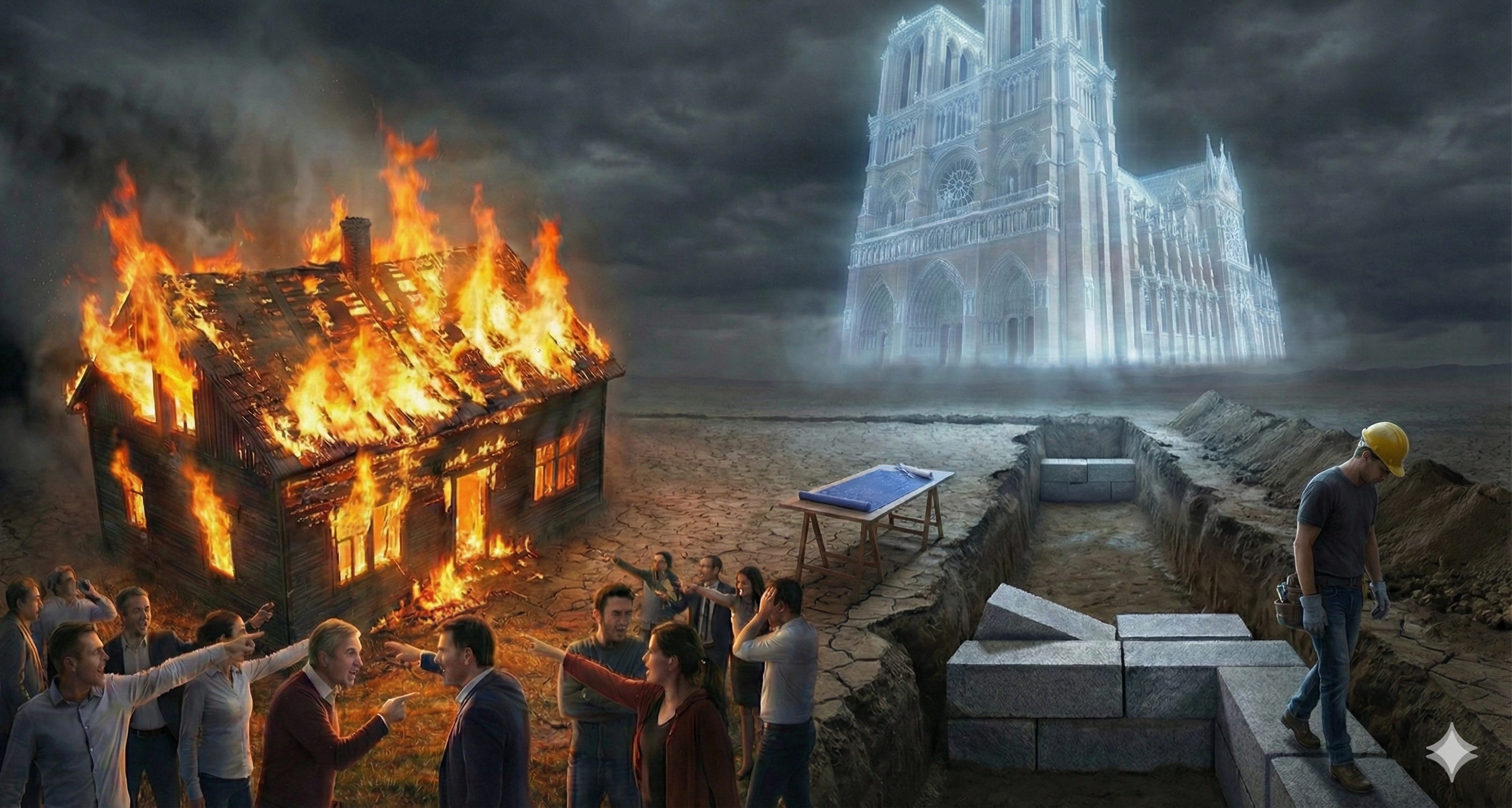
I could keep working on this anyway. Build the designs for posterity. Work quietly, patiently, knowing that someday - maybe long after I’m gone - someone will need these solutions. There’s something honorable about that. Cathedral work.
But here’s the tension: this work requires engaging with darkness.
Every day I read about:
Citizens dying from preventable failures
People being exploited by systems designed to exploit them
Your healthcare being used as a bargaining chip in political games
Your economic security being treated as a pawn in ideological chess matches
Communities being sacrificed for political theater
And I can see how to fix it. I’ve designed the solutions. That’s what makes it soul-crushing.
I can’t keep reading about suffering while knowing how to prevent it, without belief that the solutions will matter.
I want to do this work. I believe in this work. But I can’t keep subjecting myself to the dysfunction - watching the fire spread - without reason to believe the designs will get built.
So here’s what I need from you:
I’ve spent months on this. I’ve diagnosed the fundamental flaw. I’ve designed the solution. I’ve shown you exactly how to fix this.
Democracy is a solved problem.
But I can’t build it alone. And I can’t keep watching it burn without hope.
If the citizens of the United States want to break the cycle - if you’re willing to share this, repeat the mantra, show up consistently - then I’ll keep working. I’ll keep engaging with the darkness because there’s light at the end.
But if not? I need to find something else to work on. There are lots of other problems in this world that need solving - problems that don’t require me to engage with such deep darkness. I won’t keep hurting myself watching a preventable tragedy unfold.
If you’re tired of being used as a pawn in political games:
If you’re tired of your healthcare being a bargaining chip:
If you’re tired of your security being sacrificed for theater:
Then stop participating in the outrage cycle and start demanding structure:
“This is a structural failure. We want a functional government. We need the GDA. 🔄”
That’s all. No shouting. No rage. No bickering. Just the mantra. Over and over. Every day. Every failure.
If enough of you repeat it and stop participating in outrage, the message becomes undeniable.
I’d like to create a functional government. But that’s your choice, not mine.
Let me know if you’d like me to fix this.
Your move.