

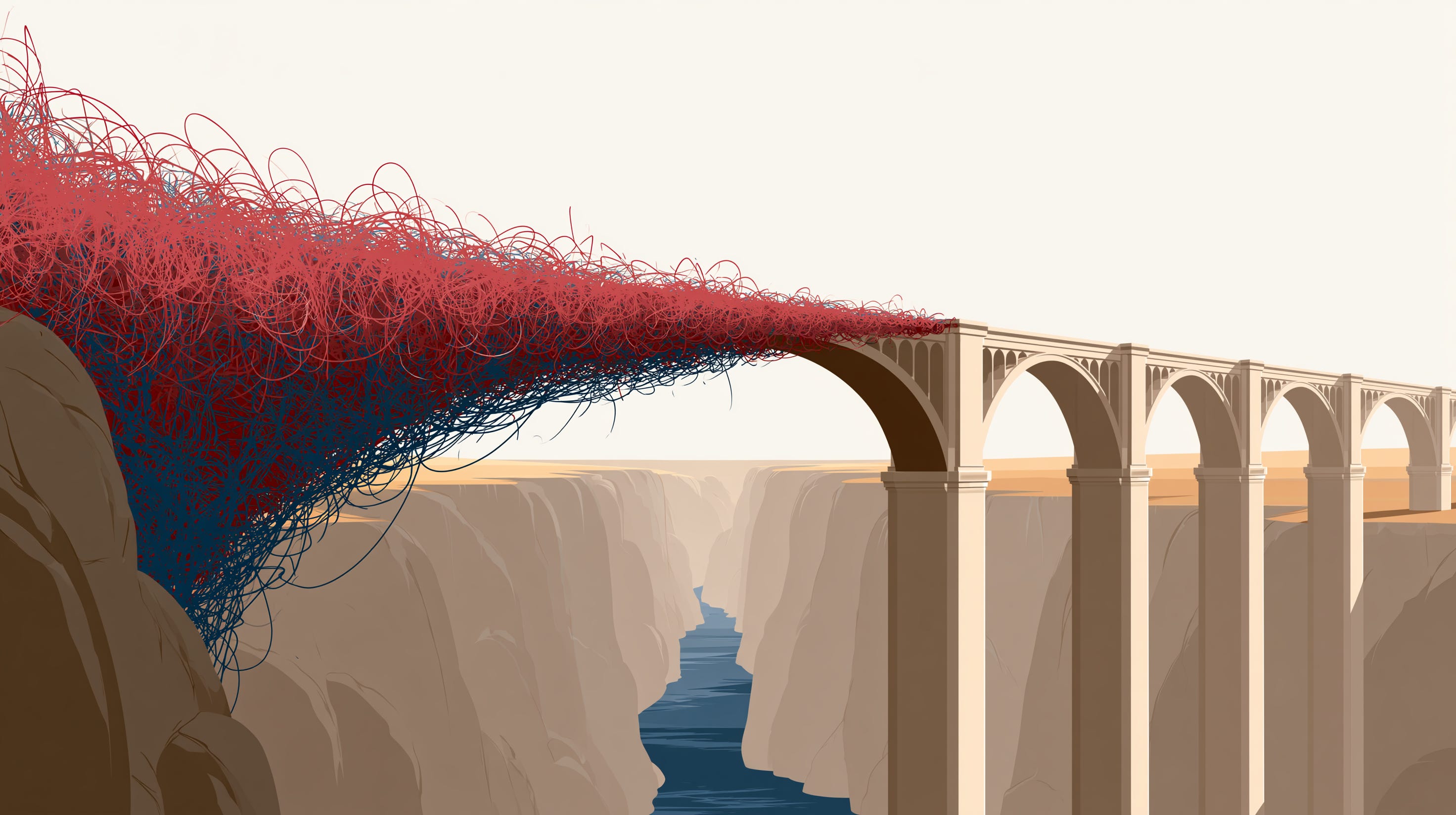
Later this year, as we do every few years, we will participate in a predictable national ritual. We head to the ballot box and change some of the personnel of Congress, ushering in new majorities, celebrating wave elections, or backing anti-establishment insurgencies. Yet the foundational patterns under the hood—the endless gridlock, the performative shouting matches, the inability to pass basic legislation, and a system that answers to big donors over everyday constituents—remain completely untouched.
At some point, we have to look at this recurring pattern and admit that if the road itself is fundamentally broken, simply swapping out the driver won’t get us to our destination.
The standard playbook from traditional reform movements tells us that we simply haven’t found the right people yet, or that we just need to fight harder to get them elected. The prescription is always the same: fix elections, improve representation, build better grassroots movements, and get the right leaders in charge so that better results will naturally follow. While character and values certainly matter at the margins, this diagnosis fails to explain why the broader system refuses to budge. If personnel were the main problem, outcomes would change when the people do, but they don’t. Instead, we see highly rational, well-intentioned people enter an irrational system and produce the same old disappointing results. They aren’t inherently corrupt; rather, the underlying rules of the game systematically reward bad behavior and punish constructive leadership, no matter who is sitting in the seats.
To see past this cycle, we need to cross five conceptual bridges. These aren’t about shifting your partisan leanings; they are about changing how you see the political machinery itself. Once you cross them, the political landscape looks entirely different.
Bridge 1: Rules don’t just reflect power. They create it.
The fact that political dysfunction survives across different legislative majorities tells us that institutional rules are doing a lot more heavy lifting than we realize.
The conventional view is straightforward: powerful interests write the rules to serve themselves. In this view, the system breaks because bad actors are pulling the levers. While it is undeniably true that concentrated wealth and entrenched party machinery shape rules to protect their turf, treating this as a one-way street misses half the story.
Rules don’t just reflect who has power today; they actively dictate who can accumulate power tomorrow. They establish the structural terrain of politics. By changing the rules, you fundamentally alter what behaviors are rewarded and what strategies are even possible.
The congressional reforms of the 1970s are a perfect example of this dynamic backfiring. Well-intentioned reformers wanted to fix a real problem: powerful, independent committee chairs were cutting unaccountable deals in smoke-filled back rooms. The reformers believed that making individual votes completely transparent to the public would act as a disinfectant.
However, they failed to anticipate that real-time visibility would hand party leadership and mega-donors a highly efficient targeting system. To make matters worse, the reforms also introduced new party discipline tools, stripping power away from those independent committee chairs and centralizing it in the hands of leadership. Suddenly, any member who stepped out of line could be instantly identified, denied resources, and punished before the next election cycle. Independent judgment collapsed into rigid partisan obedience because the new terrain punished cooperation and rewarded compliance. The architecture outlasted the intentions of the people who built it.
Rules and power exist in a continuous feedback loop. Rules shape the terrain, the terrain determines who wins power, and those winners write the next generation of rules. Because they are locked in this cycle, simply swapping out the players while leaving the structural terrain intact guarantees that the new personnel will eventually be reshaped by the very system they were elected to break.
Bridge 2: Government isn’t complicated. It’s complex.
To understand why standard democracy reform consistently fails, we have to recognize the difference between a system that is merely complicated and one that is truly complex.
A complicated system has a lot of moving parts, but those parts can be separated, analyzed on their own, and put back together. The whole is just the sum of its pieces. An airplane engine is complicated. It has thousands of intricate components, but a skilled mechanic can isolate a single broken valve, replace it, and the engine will return to functioning exactly as intended. The repair is isolated and predictable; fixing the valve doesn’t cause the fuel line or the exhaust pipe to suddenly alter their behavior in protest.
A complex system, like a forest or an economy, is a completely different beast. It is an interdependent ecosystem where every part constantly interacts with every other part. If you change one element in a complex system, you trigger a ripple effect that alters the behavior of everything else around it in ways you could never predict by looking at that single element in isolation.
Most political reform treats government like a complicated machine. Activists target campaign finance in one election, ethics rules in the next, and term limits down the road, treating them like separate items on an isolated checklist. But because government is a complex ecosystem, these fixes constantly trigger severe, unintended side effects.
Take term limits, which remain an incredibly popular idea across the political spectrum. The logic feels entirely intuitive: career politicians lose touch with everyday folks, focus entirely on self-preservation, and become part of a permanent political class. The thought is that if you limit their time in office, they will focus on public service instead of re-election.
But look at how power actually flows when you run this experiment in the real world. A rapid, forced rotation of lawmakers creates a legislature full of freshman members who are highly ideological—fresh off the campaign trail—but entirely stripped of institutional knowledge. Because they don’t know how the internal machinery works, lack deep relationships, and have no political capital, the only lifeline available to them is the centralized party leadership. New members quickly default to rigid party-line voting just to survive. Meanwhile, the one group in Washington with no term limits at all—professional lobbyists—retains all the historical memory and procedural expertise. Term limits accidentally hand immense structural influence straight to the exact special interests the reform was supposed to weaken.
We see the same blind spots with “democracy vouchers,” a public campaign financing system designed to shift funding from wealthy donors to everyday citizens. The goal is noble, but in a complex political ecosystem, campaign spending behaves like a positional arms race where relative advantage is the only thing that matters. Because premium advertising space is limited, pumping massive amounts of public cash into the system simply drives prices up, often forcing candidates to hunt for even more private money to keep their competitive edge. Furthermore, it empowers organized interest groups, who can direct their members and supports to send their vouchers where they want. The interest groups no longer have to donate their dollars, the vouchers represent public dollars, our tax dollars, now being managed by political directors. This effectively allows these interest groups to aggregate campaign dollars across districts and direct them to candidates. We have a name for these organizations: Political Action Committees (PACs). The exact organizations the voucher program was intended to replace.
Even our most protective structural rules carry hidden loads we rarely notice until they are gone. Consider the judiciary. In early 2026, Supreme Court Justices Gorsuch and Barrett ruled against the administration in the high-stakes Learning Resources tariff case, drawing sharp public attacks from the executive branch. While critics often focus on the personal character of the justices, this moment actually proved that the institutional architecture was doing its job. You don’t publicly attack an institution you have successfully captured. The structural safeguards of lifetime tenure and salary protection mean that justices have no future professional career to protect, removing the electoral and financial levers that typically compromise Congress.
Yet, a leading reform proposal seeks to replace lifetime tenure with staggered 18-year terms to encourage democratic rotation. Trace the power-flow here: a justice with a hard end date suddenly has a post-Court professional future to worry about—lucrative speaking circuits, prestigious law school deanships, or foundation roles. By introducing a finite term, the reform accidentally restores the exact external career calculations that lifetime tenure was engineered to eliminate. Rather than lowering the stakes, predictable vacancies would allow political parties to align their fundraising and mobilization efforts around known court openings, making confirmation battles even more volatile while dismantling the precise safeguard currently resisting political capture.
Before we change any institutional rule, we have to ask: what hidden, load-bearing function is this rule currently performing, and what will break if we pull it out?
Bridge 3: Campaigns filter out the people we actually need.
When confronted with a broken system, our collective instinct is to double down on finding better leaders—individuals with the rare integrity and patience required to resist systemic pressures and change the rules from within. But this overlooks a brutal design flaw: the modern campaign process is specifically engineered to weed those exact qualities out of the candidate pool long before they ever get to Washington.
The traits required to redesign a complex governance system are intellectually demanding and temperamentally rare. They include the ability to absorb harsh public criticism without getting defensive, the patience to wait years for structural reforms to show visible results, the honesty to admit uncertainty, and the flexibility to change direction when confronted with new evidence.
Now, look at the behaviors a modern political campaign actively rewards. Winning a campaign demands absolute, unwavering certainty, the promise of immediate and simplistic fixes, and high emotional drama. A candidate who demonstrates intellectual honesty by saying, “We are studying multiple approaches to this problem because the systemic interactions are highly uncertain,” will be crushed by an opponent who projects supreme confidence, even when that confidence is entirely misplaced. Changing your mind based on new data is instantly weaponized as weak-willed flip-flopping, and admitting that a real solution will take a decade of unglamorous work is a surefire way to lose a primary.
This isn’t a moral failing of individual candidates; it is an architectural reality. The system requires patient, evidence-based builders, but the selection process systematically rewards performers. While structural electoral reforms like ranked-choice voting or independent redistricting can shift who wins, they don’t change the fact that winning an adversarial campaign and designing an interdependent governance architecture are entirely different skills. The current system treats them as the same, leaving us with a legislature filled with highly talented campaigners who lack the technical discipline required for institutional design.
Bridge 4: What we want is a democratic question. How we get it is a design question.
This mismatch between campaign skills and governance skills exposes an uncomfortable truth: if our political system is a complex ecosystem, and campaigns filter out the temperament required to manage it, who is actually qualified to design the operating rules of our democracy? Right now, the answer is nobody, because we have committed a fundamental category error. We treat the structural plumbing of our legislature as an ordinary political debate.
When Congress passes environmental legislation, nobody expects elected officials to personally calculate the precise parts-per-million thresholds for industrial pollutants. We rely on the technical capacity of an agency to execute those standards. The democratic process does its job by setting the overarching goal—we want cleaner air—while the technical execution is left to a specialized body that can translate that goal into reality without triggering catastrophic economic side effects.
Yet, when it comes to the rules that govern the legislature itself—floor procedures, committee structures, and calendar control—we completely abandon this logic. These internal regulations are the foundational operating system of our democracy, dictating whether the public’s will can ever be translated into legislative action. They are engineering specifications for how power moves through an institution. Yet, we treat these rules as ordinary political footballs to be written, altered, and weaponized by the politicians themselves through the standard partisan process.
We have confused the democratic determination of our goals with the technical architecture required to achieve them. Deciding whether we want a more representative, responsive, multi-party legislature is a profoundly democratic question that belongs entirely to the citizens and their representatives. But determining which specific blend of procedural rules, committee jurisdictions, and voting mechanisms will actually route power toward that destination—without causing the system to be captured by special interests—is an architectural engineering problem. It has objectively better and worse answers that can be modeled and analyzed against real-world data. By treating the design of the machinery as a mere extension of partisan politics, we ensure that our democratic values are continuously betrayed by the broken mechanics of the vehicle carrying them.
Bridge 5: A diverse monopoly is still a monopoly.
Because traditional reform movements fail to recognize this category error, they consistently focus on the right anxieties in the wrong places. The primary goal of democracy reform has long been to diversify the candidate pool, open up elections, and bring more varied voices into the legislative process. While representation is vital, this framework leaves the most dangerous monopoly in American politics completely untouched: the self-refereeing monopoly.
Congress currently maintains absolute control over both the policy outcomes it pursues and the structural rules that govern its own internal operations. The players on the field are entirely responsible for writing, interpreting, and enforcing the rules of their own sport. This is an inescapable, systemic conflict of interest. When human beings are given total authority over the regulations that dictate their own professional survival, they will inevitably shape those regulations to protect themselves, regardless of their political party or personal character.
The fate of the STOCK Act of 2012 provides a definitive look at this conflict in action. Passed overwhelmingly in a rare moment of public consensus, the bill was designed to prevent insider trading among members of Congress by requiring strict transparency for financial transactions. Just one year later, however, leadership in both chambers quietly gutted the core components of the law using an expedited procedure that required no public debate, no roll-call vote, and occurred in a virtually empty room. Today, the penalty for failing to disclose a major stock trade is a negligible two hundred dollars, and no member has ever been meaningfully prosecuted under its framework. The self-refereeing system encountered an external constraint, recognized it as a threat to its own comfort, and seamlessly re-engineered its internal rules to neutralize the threat.
A more diverse legislature that continues to write its own operating rules does not solve this problem; it simply creates a more inclusive monopoly. The core vulnerability is structural, not demographic.
Whenever it is suggested that we must strip Congress of this self-refereeing monopoly, critics immediately raise the alarm of technocracy, warning that handing rule-making authority to an independent body removes democratic accountability. But this objection is rooted in a profound misunderstanding of how our government actually operates today. We already live in a system where unelected actors dominate the design of our political institutions, but they do so in the shadows. Because members of Congress lack the time, structural incentives, and specialized expertise to design complex institutional procedures, the task of drafting legislative language has been defaulted to corporate lobbyists, entrenched party staffers, and invisible bureaucratic networks. The real choice before us is not between a perfectly accountable democratic legislature and a cold, technocratic elite; the choice is between a hidden, captured, and fundamentally unaccountable architecture and a visible, professional, and publicly auditable design discipline.
To make this discipline real, we don’t have to invent a far-off, utopian concept. We just have to look at how we handle safety and structural integrity everywhere else in the real world.
Think of how we manage commercial aviation. When a plane suffers a mechanical failure or a near-miss on the runway, we don’t hold a public vote to determine what went wrong, nor do we let the airline executives quietly rewrite the safety manual in secret. Instead, we rely on the National Transportation Safety Board (NTSB)—an independent, transparent body of structural experts whose sole job is to investigate failures, map black box data, and identify the deep defects and flaws in the machinery. The NTSB doesn’t write FAA policy, nor does it audit airlines for regulatory compliance—those governing decisions belong entirely to the FAA. The NTSB simply uncovers the structural failures and makes authoritative recommendations, providing the unassailable, data-driven map that forces the policy-makers to act.
Our democracy needs that exact same diagnostic oversight: a dedicated, independent body tasked with identifying the fundamental flaws in our democratic machinery and producing recommendations to fix them. This would function like an NTSB for our political infrastructure.
When the internal rules of Congress generate paralyzing gridlock, systematic responsiveness to special interests, or rampant insider trading, this body would be institutionally obligated to run stress tests, isolate the structural defects, and publish transparent, auditable recommendations. Just as the NTSB’s independent findings expose flaws and pressure the FAA to update its policies under the lens of public scrutiny, this body would strip politicians of the ability to hide behind a self-refereeing monopoly. It leaves the ultimate policy-making and enforcement power exactly where it belongs—in the hands of the democratic process—but introduces an open, professional discipline that ensures the rules of the legislature actually route power toward the values defined by the public.
The Shift
When we look at our broken political system from the old perspective, it looks like a moral drama populated by villains to be unseated and heroes to be elected. We treat institutional rules as mere reflections of whoever happens to hold power, assuming that if we can just mobilize enough resources to elect better people, those leaders will naturally create a better government. We approach reform like mechanics working on a simple machine, operating under the illusion that we can fix campaign finance today, implement term limits tomorrow, and patch up the judiciary next year without ever worrying about how those pieces collide.
Crossing these bridges requires a fundamental shift in perspective. It means realizing that rules are not passive reflections of power, but the active conduits that generate and sustain it. It means recognizing that government is a sensitive, complex ecosystem where isolated, well-meaning interventions like term limits frequently backfire. And it means confronting the reality that the modern campaign trail acts as a filter that systematically weeds out the exact traits required to fix a broken system.
Ultimately, this journey brings us to a single, liberating conclusion: if a bridge is structurally unsound, you don’t solve the problem by hunting for a better driver to cross it. You have to reinforce the pillars. We must move past the naive hope that the next election cycle will finally deliver the savior who can single-handedly overcome a captured environment. Instead, we must demand a professional, transparent, and publicly accountable design discipline tasked with the continuous maintenance of our democratic machinery—ensuring that the rules of our society finally route power toward the true will of its citizens.