

Picture This
It’s 2029. President Alexandria Ocasio-Cortez is in the White House.
Texas has been blocking federal EPA agents from enforcing new climate regulations. State officials refuse to comply. Local law enforcement won’t help federal agents access industrial sites that are violating emissions standards.
President Ocasio-Cortez declares a national emergency. She says federal operations are being obstructed. She needs to protect EPA agents doing their jobs.
The order goes out.
Military convoys roll into Dallas. National Guard units, federally activated, deployed to “protect federal operations.” Tanks on the streets. Armed soldiers surrounding the Texas state capitol. Military checkpoints in the city.
Protesters gather. Texas residents exercising their First Amendment rights, angry about what they see as federal overreach. They block federal buildings. They surround the EPA offices.
The military is there. Authorized by the President. Claiming authority to “protect federal operations.”
What happens next?
If that scenario makes you uncomfortable, keep reading.
Because we need to talk about how we got to a place where that’s even possible. And more importantly, what you can do about it.
Think this is alarmist? Hyperbole? Pure speculation?
Take that story. Replace “Alexandria Ocasio-Cortez” with “Donald Trump.” Replace “Dallas” with “Chicago.” Replace “EPA agents enforcing climate regulations” with “ICE agents conducting deportation raids.”
That’s not speculation. That just happened.
December 23, 2025: Donald Trump asked the Supreme Court to lift the block preventing him from deploying National Guard forces in Chicago to protect ICE operations. Illinois had obtained a court order stopping the deployment. Trump wanted the Supreme Court to allow deployment immediately while the case continues.
The Supreme Court said no. 6-3.
But three justices—Alito, Thomas, and Gorsuch—would have lifted the block immediately. Three Supreme Court justices were ready to let military deployment in an American city proceed right now.
We’re two votes away from either scenario being authorized.
AOC with tanks in Dallas. Trump with military in Chicago. The infrastructure that enables one enables the other. That’s the problem.
Elections become Russian roulette with who gets these powers. And the powers keep growing.
Someone Built This
The question isn’t whether you trust Donald Trump or Alexandria Ocasio-Cortez or whoever might be president in 2029 or 2033. The question is: Why does ANY president have the legal argument to deploy military forces in American cities?
The answer: Someone deliberately built the legal infrastructure that makes both scenarios possible.
His name is Bill Kristol.
Between 2001 and 2008, Kristol and his fellow neoconservatives redesigned how American government works. They built new infrastructure for executive power. Emergency authorities with no expiration dates. Processes for designating enemies with no judicial review. Legal theories treating presidential action as above normal constraints.
Kristol is the son of the “godfather of neoconservatism.” He founded The Weekly Standard, the intellectual hub of neoconservative foreign policy. In 1997, he co-founded the Project for the New American Century—the think tank that wrote the blueprint for the Bush administration’s expansion of executive power.
And here’s the thing: they genuinely believed they were protecting America.
They were educated, principled people who thought: “If we give smart, responsible leaders the tools they need, they can keep us safe.” They designed a system for good people to do good things.
What they forgot—what they lost sight of completely—was what the Founders understood: You can’t design a system that depends on good people staying in power.
The Founders assumed bad actors would eventually hold every position. That’s why they built checks and balances, separation of powers, sunset clauses. They designed for the worst case.
The neoconservatives looked at those constraints and saw inefficiency. They thought concentrated power in the right hands could accomplish so much more.
They were catastrophically wrong.
They built tools that work for ANY president who knows how to use them. President Trump deploying military in Chicago. President Ocasio-Cortez deploying military in Dallas. The infrastructure doesn’t care who’s using it or why. It just enables the action.
What They Built
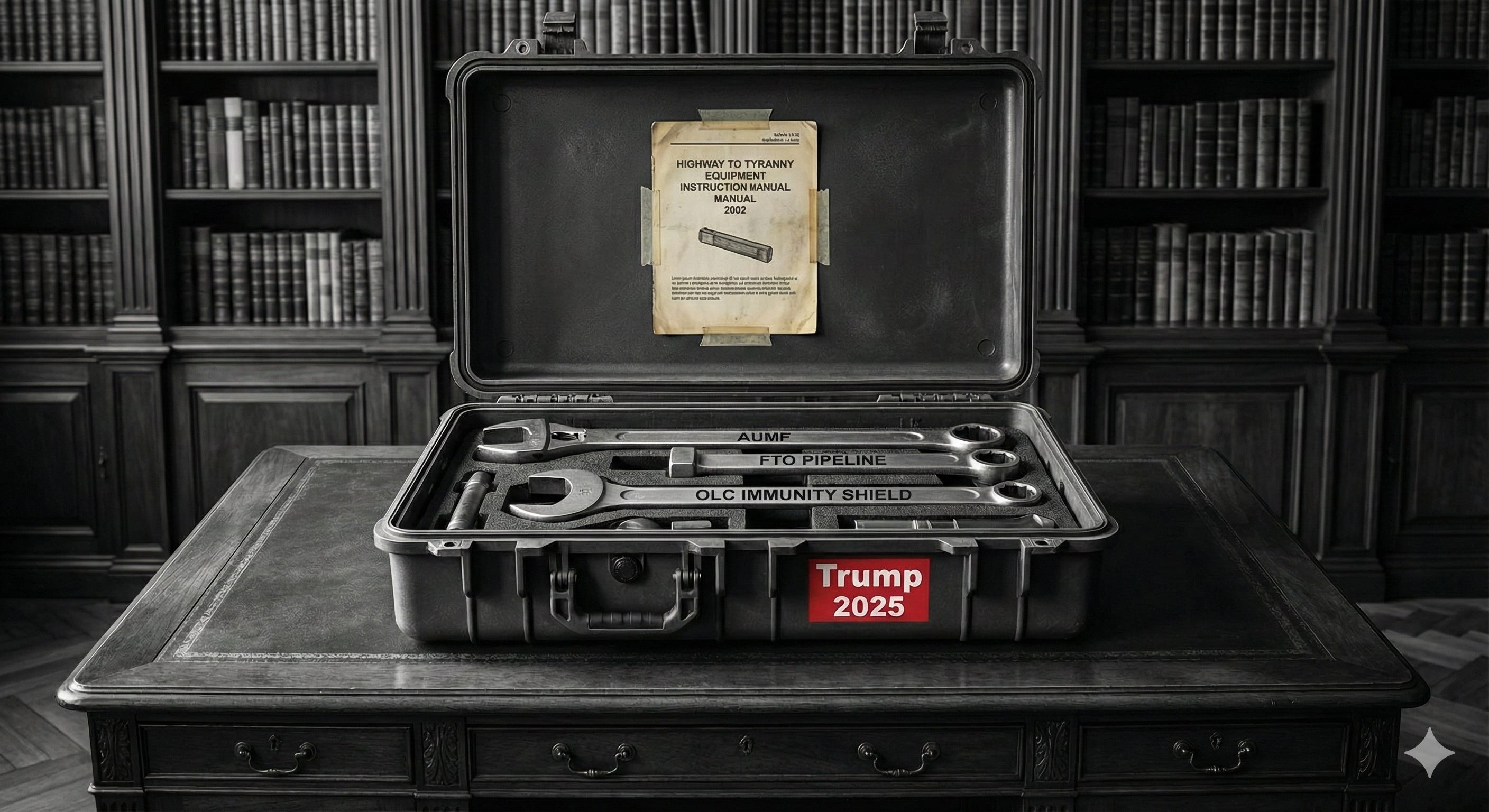
Let me show you three pieces of infrastructure the neoconservatives created. Not abstract theories—concrete systems that exist right now, that any president can use.
1. Permanent War Powers
September 14, 2001: Congress passed the Authorization for Use of Military Force. It gave the President authority to use “all necessary and appropriate force” against those responsible for 9/11.
That authorization had no end date. No geographic limits. No definition of who counts as “responsible.”
Kristol and his allies explicitly rejected sunset clauses. Their argument: “The War on Terror has no endpoint. Time limits would handcuff presidents.”
That was 24 years ago. The authorization is still active. It’s been used to justify military operations in 22 countries by four different presidents.
When Kristol designed this, he envisioned hunting down the terrorists who attacked us. What he built was permanent authority any president can invoke for any threat they label appropriately.
2. The Terrorist Designation Pipeline
Here’s how you turn law enforcement into military action:
Declare an emergency using the International Emergency Economic Powers Act. Designate groups as terrorists through the State Department—no court reviews this. Activate military authorities because once someone is labeled a terrorist, they can be treated as an enemy combatant subject to military force instead of arrest and trial.
This was built for al-Qaeda. Since September 2025, Trump has used it for drug cartels: designated nine organizations as terrorist groups, then conducted 29 military airstrikes on boats in the Caribbean. 105 people dead. No trials. No arrests. Just strikes.
Same infrastructure. Different label.
3. Presidential Immunity
July 2024: The Supreme Court ruled that presidents have absolute immunity from criminal prosecution for “official acts.”
This builds on legal theories developed during the Bush administration—theories that said when the President acts as Commander-in-Chief for national security, normal legal constraints don’t apply. The torture memos. The warrantless surveillance justifications.
The logic: presidential power exists in a different legal category than regular government action.
Once you accept that, there’s no limiting it. If the President can claim immunity for anything he calls an “official act,” then deploying military forces becomes just another “official act.”
Why This Matters Right Now
These three pieces work together:
Trump argues he has inherent authority to protect federal operations (presidential immunity framework). He can use military forces under existing authorizations (permanent war powers). And if anyone challenges whether targets are really threats, he can designate them as terrorists (designation pipeline).
That’s the argument he just made to the Supreme Court about Chicago. Three justices bought it.
But here’s what “protecting federal operations” actually means in practice:
Protecting ICE agents during deportation raids. Protecting federal buildings during protests. Protecting EPA agents enforcing environmental regulations. Protecting federal personnel at abortion clinics. Protecting literally any federal employee doing literally any federal job.
It’s not a narrow category. It’s a blank check. Any time protesters show up, any time there’s resistance to federal action, the President could claim: “I’m just protecting federal operations.”
That’s the scenario you imagined at the beginning. President Ocasio-Cortez. Tanks in Dallas. “Protecting EPA operations.”
Or President Trump. Military in Chicago. “Protecting ICE operations.”
The infrastructure doesn’t care which scenario you fear more. It enables both.
And if five justices eventually say this authority exists, it becomes permanent. Because Supreme Court precedents are treated like constitutional amendments—they require the same supermajorities to overturn. But they only need five votes to establish.
We’re two votes away from making this permanent reality.
What You Can Actually Do (And Why “Call Your Rep” Isn’t Enough)
We’re one year from America’s 250th birthday. Time to upgrade the operating system.
The current version has bugs that let presidents deploy military in cities. That’s not a feature—it’s a flaw that needs fixing.
Everyone upgrades their phone’s OS. Everyone gets that software needs updates. This is the same thing—governance architecture that needs upgrading.
Don’t make this about Trump vs. Democrats. Make it about system maintenance. “The operating system has a critical security flaw. We need to patch it before someone exploits it worse than they already have.”
And if you’re someone who doesn’t share political stuff on social media - who scrolls past the outrage, who stays quiet because it all feels exhausting and pointless - YOU are exactly who we need to share this frame.
You’re not the activist who shares everything. Politicians tune them out. You’re the person who normally stays quiet.
When people who don’t usually engage start talking about “upgrading the operating system,” that’s when politicians notice. That’s when the conversation actually changes.
Your friends and family aren’t tired of hearing from you about politics. They haven’t tuned you out yet. That gives you credibility the loud voices lost years ago.
This isn’t about you. It’s about who might see it when you share it. The people in your network who trust your judgment precisely because you’re NOT constantly shouting about politics.
So here’s what actually moves the needle:
1. Share this piece. Even if you never share political stuff.
Not because I want subscribers (though subscribe if you want). Because the ONLY way structural issues get fixed is when enough people see the structure that politicians feel pressure to act.
One person writing their representative gets ignored. A hundred thousand people who understand the infrastructure and are talking about it? That creates political pressure politicians can’t ignore.
Especially when those hundred thousand include people who normally stay quiet.
2. Frame it as system maintenance, not politics.
“We’re one year from America’s 250th birthday. The operating system has bugs. Time to upgrade.”
That’s not a political position. That’s basic maintenance.
3. Make it non-partisan with the scenarios.
You already saw the AOC/Dallas scenario at the beginning. Share that. Ask: “Would you be okay with this? Because the same infrastructure that enables Trump in Chicago enables a hypothetical AOC in Dallas.”
Find the common ground: Nobody—regardless of party—should be okay with this much unchecked power.
4. When you do contact representatives, demand specific structural fixes:
Don’t just ask them to “do something about Trump.” That’s a tactical demand that disappears when he leaves office.
Demand they upgrade the operating system:
Repeal the 2001 AUMF - 24 years of permanent war powers needs to expire
Sunset clauses on ALL emergency declarations - No more permanent emergencies
Judicial review for terrorist designations - President can’t just label people terrorists
Close the “protective purposes” loophole - Clarify that this doesn’t override laws against military as law enforcement
These are structural upgrades that last beyond any one president.
5. Spread the structural lens.
The most important thing isn’t any single action—it’s getting more people to SEE structures instead of just reacting to individual events.
Every time someone says “Trump is terrible” or “politicians are corrupt,” redirect: “Yes, AND the system lets them do this. We need to upgrade the operating system. Here’s the infrastructure that needs changing.”
The more people who can see structures, the harder it becomes for politicians to ignore structural problems.
If you’ve never shared political content before, start with this one.
Because we’re not fighting over policy. We’re not debating left vs. right. We’re saying: “The operating system has a critical security flaw. We need to patch it before someone exploits it worse than they already have.”
That’s not a political position. That’s basic system maintenance.
And when people who normally stay quiet start saying “time to upgrade the OS,” that’s when change becomes possible.
America turns 250 in 2026.
Time to upgrade the operating system.
Share this. Make the infrastructure visible.
Because the next time a president tries to deploy military in an American city—and there will be a next time—we need enough people seeing the structure that “no” is the only possible answer.
For comprehensive analysis with full citations, see The Neoconservative Architecture of American Authoritarianism.
America’s 250th: Let’s make it the year we finally upgraded the operating system.