

Author’s Note: I published a version of this essay a few days ago. It was fine. It made the intellectual argument. But reading it back, I realized I’d made the exact mistake I warn against: I spent 2,000 words explaining why the bridge was collapsing before mentioning it could be fixed.
If you’re already drowning in political despair, the last thing you need is someone explaining in meticulous detail why the water is rising.
So I rewrote it. Same core insight—different emotional journey. Hope first. Then diagnosis. Then path forward.
This is how it should have been the first time.
What If It Just... Worked?
Imagine, for a moment, that American governance simply functioned.
Not that your side won every battle. Not that your ideology became law. Just... functional. The way you expect your electricity to work when you flip the switch.
Budgets pass on time. Not your preferred budget—just a budget, completed on schedule, without drama, without last-minute standoffs, without anyone wondering whether federal employees will get paid next month.
Policy commitments hold across administrations. Businesses can make ten-year plans without wondering if the rules will reverse in four years. International partners can trust that agreements will outlast the people who signed them. Citizens can count on the regulatory environment being stable enough to build a life around.
Problems get addressed. Not perfectly. Not always the way you’d prefer. But when something clearly needs fixing—infrastructure, healthcare costs, immigration, climate risk—the system produces some durable response rather than decades of paralysis punctuated by partial measures that get reversed.
Disagreements produce compromise or clear decisions, not indefinite gridlock. When the two parties want different things, the system has mechanisms to either find middle ground or let the majority govern—rather than defaulting to “nothing happens.”
Government shutdowns are as unthinkable as the post office deciding not to deliver mail. Not because everyone agrees on spending priorities, but because the machinery for resolving disagreements actually works.
This isn’t utopia. This is just “functional.”
And it’s not fantasy. Other democracies have achieved versions of this. Not perfectly—they have their own problems, their own trade-offs, their own dysfunction. But they’ve proven the concept is possible. Governments can pass budgets on time. Policy can have continuity. Complex problems can be addressed.
The question isn’t whether functional governance is achievable.
The question is why we don’t have it.
The Liberating Answer
Here’s what we’ve been told, our whole lives, about why things don’t work:
Elect better people. If we just get the right leaders in office, they’ll fix it. The problem is bad actors, corrupt politicians, the wrong party in power.
Get more involved. Vote harder. Donate more. Make your voice heard. The system works if you work it.
Defeat the other side. They’re the ones blocking progress. Once we beat them decisively enough, we can finally move forward.
You’ve tried these. We all have. And here’s what happened: the dysfunction continued. Different faces, same gridlock. Different party in charge, same shutdowns. Different leaders, same inability to address long-term problems.
This isn’t because you failed. It isn’t because you didn’t try hard enough. It isn’t because the other side is uniquely evil or your side is uniquely virtuous.
It’s because the system itself produces these outcomes regardless of who’s in charge.
Think about that for a moment. Really sit with it.
Government shutdowns happen under unified Republican government. They happen under unified Democratic government. They happen under divided government. The pattern doesn’t change based on who wins elections. That’s not a personnel problem. That’s an architecture problem.
Policy whiplash happens because the structure creates it. One administration builds, the next tears down, the next rebuilds. This isn’t because politicians are uniquely fickle. It’s because nothing in the system creates continuity. The architecture produces whiplash.
Gridlock persists even when one party controls everything—the House, the Senate, the Presidency—because the design creates veto points and perverse incentives that make progress nearly impossible regardless of electoral outcomes.
Here’s why this is actually good news:
Design problems have design solutions.
You don’t need to change human nature. You don’t need moral transformation across the population. You don’t need everyone to suddenly agree on values. You don’t need saints in office.
You need better architecture.
The dysfunction you’ve been fighting against isn’t the result of bad people. Most people in government are trying their best within an impossible system. The dedicated public servants, the idealistic staffers, the representatives who genuinely want to solve problems—they’re all constrained by the same architecture that frustrates you.
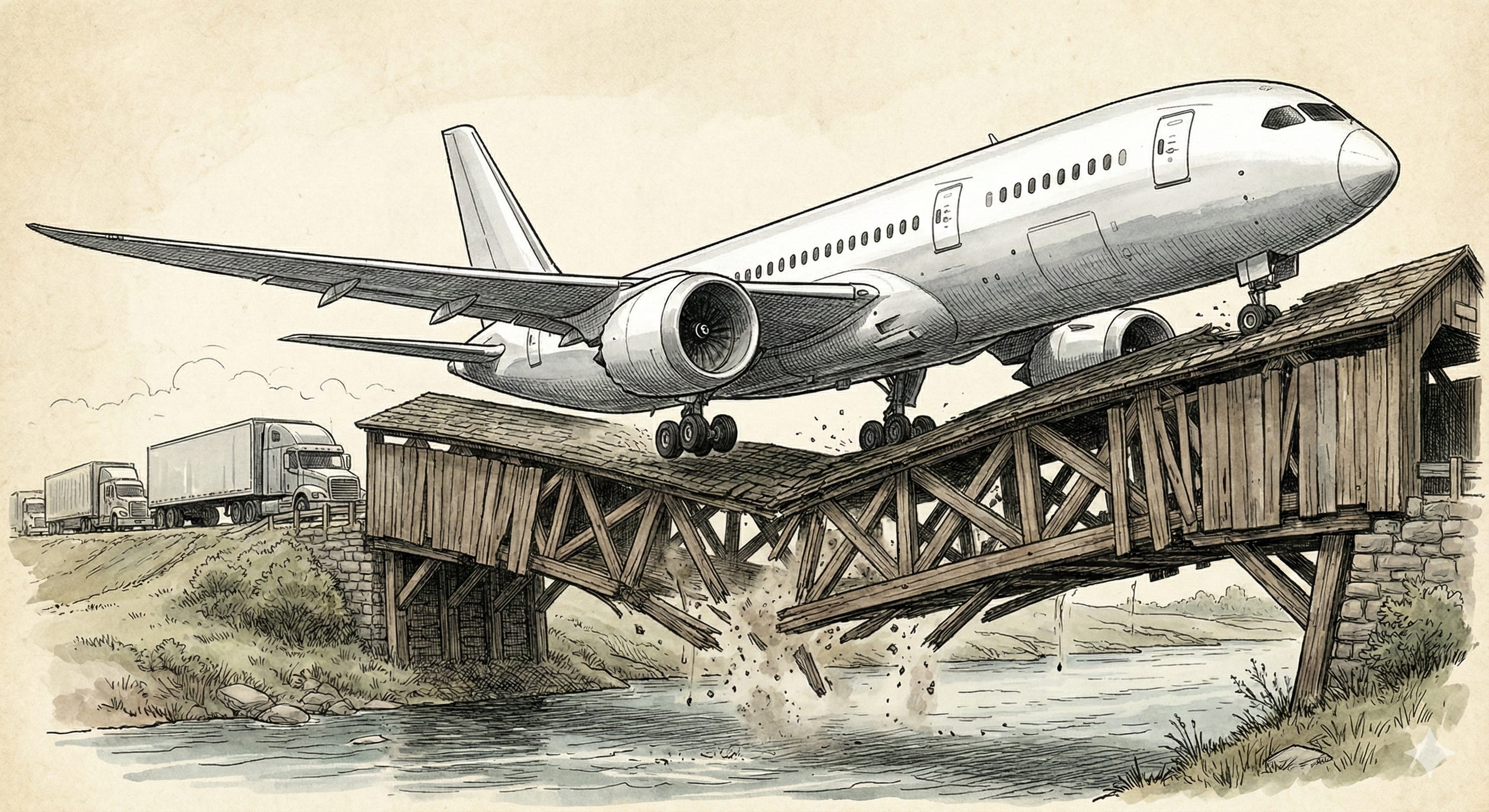
The bridge isn’t failing because the drivers are bad. The bridge is failing because it was built in the 1700s for horse-and-buggy traffic, and we’re running semi-trucks and airliners across it.
That’s not a moral crisis. That’s an engineering problem.
And engineering problems can be fixed.
The Design That’s Failing
This isn’t about blaming the Founders. They built brilliantly for their context. The Constitution was a marvel of political engineering—a system designed for thirteen agricultural states along the Eastern seaboard, four million people, communication by horseback, and a federal government with limited responsibilities.
The context has changed beyond recognition.
Today that system serves fifty states spanning a continent, 340 million people across six time zones, instantaneous global communication, a complex interconnected economy, and federal responsibilities the Founders couldn’t have imagined: nuclear weapons, pandemic response, AI regulation, cybersecurity, climate policy, space commerce, genetic engineering.
We’re running 21st-century loads on 18th-century infrastructure.
You can see the stress fractures everywhere, but here’s one concrete example of how design failure works:
Congress used to pass twelve separate appropriations bills through twelve separate subcommittees—like a bridge resting on twelve independent pillars. If one pillar had a problem, negotiations stalled on that one bill while the other eleven kept the government running. The structure had redundancy.
Over time, that process collapsed. Now almost all federal spending gets crammed into massive “omnibus” packages—one giant bill that funds everything. We’ve replaced twelve independent pillars with a single, precarious column.
The result? A disagreement over any issue—border policy, healthcare provisions, a controversial regulation—can now threaten to collapse the entire structure. One stuck negotiation means the whole government shuts down.
That’s not a failure of political will. That’s a textbook engineering failure. We stripped the system of its structural redundancy, and now it fails exactly the way any engineer would predict.
The good news: engineering failures have engineering solutions. The system wasn’t handed down from Mount Sinai. We built it. We can rebuild it.
The Shift
When you see governance as a design problem rather than a people problem, the entire conversation changes:
The old question: Who’s blocking progress?
The new question: What mechanisms make progress nearly impossible for anyone?
The old framing: We need better leaders.
The new framing: We need systems that don’t require extraordinary leaders to function normally.
The old hope: If we just win the next election...
The new recognition: Winning doesn’t fix the architecture. Both parties have won. The dysfunction continues.
The old despair: The other side will never let anything good happen.
The new possibility: The architecture constrains everyone—which means better architecture frees everyone.
This isn’t about being “above” partisan politics or pretending both sides are the same. You can have strong views about what policies you want. You can believe one party’s vision is better than the other’s.
But you can also recognize that neither vision can be effectively implemented through machinery that’s failing under modern loads. The system that frustrates your side when you’re out of power also frustrates your side when you’re in power.
The partisan lens keeps you trapped in a fight where even winning doesn’t produce durable results.
The structural lens reveals a different possibility: build machinery that actually works, and then let democracy decide what to do with it.
What We’re Building Here
This isn’t a policy platform. We’re not here to tell you which specific reforms to support. That’s a conversation for later—and it’s a conversation that requires input from across the political spectrum, because structural reform that only one side wants isn’t reform, it’s power consolidation.
We’re doing something more fundamental: making visible what partisan framing hides.
When you’re arguing about which lane should move faster, you don’t notice the beams rusting. When you’re focused on defeating the other drivers, you don’t see the cracks in the foundation. When every problem gets explained as “the other side is bad,” the structural failures become invisible.
That’s where our work begins. We make the structural failures visible.
To analyze governance the way engineers analyze failing infrastructure—not asking “who should we blame?” but “what’s the mechanism? Why does the system produce this outcome? What would need to change?”
To explore what 21st-century architecture could look like—learning from what other democracies have tried, their successes and their failures, not to copy them but to understand what’s possible.
To build the understanding that makes real structural change achievable—because you can’t fix what you can’t see, and right now, most people can’t see the structure at all.
If you’ve sensed that the dysfunction is deeper than “the other side”...
If you’re tired of fighting battles that never seem to produce durable victories...
If you’ve wondered why things stay broken no matter who wins...
If you want to believe the bridge can be fixed, and you’re ready to understand how...
That’s what we’re exploring here.
The bridge was built by humans. It can be rebuilt by humans.
Not by waiting for perfect leaders. Not by defeating our enemies. Not by moral transformation.
By engineering. By design. By the unsexy, difficult, generational work of building systems that actually function.
The bridge can be fixed.
Let’s figure out how.
"The system wasn’t handed down from Mount Sinai."
And even if it had been ...
Jason, you and I have discussed the importance of the system vs. those operating it before. The ideas expressed in your essay are solid, but both matter. Systems need to be better, but people must be willing to work with them and not game them.
I especially like the example of how there used to be twelve separate budgets. Much better idea!