


Most Americans have a pretty good idea of how Congress is supposed to work. For some, the lesson came from a civics textbook. For others, it came from a cartoon character sitting on the steps of the Capitol, waiting for the day he might become a law. Schoolhouse Rock managed to compress the legislative process into three minutes of music and animation, and for generations of Americans, that little bill became their introduction to representative government.
It was a reassuring story. A problem arose somewhere in the country, someone proposed a law to address it, and the proposal traveled to Congress. Committees studied the issue, listened to experts, and debated possible solutions. Representatives negotiated changes, the House and Senate voted, and eventually the bill might reach the president’s desk. We grow older and discover that the process is considerably more complicated than the cartoon suggested, but the basic model survives. We expect Congress to investigate problems, deliberate over competing solutions, and produce laws that address them.
And sometimes that’s exactly what happens.
Consider the Clean Air Act Amendments of 1990. During the preceding decade, members of Congress had been wrestling with an environmental problem that was becoming increasingly difficult to ignore. Scientists were studying acid rain, industrial emissions, and toxic chemicals. Environmental advocates wanted stronger protections, while businesses worried about costs, technological limitations, and the consequences of new regulations. The challenge wasn’t simply deciding whether cleaner air was desirable. Congress had to determine what kinds of laws, institutions, and incentives could actually produce it.
The questions were formidable. Should regulators require companies to install particular technologies, or allow them flexibility in how they reduced pollution? How would compliance be measured? What responsibilities should belong to federal agencies, and which should remain with the states? What would happen to industries that depended on coal? And how could lawmakers accommodate competing interests without abandoning the objectives of the legislation?
Congressional committees investigated these questions, held hearings, and examined alternative approaches. Lawmakers negotiated among themselves, with the George H. W. Bush administration, and with organizations affected by the proposed changes. In 1990, the House passed its version of the legislation 401 to 21, while the Senate approved its version 89 to 11. The two chambers then reconciled their differences before President Bush signed the final amendments in November.
The resulting law was ambitious and technically complicated. It expanded regulation of toxic emissions, strengthened enforcement mechanisms, established new permitting requirements, and introduced a market-based system allowing certain businesses to trade emissions allowances. It wasn’t a perfect law, and its provisions remained subject to disagreement. But it demonstrated what the legislative process could accomplish when lawmakers had the resources, expertise, and political conditions necessary to tackle a difficult problem.
This is the Congress we recognize from our civics lessons, and it’s the Congress many of us expect to see when we turn on the news. When reality doesn’t match that expectation, we have no shortage of explanations. Politicians are too partisan, too selfish, too interested in reelection, too beholden to donors, or too unwilling to compromise. Every election brings another collection of candidates promising to clean things up, restore common sense, and make Washington work again.
There’s something comforting about this explanation. The committees still exist, Congress still possesses its constitutional powers, and the procedures for investigating problems and developing legislation haven’t simply disappeared. If the institution worked that way before, surely it could work that way again with the right people.
We readily accept that Congress works better under some circumstances than others. Sometimes it functions as we expect, and sometimes it doesn’t. That’s politics. But this leaves a curious question unexplored: if we know Congress can perform these functions, why do we accept that its ability to do so depends so heavily on the people and political conditions of the moment?
For a long time, I made a similar assumption about people who used the systems I built.
The people who couldn’t change the software
For nearly twenty-five years, I worked in software development. Much of that time was spent building and maintaining systems that other people depended on to do their jobs. I knew those systems intimately, including the decisions that had shaped their design, the compromises made along the way, and the dependencies that could make a seemingly simple change surprisingly difficult.
Every so often, something peculiar would turn up in the data. An account had been configured in a way that made no sense. A field contained information that belonged somewhere else. Sometimes an elaborate sequence of steps had developed around a task the software was supposed to perform automatically. I’d begin investigating, tracing the problem through the system until I found the person responsible.
There was usually a perfectly understandable explanation. An employee had encountered an obstacle. Perhaps a screen wouldn’t let them complete a task, or a particular field didn’t behave the way they expected. They tried a few things, discovered an alternative that seemed to solve the immediate problem, and moved on. Over time, the workaround became routine. Sometimes other employees adopted it, too, until an improvised solution had quietly become part of the organization’s normal way of doing business.
From my perspective, this could be maddening. The original problem might have required only a few minutes to correct, while the workaround had introduced months of complications. I’d find myself wondering why nobody had simply told me what was wrong.
Eventually, I learned that employees had actually been instructed not to contact me directly. They were supposed to use other channels for reporting problems, and meanwhile they still had work to do. From their perspective, inventing a workaround was often the most practical option available.
That changed how I understood their behavior. They had no reason to know whether a change would require five minutes of programming or five months of development. To me, the software was something I could modify because I knew how it worked and what its limitations were. To them, it was simply the environment in which they worked. They couldn’t see the possibilities I could see, and they had little practical reason to assume those possibilities were available to them. For all intents and purposes, the software was immutable.
I could have continued insisting that employees follow the prescribed procedures. After all, the software generally worked when people used it as intended. Plenty of programmers respond to these situations that way, treating unexpected behavior as evidence that users need more training or clearer instructions. But that wouldn’t explain why the same problems kept appearing, or why employees repeatedly found reasons to work around the system. Their behavior was telling me something about the environment in which they were operating.
The experience changed my approach to engineering. I became less interested in whether the software was doing exactly what I’d designed it to do and more interested in whether it was helping people accomplish what they needed. If employees continually invented workarounds, that was information about the system, not simply evidence that they needed better training. Wherever practical, I wanted the software to adapt to human needs rather than forcing humans to continually accommodate its limitations.
Years later, when I began studying Congress, I recognized a similar relationship between citizens and their government. Most Americans can recognize when government isn’t serving their needs, and they may understand quite well how a particular law affects their family, business, or community. What they generally don’t possess is the specialized knowledge, access, or time required to change the institutions and procedures responsible for those outcomes.
I encountered this while examining legislation in Utah. I could read the proposed bill, investigate its implications, and develop an informed opinion about what needed to change. But understanding the proposal didn’t give me a practical role in developing its provisions. I could contact representatives, try to engage with the legislative process, and spend additional time learning which procedures and relationships might give me an opportunity to be heard. Meanwhile, the legislation continued moving.
For someone who isn’t a professional advocate, meaningful participation can become a substantial undertaking in its own right. There are multiple legal and political avenues for influencing government, but learning how to use them effectively demands resources that citizens possess in vastly unequal amounts. A person who can hire attorneys, retain lobbyists, or employ policy specialists occupies a very different position from someone who has an hour after dinner to read a proposed bill.
The barriers don’t merely make participation inconvenient. They help determine who can participate consistently, whose objections receive sustained attention, and who has the capacity to develop alternative proposals. When participating in government requires extraordinary effort, people who can afford that effort acquire an advantage.
For many citizens, however, there is one part of the system that remains familiar and comparatively accessible: elections. They may have little ability to change the machinery itself, but they can replace the people operating it. And when those people don’t produce the results we expect, replacing them seems like a reasonable thing to try.
There’s just one complication. The people we elect are expected to do considerably more than operate the machinery.
An extraordinary job description
The American political system has a peculiar relationship with its founders. George Washington, James Madison, Alexander Hamilton, Benjamin Franklin, and their contemporaries occupy an almost mythical place in our national imagination. We study their arguments, quote their writings, and invoke their intentions when debating the problems of modern government. But consider what these people were actually doing.
They weren’t simply running for office and promising solutions to the problems of their day. They were studying political systems, examining historical failures, debating the behavior of governing institutions, and developing mechanisms intended to produce particular outcomes. Madison, in particular, approached questions of government with an intensity that would be familiar to someone studying the behavior of complicated systems. He examined historical confederacies, competing institutional arrangements, and the ways ambition, faction, and conflicting interests could undermine republican government.
These were not merely politicians. They were also architects of the institutions they intended to operate, working with the knowledge and experience available to them.
Now consider what we expect from an ordinary member of Congress. We elect someone because we believe they understand our community, share our priorities, or possess the judgment to represent our interests. Once in office, however, that person must confront problems that can occupy entire academic disciplines.
Immigration involves economics, international relations, labor markets, humanitarian obligations, and constitutional law. Climate change requires understanding atmospheric science, energy systems, technological possibilities, international cooperation, and economic trade-offs. Artificial intelligence introduces questions about computing, intellectual property, employment, national security, privacy, and technologies that change faster than most institutions can respond. A representative might be required to consider aspects of all three in the same legislative session, alongside countless other issues.
And understanding the underlying problems is only part of the assignment. Legislators must also help determine how to construct laws capable of addressing them. That requires considering which institutions should administer a program, what authority those institutions will need, what incentives the law will create, how compliance should be measured, and what unintended consequences might arise when its provisions interact with thousands of existing laws and regulations. Meanwhile, representatives must navigate Congress itself, with its committees, leadership arrangements, parliamentary procedures, budget constraints, party expectations, and competing constituent demands.
There is another complication that makes this arrangement unusual. Legislators aren’t simply subject to the rules governing their work. They also have authority to change many of those rules.
Congress determines how its committees are organized, how institutional resources are distributed, and which procedures govern the consideration of legislation. Political leaders can pursue changes intended to make the institution more efficient, maintain party unity, or help their members advance shared objectives. Each change may respond to a genuine difficulty encountered in the course of governing.
But an adjustment that makes one person’s job easier can change the conditions under which everyone else works. A procedure that gives leadership greater control over the legislative schedule might help a majority coordinate its priorities while limiting opportunities for individual members to advance competing proposals. Rules that strengthen party discipline may make collective action easier while changing the consequences representatives face when they disagree with party leaders.
The effects extend beyond the people who originally made the decisions. Future representatives inherit the procedures, incentives, and constraints their predecessors created, then adapt their own behavior accordingly. They may also modify those arrangements to address new problems, adding another layer of changes whose consequences interact with what came before.
We can observe the resulting behavior and conclude that representatives have become too partisan, too obedient to party leadership, or too unwilling to cooperate. Sometimes those judgments may be deserved. But they don’t tell us whether the rules themselves are contributing to the behavior we’re criticizing.
A legislator who modifies a procedure to solve an immediate problem may be doing something quite reasonable from their own perspective. Yet the change can affect the institution as a whole in ways that weren’t anticipated or independently evaluated. The people who operate the system are also helping redesign it, often in response to the incentives that system creates.
All of this takes place on top of the already extraordinary expectations we place on elected officials. We expect Congress to produce Madisons and presidents to be Washingtons, only now we’re asking them to govern a world vastly more complicated than anything the founding generation could have anticipated.
And when elected officials struggle to meet those expectations, our instinct is to look for someone more capable.
Madison had considered the danger of that approach long before the modern problems of governing existed. In Federalist No. 10, while examining the difficulties created by competing economic and political interests, he acknowledged that wise leaders might sometimes reconcile those interests for the common good. But he was unwilling to make good government depend on that possibility. “Enlightened statesmen will not always be at the helm,” he warned.
It was a remarkable admission from someone helping design a new political system. Madison understood that institutional arrangements needed to function even when the people operating them lacked extraordinary wisdom or virtue. He was trying to construct a system that could account for human behavior rather than merely hope that people would behave differently.
Two centuries later, the expectations we place on our representatives suggest that we haven’t entirely absorbed the lesson. And when lawmakers discover that they lack the expertise, time, or resources needed to fulfill all those expectations, they face a practical problem that would have been familiar to the employees using my software.
They still have work to do.
When someone else does the engineering
Imagine arriving in Congress with a collection of promises and priorities. Your constituents want something accomplished, and you intend to deliver. But the problem is complicated, the legislative calendar is crowded, and your staff is already managing more work than it can comfortably handle. Even if you understand the problem, translating that understanding into viable legislation is another task entirely.
Then someone offers to help. Perhaps it’s an advocacy organization that has spent years studying the issue, an industry association with considerable technical expertise, or a think tank with a proposal already prepared. Its representatives bring research, explanations, and legislative language that could be incorporated into a bill. You might share their objectives, disagree with parts of their recommendations, or believe that their proposal would genuinely benefit your constituents. Regardless, they’ve supplied something valuable: work that you would otherwise need to undertake or obtain somewhere else.
The American Legislative Exchange Council, commonly known as ALEC, provides one institutional example of this arrangement. It brings state legislators and policy participants together around legislative proposals and maintains a library of model policies that lawmakers can introduce or adapt. Supporters regard this as a way to exchange expertise and advance shared policy objectives; critics raise concerns about the influence of organized interests over laws affecting the broader public. The disagreement is important, but so is the arrangement itself. Organizations outside government are participating in the design of legislation before the public’s elected representatives decide whether to adopt it.
An especially revealing example emerged in 2013, when The New York Times examined proposed changes to federal financial regulations. According to emails reviewed by the newspaper, Citigroup’s recommendations appeared in more than seventy lines of an eighty-five-line bill considered by the House Financial Services Committee. Two important paragraphs prepared with other banks had been reproduced almost word for word. The proposal concerned the regulation of certain derivatives transactions, and its supporters argued that it would correct problems in the regulatory framework adopted after the financial crisis. Opponents argued that the changes would weaken protections intended to reduce financial risk.
The point isn’t that lawmakers should never consult people with an interest in legislation. Quite the opposite. A legislature that ignored the expertise of affected businesses, workers, scientists, attorneys, and communities would have difficulty making informed decisions. Nor does the presence of outside drafting prove that a particular legislator lacked the ability to develop an alternative. Political agreement, ideological preferences, and organized advocacy all influence which proposals receive attention.
But the episode illustrates a distinction that is easy to overlook. There is a difference between telling representatives what you want a law to accomplish and supplying the technical design of the law itself. Some stakeholders can afford to do both. They can employ people who understand the relevant institutions, investigate alternative approaches, prepare legislative language, and sustain their involvement through months or years of deliberation. Others may struggle just to find time to understand a proposal before it advances.
This creates a vulnerability that doesn’t depend on every politician being corrupt or every outside organization acting dishonestly. It can emerge through ordinary decisions made by people trying to accomplish difficult work with limited resources. A representative who lacks sufficient independent support may find a ready-made solution genuinely useful, even when the people supplying it have interests different from those of the broader public.
When the people responsible for making the rules can’t engineer them, someone else will.
And unlike the improvised workarounds developed by employees using software, the solutions legislators adopt can change the system itself. A proposal developed to address one group’s immediate needs may become a legal requirement governing millions of people, reshaping incentives and creating consequences that extend far beyond the original problem.
The question, then, is not simply who has the authority to approve legislation. It is whether the people exercising that authority have adequate independent capacity to evaluate the designs placed before them, including how those designs interact with the rules and institutions already in place. A legislator may have the final vote while still depending heavily on someone else to explain which alternatives are feasible, what the consequences might be, and whose requirements have been built into the proposed law.
That relationship is familiar in another field, where complicated decisions are routinely separated from the specialized work needed to carry them out.
A different way to organize the work
Large organizations confront problems of considerable complexity. A business developing a product used by millions of people must understand its customers, manage costs, comply with regulations, respond to changing technology, anticipate security threats, and reconcile competing demands. No single person can reasonably master every part of that work, and companies generally don’t attempt to solve the problem by searching for an executive capable of doing everything personally.
Instead, they divide responsibilities among people whose expertise serves different purposes.
In software development, one of those roles is commonly called the product owner or product manager. The terminology varies among organizations, but the underlying responsibility is familiar. Someone needs to understand what users and other stakeholders are trying to accomplish, determine which needs matter most, reconcile conflicting requirements, and establish what the product is supposed to deliver.
Engineers work with those requirements to develop the underlying design. They investigate technical alternatives, evaluate reliability and security, consider costs, and determine how different components should interact. Operations teams deploy and maintain the resulting system, while information about its actual performance informs subsequent decisions.
These groups work together, but they perform different jobs. A product manager doesn’t need to write the software, and engineers don’t independently determine the product’s purpose. Consequential changes remain subject to approval by the people responsible for the product and its requirements.
That arrangement helps explain something about the expectations we’ve placed on elected representatives. Citizens are the stakeholders in democratic government. They have different needs, priorities, values, and preferences, which sometimes conflict. Their representatives are responsible for understanding those interests, reconciling competing demands, and establishing public objectives through authorized political processes.
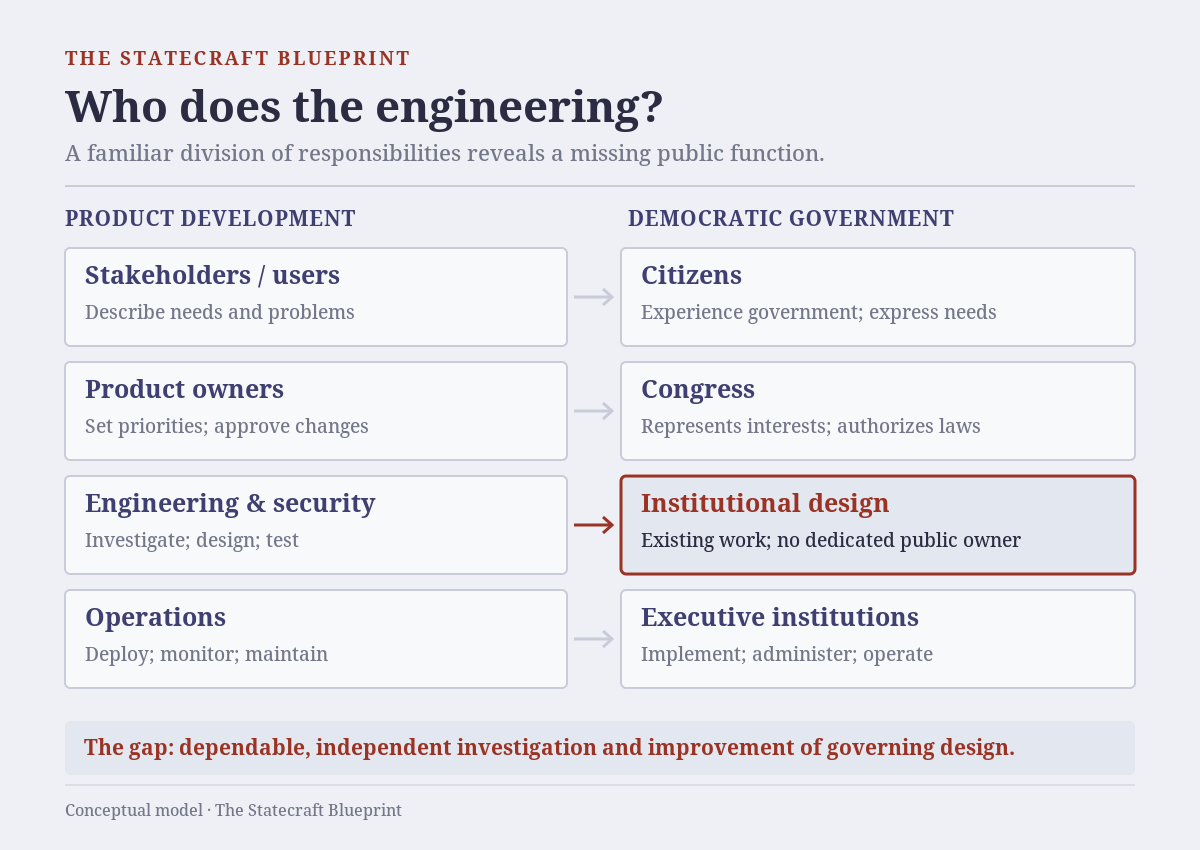
But determining what government should accomplish is not the same as designing the institutions and legal mechanisms capable of accomplishing it. Those designs require specialized work, just as implementing and operating them requires a different set of capabilities.
The comparison has obvious limits. A democratic government isn’t a business, citizens aren’t merely customers, and political authority cannot be reduced to a corporate management hierarchy. Elected representatives must remain accountable to the people, and the technical details of legislation often involve substantive choices about rights, costs, and competing values. But none of those distinctions eliminates the advantages of organizing specialized work around clearly defined responsibilities.
The separation also offers a way to examine how institutional changes are developed and approved. Engineers don’t merely solve the immediate problem presented to them. They are responsible for considering how a proposed change affects other parts of the system, whether it introduces new vulnerabilities, and how its performance can be evaluated after implementation. Product owners retain authority over the requirements and the approval of consequential changes, but they have specialists whose job is to investigate the design rather than simply make the current arrangement more convenient to operate.
Government already recognizes much of this principle. Congress relies on committees, professional staff, legislative counsel, the Congressional Research Service, the Government Accountability Office, and the Congressional Budget Office. Executive agencies employ scientists, lawyers, economists, administrators, and other specialists who develop and implement complex public programs.
The democratic division of labor is not a new idea. The difficult question is whether we’ve organized that labor so that the necessary work can be performed reliably, independently, and in the interests of the people government is supposed to serve.
Consider again the committees responsible for the Clean Air Act. Their accomplishments depended on staff resources, institutional knowledge, legislative procedures, and the willingness of lawmakers to devote sustained attention to a complicated problem. Those conditions mattered enormously, yet they were never guaranteed to persist.
According to the Congressional Research Service, House committee staffing fell by approximately 38 percent between 1977 and 2023, even as total House staffing increased slightly. Over that period, staff became more concentrated in members’ personal offices and other institutional functions, rather than in committees performing collective legislative and investigative work. The shift doesn’t establish that congressional performance declined by the same amount, but it demonstrates that the distribution of institutional capacity can change substantially.
Congress also experimented with specialized analytical institutions that it later chose not to maintain. In 1972, it established the Office of Technology Assessment to help lawmakers understand the likely consequences of emerging technologies. The office produced hundreds of assessments and related publications over more than two decades, examining subjects that ranged from healthcare and energy to national security.
Then, in 1995, Congress eliminated its operating funding as part of a broader effort to reduce legislative-branch spending. The office closed, although the statute authorizing its establishment remained in place.
The details of that decision remain important. Critics had questioned the office’s usefulness, speed, costs, and perceived biases, while supporters argued that it provided valuable independent expertise. Its closure does not establish that lawmakers deliberately eliminated an institution because its findings were inconvenient. What it does establish is that a specialized analytical capability can exist within the formal structure of government and nevertheless become unavailable when the political institution responsible for sustaining it decides otherwise.
There is an unresolved dependency here. The people who need the expertise are also among those who determine whether the institutions providing it will have the resources and authority to continue working. That arrangement may function well under some conditions and deteriorate under others.
Restoring committee staff or rebuilding analytical offices could improve Congress’s capacity. But doing so would not, by itself, answer a more fundamental question: who bears continuing responsibility for investigating the design of government when that design itself becomes the problem?
The existing institutions perform many kinds of valuable work, but their mandates, clients, and methods differ. A budget office evaluates fiscal consequences. A research service assists legislators. An oversight agency examines programs and performance. Legislative counsel helps turn policy decisions into legal language. None of those responsibilities should be dismissed, yet the presence of all those functions does not automatically establish a dependable process for investigating how governing institutions themselves succeed, fail, or become vulnerable to exploitation.
The issue becomes especially important when the objects of investigation are the rules through which lawmakers exercise power. A committee may have the authority to investigate a problem, but its agenda and resources can be affected by the very institutional arrangements under examination. Legislators may improve procedures to address immediate difficulties while leaving the broader consequences of those changes unexamined. Over time, the accumulated arrangements can shape what representatives are able or willing to do.
To understand what’s missing, it helps to distinguish three different kinds of work that are often bundled together under a single word: policy.
What a policy actually contains
Suppose Congress decides to reduce air pollution. That decision involves political values, public priorities, and trade-offs that elected representatives are responsible for making. How much reduction should the country pursue? What costs are acceptable? What competing interests deserve consideration? These questions establish the objective and the boundaries within which government should act.
But deciding that the country needs cleaner air doesn’t determine how to achieve it. Lawmakers must choose among different mechanisms, each of which can produce different consequences. They might establish emissions limits, require particular technologies, create tradable allowances, authorize an agency to develop regulations, or combine several approaches. Those choices determine how the law interacts with the behavior of businesses, administrators, courts, and citizens.
Once an arrangement has been authorized, someone must put it into operation. Agencies develop rules within their authority, administer programs, monitor compliance, and enforce requirements. The outcomes depend not only on what lawmakers wanted or how the law was constructed, but also on what happens when institutions begin carrying out their responsibilities.
These are three distinct, though interconnected, components of public policy: mandate, architecture, and execution.
The mandate describes what government is supposed to accomplish and the political objectives and constraints that govern the effort. Architecture describes the mechanisms designed to fulfill that mandate: the authorities, rules, incentives, procedures, and safeguards through which the objective might be achieved. Execution is the implementation and operation of the authorized design.
Put simply, Policy = Mandate + Architecture + Execution.
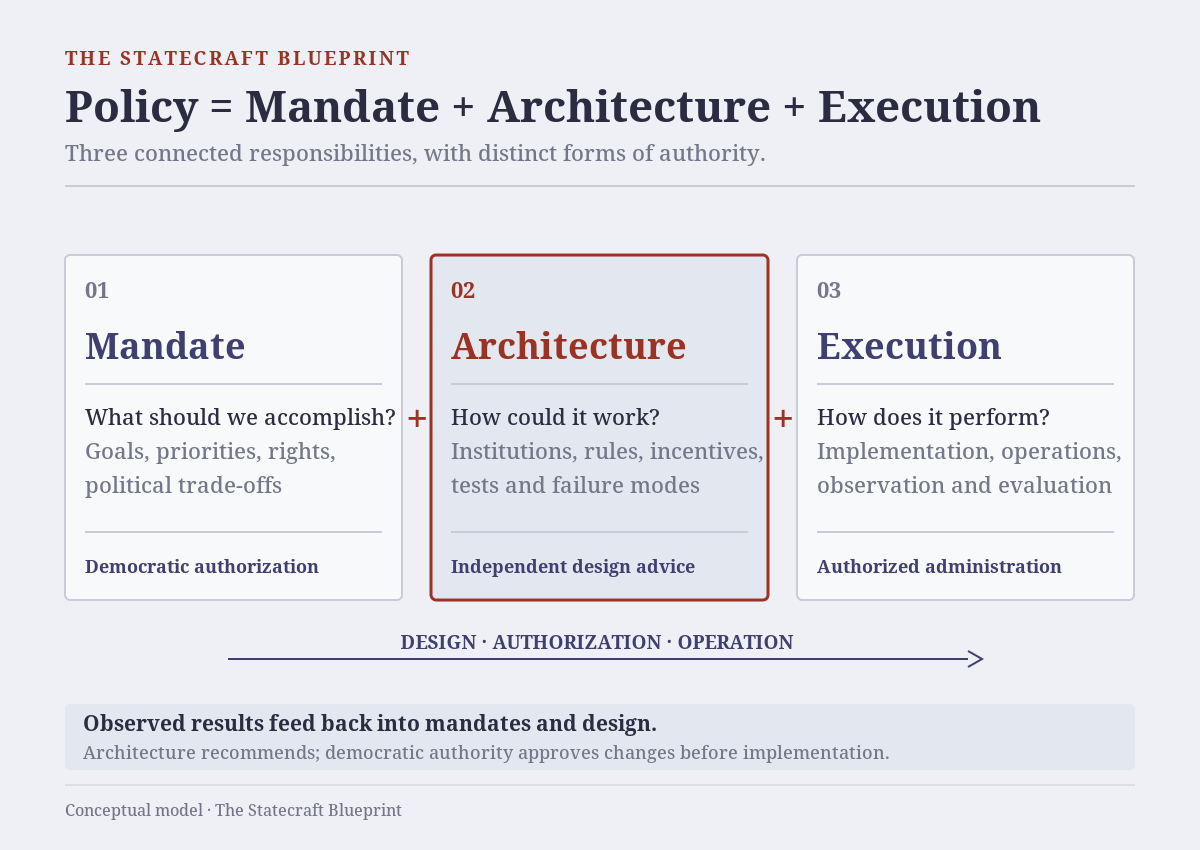
The distinction becomes useful when a policy produces an unexpected outcome. Imagine that an environmental program is failing to reduce pollution. An investigation might discover that the responsible agency hasn’t enforced rules that are already clear, making execution the immediate problem. Or it might discover that businesses are complying with the rules while exploiting provisions that undermine the law’s purpose, suggesting a defect in the architecture.
A third possibility is that the program is functioning exactly as authorized, but the public has come to reject the original objective or the trade-offs lawmakers chose. In that case, redesigning the administrative machinery might not address the disagreement. The mandate itself may need to be reconsidered through political deliberation.
The same distinction applies to Congress’s own procedures. Suppose a procedural change makes it easier for party leaders to determine which proposals reach the floor. The change may serve a legitimate objective, such as coordinating legislative business or reducing delays. But it may also alter the incentives facing individual representatives, affecting their willingness or ability to pursue alternatives, challenge leadership, or cooperate across party lines.
If those behaviors subsequently change, the explanation may not lie entirely in the character of the people elected to Congress. Some of the behavior may reflect the architecture under which they operate. An investigation would examine the mechanisms, the evidence for competing explanations, and whether different arrangements could better serve the institution’s authorized responsibilities.
The same disappointing outcome can therefore arise from different causes, each requiring a different kind of response. Changing elected officials may sometimes be appropriate, but it isn’t a substitute for knowing what actually failed. Nor does a failure to enact legislation necessarily indicate dysfunction; disagreement and the rejection of proposals can be legitimate outcomes of democratic decision-making. The question is whether the institution can reliably perform its responsibilities even when the people operating it disagree.
An institutional engineering function could make that investigation a continuing public responsibility. It would examine the mechanisms of government, study their performance, identify vulnerabilities, compare possible corrections, and explain the consequences of different designs. Its findings would inform the people and institutions authorized to decide what changes should be made, rather than becoming law simply because specialists recommended them.
One possible long-term implementation of that function is what I’ve called a Governance Design Agency: an independent, advisory institution dedicated to investigating and improving the architecture of government. The specifics of such an organization would require substantial work, but the central idea is more important than the particular agency proposed to carry it out.
It would also change the experience of an ordinary citizen who discovers that a government program or legislative procedure isn’t working. Instead of having to become an expert in the entire machinery of government to seek a correction, the citizen could bring evidence of a potential systemic failure to an institution equipped to investigate it. The inquiry might reveal an architectural defect, an execution failure, an unresolved political disagreement, or a misunderstanding of how the system is supposed to operate. Each result would help clarify which institution, if any, should act.
Of course, an institution responsible for investigating government would have vulnerabilities of its own. Its leadership might become politically dependent, its methods could reflect hidden assumptions, its investigations could be influenced by interested parties, and its funding could be threatened. The history of the Office of Technology Assessment demonstrates why the last concern deserves particular attention.
Those possibilities aren’t reasons to assume such an institution would be immune to failure. They are reasons to examine its design carefully. Public findings, reviewable evidence, procedures for challenging conclusions, rules governing conflicts of interest, protections for investigations, and alternative funding arrangements would all be subjects for evaluation.
An engineer encountering a predictable vulnerability doesn’t ordinarily conclude that engineering is impossible. The next step is to investigate how the vulnerability arises, under what conditions it matters, and which safeguards might address it without creating worse problems.
That’s a known failure mode. Design for it.
The principle applies just as well to Congress, the executive branch, and the institutions responsible for overseeing them. If officials can use a rule in ways that undermine its purpose, that possibility deserves investigation. If oversight depends on someone who benefits from preventing it, the dependency deserves scrutiny. If citizens must expend extraordinary resources to influence the laws governing them, the barriers deserve examination.
The task is not to make everyone behave as the system’s designers hoped. It’s to understand the behavior the system actually produces and consider whether its architecture can be improved.
And that brings us back to the people who designed the American government in the first place.
The manual we inherited
There is something remarkable about the way Americans remember the founding generation. We treat the Constitution as a foundational achievement, debate its meaning, and examine how its provisions apply to problems the Founders never encountered. Much of our political and legal culture is devoted to understanding what they wrote and what they intended.
But the Constitution wasn’t the only thing they left behind.
During the struggle over ratification, Alexander Hamilton, James Madison, and John Jay published a series of essays defending the proposed constitutional system. Their immediate purpose was to persuade Americans to adopt the Constitution, but the arguments they developed also preserved an extraordinary amount of reasoning about how political institutions work.
The essays we now call The Federalist Papers examined historical failures, competing forms of government, the problems of representation, the distribution of authority, and the dangers created by concentrated power. Their authors explained not only which institutions they proposed, but why they believed those arrangements would work and which difficulties they were intended to address.
Madison’s treatment of faction in Federalist No. 10 is particularly revealing. He began with the observation that people naturally form groups around different interests, opinions, and attachments. Those groups can pursue objectives that conflict with the rights of others or the long-term interests of the community. He considered whether the causes of faction could be eliminated, then rejected that possibility as either incompatible with liberty or contrary to the realities of human thought and behavior.
His response was to examine how institutions might control the effects of faction instead.
The significance lies in the method. Madison wasn’t simply telling citizens to become less selfish or asking politicians to rise above competing interests. He was identifying a recurring feature of human behavior and examining which institutional mechanisms might account for it. His design choices were informed by historical experience, theories of representation, and assumptions about the ways political power would be exercised.
The constitutional framework that emerged from those debates was an initial implementation of an ambitious institutional design, constrained by the knowledge, experience, and political circumstances of the eighteenth century. Its architects could not have anticipated modern political parties in their eventual form, the scale of administrative government, global financial markets, digital communications, or the problems that arise when technological change transforms society faster than public institutions can adapt.
They also couldn’t observe how their arrangements would perform over the following two centuries. We can.
We have watched political parties develop, legislative procedures evolve, institutional authority shift, and new forms of economic and political influence emerge. We have accumulated extensive evidence about how organizations behave, how incentives shape decisions, and how complex systems produce consequences their designers never intended. We possess entire fields of knowledge that the founding generation could scarcely have imagined.
And we still possess much of the reasoning behind their original choices.
In modern engineering terms, we inherited both an initial implementation and a substantial body of design documentation. The Federalist Papers are not a literal specification for a future government agency, but they do something that makes them useful beyond the political controversy for which they were written. They show us what problems the architects were trying to solve, what assumptions they made, and why they believed particular mechanisms would work.
That documentation gives later generations something to examine against experience. We can ask whether the anticipated behavior occurred, whether the safeguards functioned as intended, and which conditions produced outcomes the designers could not foresee. We can investigate how new institutional arrangements interact with old ones and whether different mechanisms would serve democratic objectives more reliably.
Yet despite the extraordinary amount of experience we’ve accumulated, we have not established a dependable, continuing public responsibility for systematically applying that knowledge to the architecture of government itself. Institutions have been reformed repeatedly, but the work of institutional engineering remains dispersed among political bodies, administrative agencies, research organizations, and interested outsiders, each operating under its own mandates and constraints.
Meanwhile, the people working within those institutions continue modifying the rules and procedures that shape the behavior of their successors. Some changes solve genuine problems. Others may introduce new dependencies, concentrate power, or weaken safeguards. Their combined effects can be difficult to recognize because each modification becomes part of the environment in which the next generation of officials must operate.
When the resulting behavior disappoints us, much of our political conversation still revolves around finding leaders capable of making the existing system work as we believe it should. We search for people with Madison’s judgment, Washington’s character, and the extraordinary competence to navigate problems that neither man could have imagined.
But Madison had already warned us against making enlightened leadership a prerequisite for effective government. He understood that political institutions must account for the people who actually operate them, including those whose ambitions and interests conflict with the public good. He and his contemporaries developed their designs with the knowledge available to them, leaving behind not only the institutions they created but the arguments that explain why they created them.
Perhaps the most valuable part of that inheritance isn’t simply the government they built. It’s the example they set of investigating human behavior and designing institutions around what they discovered.
And perhaps the most faithful way to honor Madison isn’t to keep looking for another Madison.
It’s to pick up the tools he left us—and continue building.