

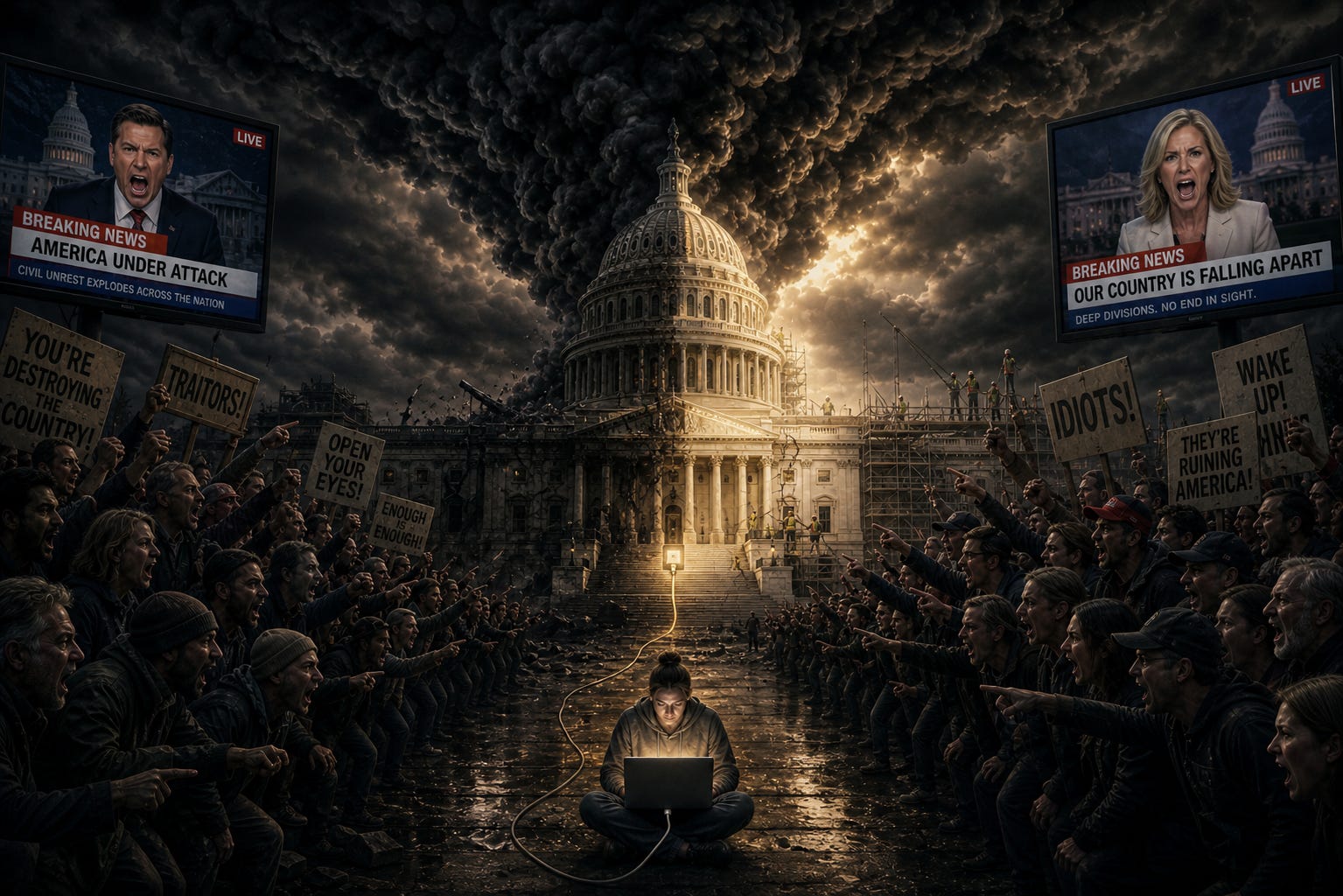
We have written about budgets. About leadership. About shutdowns, Wall Street, education, trade policy, and the quiet collapse of institutional norms. We have analyzed executive orders, mapped how legislation interacts with existing architecture to produce harm nobody intended, and traced the wiring behind a hundred different policy failures.
We have been writing about a lot of different things.
But the thing is — we haven’t. We’ve been writing about one thing, from a hundred different angles.
Here it is.
The Problem
Every dysfunction you’ve ever felt from your government — the gridlock, the broken promises, the policies that help no one, the crises that recur like clockwork — traces back to the same structural failure.
The government has stopped serving its citizens.
Not because the wrong people are in charge. Not because we elected the wrong party. Not because democracy is failing.
Because the machinery of governance — the rules, the processes, the incentive structures, the institutional architecture — has evolved into something that insiders navigate far more easily than ordinary citizens. Whatever its original aspirations, the system as it now functions is not legible, accountable, or responsive to the people it is supposed to serve. It rewards those who know how to work it. Everyone else gets the outputs.
The result: policies get made in separate silos with no institutional requirement to ask how they interact. Trade decisions produce economic consequences nobody tracked. Undefined statutory terms get handed to agencies that define them however the loudest lobby prefers. The budget process was designed to fail, so that when it does, nobody has to take responsibility.
These aren’t separate problems. They’re the same problem, viewed from different angles.
A government that doesn’t serve its citizens produces a different broken outcome every time you look at it.
The question is how a system designed to represent citizens became so difficult for citizens to see, understand, and direct. The answer is not a single cause. But one major part of it lies in how Congress reorganized itself.
Where It Broke
The First Branch is where it starts. Congress is the most powerful institution in American government — the branch from which everything else flows. Executive power, agency authority, judicial jurisdiction: all of it ultimately derives from what Congress enables, funds, and permits.
Which is why it matters that Congress has been systematically stripped of the conditions required for deliberation.
This wasn’t inevitable. It wasn’t accidental. It has a starting point.
In 1970, the Legislative Reorganization Act restructured how Congress operates. Three provisions — sections 120 and 121 and section 104 — rewired the incentive architecture of the First Branch in ways that concentrated power in party leadership, reduced the independence of individual members, and began the slow transfer of legislative authority to the executive and to the organized interests that learned to navigate the new system.
This was not the only inflection point, and the dysfunction it accelerated has many other causes — campaign finance, media fragmentation, party sorting, the growth of the administrative state. But the 1970 Act rewired the core incentive architecture of the First Branch in ways that made most of what followed more likely. The polarization and divisiveness. The voting along party lines. The gridlock. The leadership coercion. The lobbyist capture. The members who arrive in Washington genuinely wanting to govern, and discover they are not permitted to.
We are not here to attack Congress. We are here to restore it.
The people you elect cannot do their jobs under the current rules. The rules have to change before anything else can — and we know exactly which rules.
The Uneven Playing Field
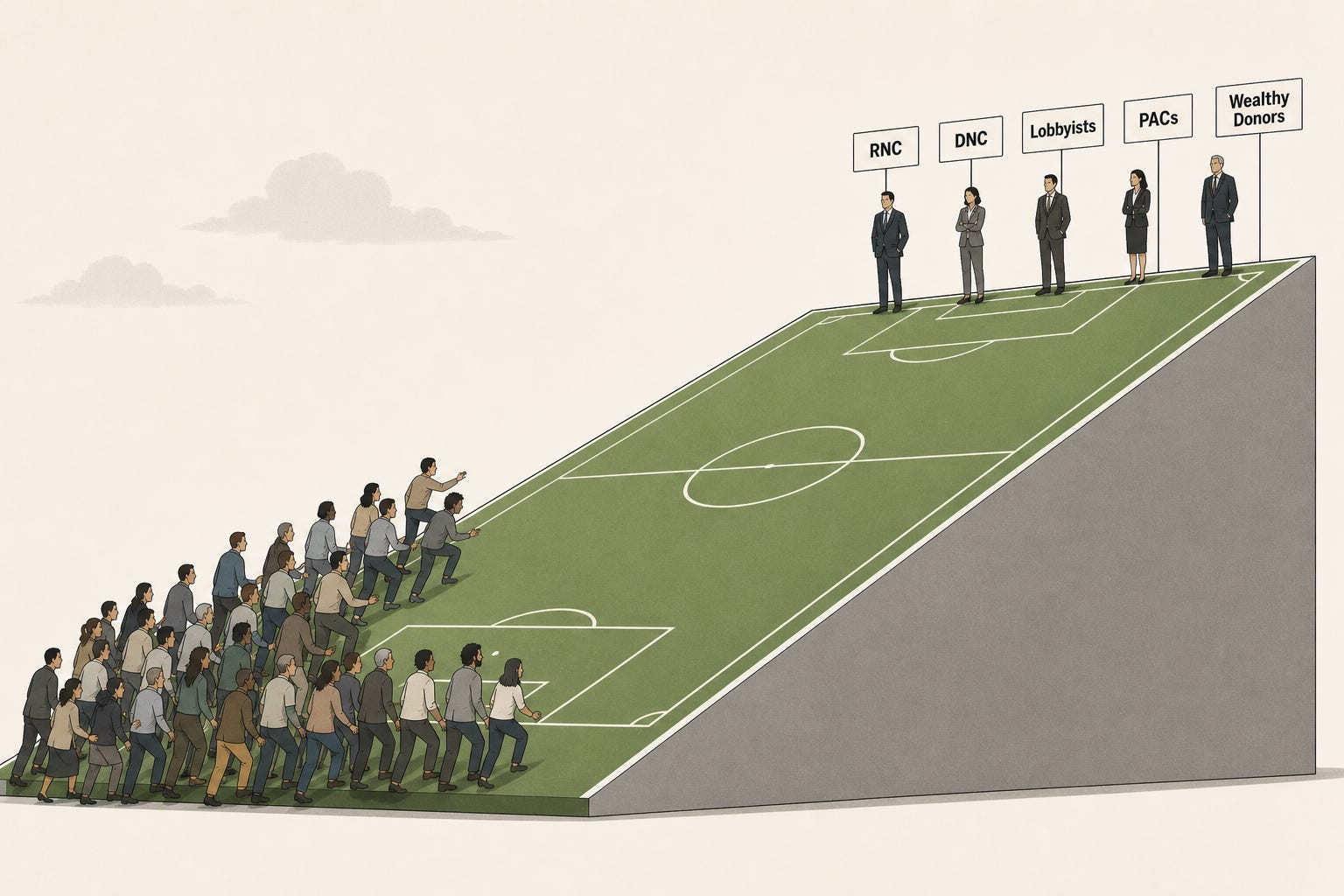
Here is what those rules produced — and why it matters for you directly.
Right now, party leaders and lobbyists can hold lawmakers accountable in real time. Voting records are available immediately. Scoring systems track every vote, in committee and on the floor, and translate them into campaign finance decisions, primary threats, and leadership punishment — all before the next election, all while the legislative session is still underway.
You, as a citizen, are stuck waiting until Election Day.
That asymmetry is not an accident. It is the direct consequence of the 1970 rules. Organized interests with resources, infrastructure, and permanent presence in Washington can apply continuous pressure throughout a legislative term. Citizens can only respond at the ballot box — every two years for House members, every six for Senators — with imperfect information, after the damage is done.
This is why your representatives don’t represent you the way you expect. It isn’t that they don’t care. It’s that the system applies far more immediate and concrete pressure from organized interests than it ever will from constituents. Rational actors respond to the incentives they face. The incentives are broken.
Changing this is what the TSB legislative text is designed to do. Delay the release of voting records until the electoral window — when citizens can actually act on the information. Organized interests will still have advantages of wealth, access, and permanence. But their timeline for coercion gets compressed. The continuous pressure loop gets disrupted. The playing field doesn’t become level, but it becomes less tilted.
This is where we start.
What We’re Building
Democracy shouldn’t require heroic effort.
You shouldn’t need to be a lawyer to understand how a policy was made, a PhD to read the federal budget, or a watchdog organization behind you to hold your representative accountable. We don’t design other systems this way — we build structural safeguards, hire engineers, create accountability mechanisms with real teeth. We have never done this for governance itself.
A real democracy meets its citizens where they are. It conforms to them. They don’t conform to it.
The Statecraft Blueprint exists to fix the design. Not the policies. Not the personnel. The design.
We are building toward a government where citizens can:
See how their government spends money — through financial statements that meet the same comprehensibility standards we require of public companies
Trace how a policy was made — the upstream forces, the lobbying, the leadership coercion, the committee process, the floor scheduling — not as an investigative project, but as a matter of routine transparency
Understand what a law will do before it takes effect — including how it interacts with existing architecture, what second and third-order effects it will produce, what it leaves undefined and who gets to fill those gaps
Identify quickly when the system starts to drift — so accountability doesn’t require years of effort to establish what should have been visible from the start
That is the long-term architecture. It is what the Governance Design Agency would make permanent — professional institutional design, separated from political cycles, systematically serving the public interest.
The goal is not to make citizens into specialists. The goal is to build a government that doesn’t require them to be.
What We Are Releasing
Here is the first practical release.
For 250 years, Congress has written its own rules.
The results are in.
The legislative text we are releasing targets the specific provisions — LRA 1970 Sections 104, 120, and 121 — that created the coercion surface described above. The Church Bells briefs provide the structural analysis: how these provisions interact with existing architecture, what the fix produces, what it doesn’t yet address.
Neither document is final. They will need refinement. We need lawyers, scholars, and practitioners to stress-test them, find the gaps, and improve them. That is part of the process.
But we have a starting place. And starting places matter.
We are presenting this in three layers:
For citizens: A plain-language explanation of what each provision means for your life, your community, your ability to hold your representatives accountable. You do not need to read the legislative text. You need to understand what it does — and decide if you want it. Start with the rules-only instrument and the Section 104 companion amendment.
For the analytical reader: The Church Bells briefs provide the structural analysis — how these provisions interact with existing architecture, what the fix produces, what it doesn’t yet address. Read the analysis of the rules-only instrument and the Section 104 companion, alongside the original briefs on Sections 120 & 121 and Section 104.
For lawyers, legislators, and policymakers: The legislative text itself — the rules-only instrument and the Section 104 companion statutory amendment. Read it. Critique it. Propose alternatives. The point is not that our specific design is the only possible design. The point is that we need a design — and institutions are poorly positioned to redesign the systems that currently empower them. Self-reform has proven, repeatedly, too partial and too reversible to hold.
This is the first step. There are many others.
Once the coercion loop is disrupted and lawmakers are free to deliberate, the next work begins: formalizing the kind of structural analysis the Church Bells briefs demonstrate — so that before legislation passes, its impacts are evaluated as a matter of institutional requirement, not individual effort. The burden shifts back onto Congress to show its work. To demonstrate that harms have been considered and diminished.
That is where this is going. But first, the playing field has to be leveled enough for the other work to matter.
This Is Different
You’ve heard this before. Every election cycle, someone promises to fix Washington. Every reform movement says this time is different.
They weren’t.
Here’s why this is.
Most reform efforts target outcomes, not the machine.
Term limits. Campaign finance reform. Ranked choice voting. These are all attempts to produce different results from the same broken system. Swap out the players. Change how money flows. Adjust the voting math. But the machine — the rules that govern how Congress actually operates — stays intact. And the machine keeps producing the same outcomes, with different faces attached.
TSB is targeting the machine.
Most reform efforts ask Congress to act against its own interests.
“Elect better people.” “Hold them accountable.” “Primary the bad ones.” All of these require individual politicians to voluntarily sacrifice their own power and security for the public good. Some do. Most don’t. The system selects against the ones who try.
We’re not asking Congress to be better people. We’re changing the incentive structure so that the rational move — the self-interested move — aligns with the public interest. When the coercion loop is disrupted, voting your conscience becomes safer. We’re not appealing to virtue. We’re redesigning the environment.
Most reform efforts are vague.
“Drain the swamp.” “Get money out of politics.” “Fix the system.” These are feelings, not proposals. Even serious reform efforts — congressional ethics legislation, campaign finance overhaul — tend to stay general. High principles, light on mechanism.
TSB is hyper-specific. We have identified the exact provisions — 1970 LRA Sections 104, 120, and 121 — that created the coercion surface. We have written the legislative text. We have analyzed the structural consequences. We have named the mechanism, designed the fix, and published both.
The what. The how. The why. All of it, in plain language, available for anyone to read and critique.
That’s not normal. But it should be. And it requires no hero inside the building to make it happen.
TSB’s first move is outside pressure. Citizens telling Congress — directly, specifically, in writing — what rules they are going to follow. Not asking. Telling.
The Constitution reserves this power to the people. We have always had it. We have rarely used it this precisely.
The Pushback
We expect resistance. We welcome it.
To those who will say this is unrealistic: we are in the 2026 midterm season. Look at the candidates. Read their platforms. Identify the one who is going to walk into Washington and fix the structural architecture of the First Branch. We will wait.
To those who will say this overreaches: the alternative is what you have now. If you have a better proposal, publish it. We will read it seriously.
To those who will say citizens shouldn’t write the rules for Congress: the Constitution disagrees. Congress governs at our consent, not the other way around.
This is your system. We are not building it for you. We are building it with you.
What We Need From You
There is one more thing that makes this different from every political movement you have ever been part of.
Every other approach asks you to trust someone else.
Vote for this candidate — and hope they mean it. Donate to this organization — and hope they spend it well. Support this reform — and hope the right people in Washington decide to act on it. The ask is always the same: hand your power to someone else, and wait.
This is not that.
We are not asking you to find the right hero and send them to Washington. We are not asking you to hope that someone, somewhere, will decide to sacrifice their own interests for yours. We have spent enough time waiting for that to happen.
This is your opportunity to put your voice directly behind a specific demand. Not a candidate. Not a party. A document. A mechanism. A set of rules, written in plain language, that you can read yourself.
We The People, telling politicians — in no uncertain terms — exactly what we want and exactly how we want it done.
That is not a petition. That is not a protest. That is citizens exercising the authority the Constitution always gave them, with enough specificity that no one can pretend they didn’t understand the ask.
You don’t have to trust us. You don’t have to trust Congress. You just have to decide whether you want a government that works — and then say so, loudly, to the people whose job it is to build one.
The machinery of governance responds to pressure. It always has. The question is whether the pressure comes from citizens or from the organized interests that are already inside the building.
We are building the outside pressure. We are naming the structural failure, proposing the structural fix, and asking you to stand behind it — not because you trust us, but because you can read it yourself.
The standard we are proposing is not complicated: a government that serves its citizens, that can be held accountable by them, that does not require heroic effort just to understand.
That is not a radical demand. It is the original promise.
This is the revolution: We The People calmly, but firmly, telling Congress not just to change the rules — but which rules to change, and how to change them.
Do you want a functional government that serves you?
Don’t tell us.
Then tell everyone else. Share this with one person who is as frustrated as you are. Post it. Forward it. The outside pressure only builds if more people know it exists.
A note on language: Throughout these writings we have used “we” rather than “I.” This is deliberate. The Statecraft Blueprint is one voice, but it is not one person’s voice and not one person’s movement. The demand for a government that serves its citizens belongs to every citizen. The “we” in these pages is We The People — in the oldest and most literal sense of that phrase.