

Bill Kristol, architect of the “unitary executive” theory and advocate for expanded presidential authority during the Bush administration, helped design the modern executive power toolkit. Signing statements that reinterpret laws. Broad claims of executive authority. Minimal congressional oversight. Tools that concentrate power in the presidency. Now he’s alarmed that Donald Trump is using exactly what he built.
Meanwhile, political theorist Danielle Allen, in her work on democratic renewal, argues we need democracy to control how policies get implemented. Democratic legitimacy requires popular input on the details. But when conservatives win elections and start rewriting election rules using those same democratic processes? Suddenly those democratic mechanisms need guardrails, need constraints, need to be removed from political control.
Same pattern. Different tribes. Both saying: “This system only works when we control it.”
That’s not a political position. That’s an admission. They’re telling you the system is designed for winner-take-all control - they just want to be the winners.
This Isn’t Cooperation - It’s Escalation
This isn’t a left vs. right problem. It’s an arms race. But they’re not building new weapons - they’re fighting over the same concentrated power, escalating their tactics.
First wave: Neoconservatives dismantle constraints. Post-9/11 executive power expansion. Unitary executive theory. Enhanced interrogation. Warrantless surveillance. Signing statements that reinterpret congressional intent. They built these tools believing they’d use them responsibly. “We need this authority to keep America safe. Trust us - we’re the adults in the room.”
Second wave: MAGA weaponizes what was built. Same toolkit. More aggressive use. Trump picks up every tool the neocons assembled and uses it exactly as designed - just for purposes they never intended. The neocons are horrified: “Not like THAT! We meant these for responsible leaders!” Too late. The gun was already loaded.
Third wave: Progressives see MAGA wielding the toolkit and realize they need to fight fire with fire. Watching concentrated power in hostile hands, progressives start assembling their own version. Left-wing authoritarianism (LWA) rising in response. Not because they’re naturally authoritarian - because they’ve been losing since the Bush administration and using the same playbook finally seems like the winning move. “We need authority to stop them. We need power to help people.”
I already know what progressives are thinking: “This is false equivalence. We’re trying to HELP people. Our intentions are better. Our values are different.”
You’re right - your intentions ARE different. Your intentions are better.
But architecture doesn’t care about your intentions.
“Good people with good intentions should have power to do good things”
“Good people with good intentions should have power to do good things” - that’s exactly what Bill Kristol said defending neocon policies. It’s what every faction believes. The governance architect sees what they all miss: a system that requires virtuous people with good motives isn’t a system. It’s a loaded gun we keep handing to people we trust, then act shocked when someone we don’t trust picks it up.
You want to use executive authority to protect vulnerable populations. Trump wants to use it to hurt his enemies. Kristol wanted it to fight terrorism. You all think the difference is your intent. The structural architect sees the difference is nothing - you’re all arguing over who gets to wield power that shouldn’t exist in that concentrated form.
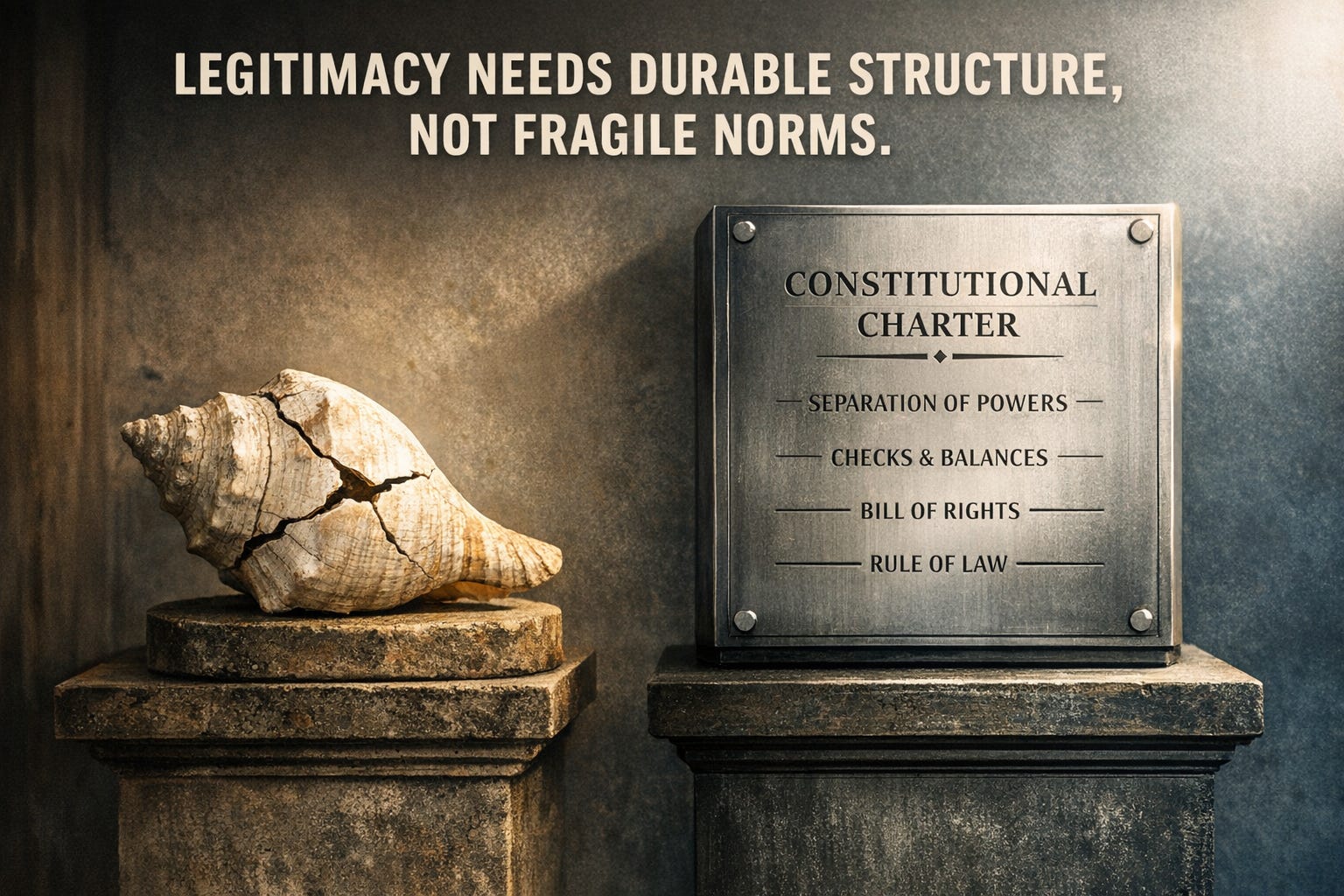
You’re fighting over the conch from Lord of the Flies. The fact that you’d use it to help people instead of hurt them doesn’t change the fact that you’re fighting over a conch instead of building a functioning system of cooperation.
Same pattern. Same mistake. Different tribes.
And none of it is cooperation. It’s all escalation.
Each side pointing at the other: “Look what THEY did! We have no choice!” Escalating their rhetoric. Sharpening their tactics. Fighting harder for the same concentrated power. Because what else is there? They can’t see anything else. They’re captured by the game.
We’ve Misunderstood What Democracy Is
Here’s the uncomfortable truth: We don’t have a system of cooperation within constraints. We have a system of power swapping.
When it’s your turn, you can do anything. When it’s their turn, they can do anything to you. Back and forth. Elections aren’t competitions within agreed rules - they’re battles for unconstrained control.
Of course everyone fights with existential desperation. The stakes aren’t “which policy approach wins this round.” The stakes are “who gets unconstrained power for the next 2-4 years to implement their vision and dismantle what the other side built.”
That’s not democracy. That’s a slow-motion civil war with elections instead of bullets.
Real democracy should be cooperation within mutually agreed constraints that bind everyone.
Boundaries that hold regardless of who wins. Constraint propagation throughout the system - rules at every level that enforce cooperation. Processes that both sides can trust even when they lose. Policy competition within a stable framework, not tribal warfare over who gets to wield unconstrained power.
We’re all stuck on this planet together. All stuck in this country together. We need to find ways to work together. And right now, none of the major factions are focused on working together. They’re focused on winning control. And they know - we all know - that once one tribe gets power, they won’t constrain it voluntarily. They won’t give it up. Even if limiting that power would create better outcomes for everyone.
This is basic Game Theory. The Prisoners’ Dilemma. Tragedy of the Commons. Concepts we understand BETTER since the Founders’ time. We have 238 years of additional knowledge about how humans behave in systems, how incentives shape choices, how unconstrained power corrupts regardless of intentions.
And we’re still operating as if none of that matters. As if good people with good motives are enough.
The Founders Warned Us
The Founders understood this problem. They weren’t naive about human nature or power. They knew exactly what we’re experiencing - and they tried to prevent it.
George Washington, in his 1796 Farewell Address, warned explicitly:
“The alternate domination of one faction over another, sharpened by the spirit of revenge... is itself a frightful despotism.”
He saw it. The back-and-forth. The escalation. The spiral. This is exactly what we’re living through when we look at the media - social and traditional.
James Madison, in Federalist No. 51, designed the entire constitutional architecture around preventing concentrated power:
“Ambition must be made to counteract ambition... If men were angels, no government would be necessary. If angels were to govern men, neither external nor internal controls on government would be necessary.”
He didn’t trust good intentions. He didn’t design for virtuous leaders. He designed systems where ambition counteracts ambition. Where power is distributed. Where no faction can dominate.
We’ve dismantled what they built.
We’ve removed the constraints. Weakened the checks. Concentrated authority in ways they explicitly warned against. Not through some dramatic coup - through a thousand small decisions, each one seeming reasonable in isolation, that collectively created cascading failure modes they designed against.
And now we’re experiencing exactly what they predicted: frightful despotism alternating between factions, sharpened by the spirit of revenge.
Restoration, Not Reform
The Founders tried to build cooperation through architecture. Their principles weren’t just good ideas - they were structural solutions to the exact problem we’re facing now.
Popular sovereignty - the people are the ultimate authority, not kings or aristocrats or experts or “the adults in the room.”
Distributed power - no single person or faction should control everything. Separate powers across branches, across levels of government, across competing interests.
Mutual accountability - power holders must be accountable to each other and to the people. Checks and balances aren’t optional features, they’re load-bearing walls.
Rule of law - laws bind everyone, including those who make them. No one is above the system.
These weren’t abstract ideals. These were architectural principles designed to enforce cooperation even when people didn’t want to cooperate. To make ambition counteract ambition. To prevent exactly what we’re experiencing.
Their principles were brilliant. They designed brilliantly for their time. But they only had 1780s knowledge to work with.
They didn’t account for political parties - thought they could prevent them from forming. They didn’t account for modern mass communication - designed for a world where news traveled at horse speed. They didn’t account for the administrative state - couldn’t imagine a government that touches every aspect of daily life. They designed for horse-and-buggy governance in what’s become a space-age world.
We can honor their principles while acknowledging their implementation carries 238 years of technical debt.
You don’t restore a historic building by refusing to update the wiring and plumbing. You preserve what was brilliant about the design while making it work for modern needs. That’s not disrespecting the architects - that’s honoring their vision by asking what they would build if they were here with modern knowledge.
This isn’t rejecting the Constitution. This is asking: How do we implement these principles - popular sovereignty, distributed power, mutual accountability, rule of law - in 2026?
How do we build architecture that enforces cooperation in a world of 330 million people, instant global communication, complex interconnected systems, and tribal media ecosystems the Founders couldn’t have imagined?
How do we finish what they started - using 238 years of additional knowledge about how to actually make it work?
What Restoration Looks Like
Not “better people” wielding the same broken power structures.
Not waiting for your tribe to finally get control and fix everything.
Not hoping the other side will voluntarily constrain themselves when they win.
Professional governance design. Architecture that embodies founding principles using tools they didn’t have.
Think about the Federal Reserve. It doesn’t collapse every time a new president takes office. It doesn’t lurch from tight money to loose money based on which party controls Congress. Why? Because it’s designed with architectural redundancy and the same founding principles:
Distributed power - Fed Chair can’t act unilaterally, requires board consensus, eliminating single points of failure
Mutual accountability - Subject to congressional oversight, transparent methodology, clear mandate
Rule of law - Bound by Federal Reserve Act, can’t just do whatever
Popular sovereignty - Ultimately accountable to elected officials, who are accountable to people
Professional staff. Insulated from day-to-day politics while remaining democratically accountable for outcomes. Both parties can lose an election without losing their minds about what happens to monetary policy.
That’s what the Founders were trying to build for all of government. We just gave up halfway through.
Now imagine applying that same architecture to governance itself. Not monetary policy - the systems that make policy decisions possible.
The Governance Design Agency would do for government what the Founders tried to do with the Constitution - build architecture with proper incentive structures that make cooperation the path of least resistance:
Popular sovereignty: Designed by and for the people. Subject to democratic oversight. But insulated from the dysfunction that currently makes governance impossible.
Distributed power: Can’t make policy, only design systems. Can’t implement, only architect. Subject to checks from all three branches. No concentrated authority that could be weaponized.
Mutual accountability: Transparent methodology. Professional standards. Regular review. Accountable to Congress for budget, to courts for constitutional compliance, to citizens for outcomes.
Rule of law: Bound by the Constitution and founding principles. Can’t redesign the system to favor one party. Must create architecture that both sides can trust even when they lose.
Using knowledge the Founders didn’t have: Game Theory showing how incentives shape behavior. Institutional economics explaining how systems succeed or fail. 238 years of evidence about what works and what doesn’t.
This isn’t reform. This is restoration using modern tools.
It’s what Madison would design if he were here with 238 years of additional knowledge. What Hamilton would build if he had access to Game Theory and modern systems engineering. What Washington would demand if he saw the “frightful despotism” alternating between factions that he explicitly warned against.
The GDA doesn’t represent some radical new idea. It represents finishing what the Founders started - building architecture that enforces cooperation even when people don’t want to cooperate.
You become the conservative when you advocate for restoring founding principles. They become the radicals who’ve abandoned what made this country work.
I’m sure this sounds like a fanciful tale you’ve heard before. For decades, politicians have promised they’d fix the system. Every campaign, every reform proposal, every “this time will be different” speech.
Well, this IS different. I’m not a politician. I don’t aspire to be a politician. I’m a systems engineer with 20 years of experience building and fixing complex architectures. And this isn’t reform. This isn’t renovation.
This is restoration.
The Statecraft Blueprint and the Governance Design Agency represent finishing what the Founders started - restoring the principles they fought for using tools and knowledge they didn’t have.
The Choice
No existing faction is going to build this. They’re all captured by the game. They can’t see past winning control because winning control is the only thing they can imagine.
MAGA won’t build systems that constrain executive power - they want strong executives when their guy is president.
Neoconservatives won’t dismantle what they built - they designed it and want to control it when “responsible adults” are in charge.
Progressives won’t build neutral architecture - they want power to help people and can’t imagine trusting systems when bad people might operate them.
All of them prefer a system with critical failure modes they might control over architecture that both sides can trust.
All of them are fighting to wield power instead of building systems that enforce cooperation.
All of them have abandoned the founding principles they claim to honor.
You have a choice.
Keep fighting for your tribe to control a broken system. Keep hoping your side wins and uses power wisely. Keep pretending good intentions make concentrated power safe. Keep calling it “democracy” when it’s really just power swapping. Keep abandoning what the Founders built because you think your cause justifies it.
Or demand restoration. Real restoration. Architecture that embodies the principles they fought for - popular sovereignty, distributed power, mutual accountability, rule of law - using tools and knowledge they didn’t have. Professional governance design that both sides can trust even when they lose. Constitutional-level reform that finishes what they started.
Those are the only two paths.
One leads to continued escalation. Washington’s “frightful despotism” alternating between factions. Madison’s nightmare of unchecked ambition. The slow-motion civil war we’re already living through.
One leads to what they actually tried to build - cooperation within mutually agreed constraints that bind everyone. Real democracy, not tribal warfare over who gets the conch.
We’re all stuck on this planet together. All stuck in this country together.
The Founders gave us principles that work. We’ve drifted from them. We can find our way back.
Choose.
Interesting concept. I agree that there is an opportunity to improve governance. One thought: why two parties? Multiple political parties can lead to coalition governing; which can lead to a similar better outcome.