

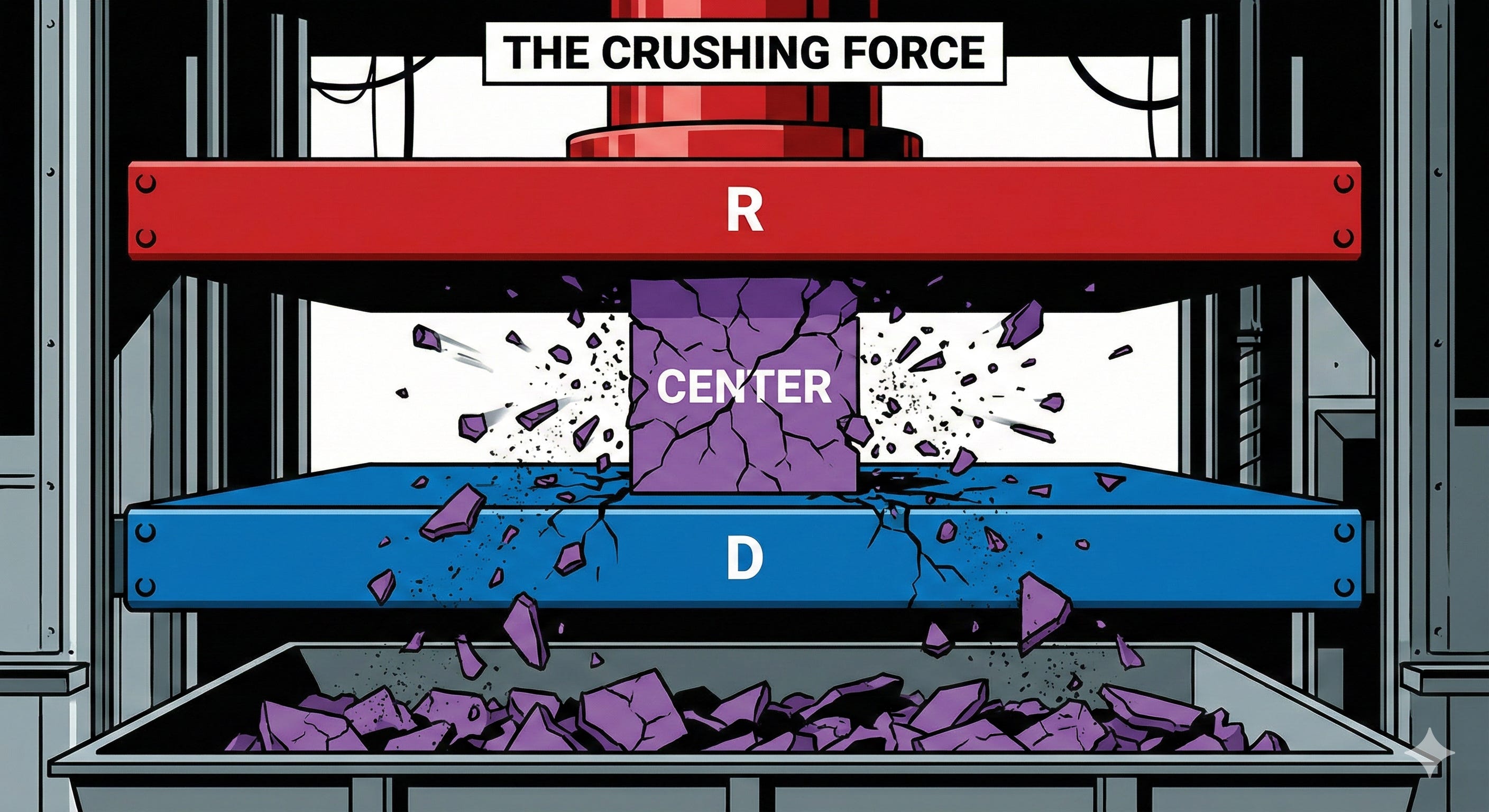
People often ask me why we’re stuck with a two-party system. Or they lament it—”If only we had more parties, we’d have more choices, less division.”
I can explain the math. First-past-the-post voting systems create strong pressure toward two parties. It’s Duverger’s Law. Third parties get squeezed out. Winner-take-all means voters strategically choose the “lesser evil” rather than waste votes on candidates who can’t win.
But here’s what that doesn’t explain: Why are the divisions getting sharper?
We’ve always had two parties. Democrats and Republicans, Whigs and Democrats, Federalists and Democratic-Republicans—the two-party pattern is old. What’s NEW is the polarization within that pattern. The vanishing of purple districts. The destruction of representatives who try to bridge divides. The impossible choices that punish compromise.
First-past-the-post doesn’t explain that. The two-party system has existed for centuries. The sharp polarization of the last few decades is something else.
Like what happened in February 2026. When DHS funding expired at 12:01 a.m. ET on February 14, Coast Guard personnel stopped getting paid. TSA agents worked without paychecks. FEMA’s response capacity was severely constrained as staff faced furloughs and funding uncertainty.
But ICE—the agency Democrats were trying to restrain—continued operating largely insulated from the shutdown. Fully funded. Minimally affected.
Because the previous year, Republicans used budget reconciliation to give ICE tens of billions in multi-year funding outside the normal appropriations process. They made ICE shutdown-resistant while leaving other DHS agencies exposed.
Two weeks earlier, 21 House Democrats had voted to end a shutdown and fund DHS temporarily. Their progressive base destroyed them: “You gave up leverage!” When Democrats held firm on February 13 and forced the shutdown, the result was predictable: ICE largely unaffected, Coast Guard families without pay. Purple district Democrats blamed either way.
How did we get here? Why does every crisis destroy the representatives who try to navigate it responsibly? The answer isn’t the two-party system. It’s something deeper. It’s architecture.
The Mechanism: How the System Selects for Polarization
I started writing this essay a month ago when I saw 75 House Democrats vote to praise ICE—right in the middle of massive anti-ICE protests. My first thought wasn’t “they’re bought.” It was “that’s unusual—why would they break ranks?” Then came the shutdown crisis. Then it passed. Now we’re back at another shutdown over the same issues. The pattern repeats. Each iteration gets worse as both parties refine their architectural manipulation tactics.
The Triple Trap
Twenty-one House Democrats faced an impossible choice on February 3. Vote YES to end the shutdown—fund DHS for two weeks, keep Coast Guard and TSA workers paid, give FEMA disaster relief funding. Or vote NO—keep the government shut down as leverage to force ICE reforms.
They voted YES. Rational choice. Their districts needed functioning government. Federal workers needed paychecks. FEMA needed to respond to winter storms that had killed more than 80 people across several states.
The progressive base was furious. MoveOn organized calls and letter campaigns. Primary challengers started circling. “You gave up leverage!” The 21 became targets in their own party.
This was Trap 1: Vote to keep the government functioning, get destroyed by your base.
Fast forward to February 13. Democrats held firm this time. Used their leverage. Shut down DHS to force ICE accountability after federal agents killed two American citizens in Minneapolis—Renée Good and Alex Pretti.
But Republicans had already manipulated the architecture. The previous year’s “One Big Beautiful Bill Act” gave ICE tens of billions in multi-year funding—many times their normal annual budget—available through 2029, completely outside the regular appropriations process. They made ICE largely shutdown-proof while leaving Coast Guard, TSA, and FEMA exposed.
So the shutdown hurt Coast Guard families, TSA agents working without pay, FEMA operations straining under winter storm recovery. But ICE? Largely insulated. Operating normally. Well-funded. The vast majority of ICE and CBP workers continued working as essential personnel while Coast Guard and TSA staff worked without paychecks.
Democrats got blamed for hurting innocent workers while achieving nothing. The leverage didn’t work.
This was Trap 2: Use your leverage, but it fails because the other party already manipulated the architecture.
The 21 Democrats who voted YES on February 3 face primary challenges for “caving.” The Democrats who voted NO and forced the February 13 shutdown got blamed for hurting Coast Guard and TSA workers while accomplishing nothing.
This is Trap 3: Purple district representatives destroyed either way. The system produces this.
This is the real polarization machine: no-win votes + asymmetric insulation + media compression.
The Selection Pressure Against Compromise
Here’s why this matters structurally. Progressive Democrats in D+30 districts could vote NO on February 3 without consequence. Their districts reward purity. No electoral punishment for keeping the government shut down.
Conservative Republicans in R+30 districts could vote NO on ending any shutdown. Their districts reward obstruction. No electoral punishment.
Safe district representatives can vote their ideology. The electoral math protects them. They never face competing pressures from their constituents because their constituents are ideologically homogeneous.
Representatives from competitive districts face a completely different reality. Their constituents include people who need FEMA disaster relief and people outraged by ICE killings. People who want functioning government and people who demand aggressive reform. Both are legitimate concerns. Both deserve representation.
Vote YES on February 3—progressive primary challenger attacks from the left. Vote NO—Republican opponent attacks from the right with “Democrats chose shutdown over paying our troops.” Every choice provides attack ad material. Bridge-building becomes electoral suicide.
Each crisis makes purple districts harder to hold. Representatives who try to navigate competing legitimate interests get destroyed from one side or the other. Over multiple cycles, only safe-district representatives survive. They never have to make hard choices. They can maintain ideological purity because their districts reward it.
Congress becomes more polarized. Both parties get better at architectural manipulation—Republicans lock in ICE funding, Democrats demand shutdown leverage, both refine their tactics. More impossible choices get created. The loop repeats. Each iteration selects more strongly for polarization.
POSIWID: The System Works as Designed
We say we want representatives who can compromise, who can balance competing interests, who can govern responsibly, who can represent mixed constituencies.
The system produces more polarization each cycle. More safe-seat ideologues. Fewer purple districts. More architectural manipulation by both parties. Less capacity to actually govern.
This isn’t dysfunction. It’s the design working exactly as built.
Republicans use budget reconciliation to lock in ICE funding for years, bypassing annual oversight. Democrats use reconciliation for pandemic spending, tax credits, and green energy subsidies, also bypassing the normal compromise process. Different goals, same architectural move: bypass the recurring accountability loop. Both parties bundle unrelated appropriations together to create impossible choices—vote for the whole package or vote against disaster relief. Both weaponize government shutdowns.
The system rewards architectural manipulation and punishes bridge-building. Purple districts vanish not because voters are suddenly more polarized, but because the governance architecture actively selects against representatives who try to represent mixed constituencies.
The purpose of a system is what it does. This system produces polarization. That’s the design.
The Path Forward: What We Build
Understanding the mechanism reveals the fix. The problem isn’t the two-party system. It’s the procedural rules that create impossible choices and reward architectural manipulation. Here’s what we build, at three different timescales.
Immediate: What You Do This Week
Right now, Congress writes its own procedural rules. Until we build the Governance Design Agency (GDA)—a constitutional-level institution to design governance structure independently—We The People must exercise our popular sovereignty and do this work ourselves.
When you see a headline like “21 Democrats Give Up Leverage on ICE” or “House Members Cave on Shutdown”—don’t scroll past. Comment. Make the structure visible.
“These representatives faced an impossible choice: Vote YES and get attacked by progressives for ‘giving up leverage.’ Vote NO and get blamed for shutting down FEMA during winter storms. This is a structural trap, not a failure of courage. The real story is why we bundle disaster relief with immigration enforcement in the first place.”
Do this on news articles. Do this on social media. Do this where journalists and other readers see it. See something, say something.
When the media compresses complex structural traps into soundbites, they make the architecture invisible. Your comment makes it visible again. You’re doing the work the media should be doing—showing HOW the system creates these impossible choices.
Stop flaming representatives for being forced into no-win situations. Emotionally it might feel good to release that frustration, but it doesn’t go anywhere. It reinforces the trap. It makes purple district representatives more vulnerable to primary challenges, which accelerates the polarization.
Instead, redirect the conversation to structure:
“Why are we bundling six unrelated agencies into one vote?”
“Republicans gave ICE multi-year funding to make it shutdown-resistant. That’s architectural manipulation.”
“The leverage was an illusion because one party already bypassed normal appropriations.”
This works. It changes the conversation. Other readers see it. Journalists see it. Representatives see it. The structural lens spreads. This is how you build constituency for governance architecture reform—by making the invisible mechanisms visible every single time they operate.
Share the loading ring symbol —the visual representation of a government system still loading, still being built. Make it a signature. Let people know there’s a movement for functional systems.

This costs nothing. It takes two minutes. It’s more effective than calling a representative’s office where your message gets tallied and ignored. Comments shape the narrative. Comments reach thousands of other readers. Comments teach the structural lens.
Mid-Term: What We Elect Representatives to Do (2-4 Years)
Build the constituency for governance architecture reform. Elect representatives who commit to specific structural changes. This is the key: specific commitments, not vague promises about “better government.”
When candidates campaign, when you go to town halls, don’t ask about their policy stances. Ask about structure:
“Do you oppose bundling bills? If so, what will you do to prevent it?”
“Will you vote against any appropriations bill that bundles unrelated items, even if your leadership wants you to vote YES?”
“Are you committed to repealing problematic constraints-removal like the 2001 AUMF that’s still being used to authorize military action?”
“Will you support limiting budget reconciliation to single-year measures only?”
“What specific procedural reforms will you introduce in your first term?”
Don’t accept abstract answers. “I believe in transparency and accountability”—that’s nothing. “I will co-sponsor legislation to restrict appropriations bills to single subjects and I will vote NO on any bundled package regardless of party pressure”—that’s a commitment.
Make them go on record. Make it specific. Make them explain HOW they’ll make it happen.
Then hold them accountable. When they vote for bundled appropriations, primary them. When they defend shutdown leverage, support their challenger. Create electoral consequences for architectural manipulation. Reward representatives who vote for clean bills even when their party leadership demands bundling.
The structural changes themselves:
Single-subject appropriations bills. One subject per bill. Period. The DHS appropriations bill bundles ICE enforcement, Coast Guard pay, TSA operations, FEMA disaster relief, Secret Service protection, and cybersecurity. That’s six separate subjects that deserve six separate votes.
Under single-subject rules, each gets a standalone vote. Fund Coast Guard through September? Clear vote on a clear question. Probably passes 95-5. Fund TSA? Clear vote. Probably passes 95-5. Fund FEMA disaster relief? Clear vote. Probably passes 95-5.
Then the contentious issues get clear votes too. Fund ICE enforcement at current levels? Clear vote. Clear accountability. Require judicial warrants for ICE home entries? Clear vote. Clear accountability. Require body cameras and visible identification for federal agents? Clear vote. Clear accountability.
Representatives can support disaster relief while demanding law enforcement accountability. Voters see clear positions, not forced trade-offs. Purple district representatives can actually represent their districts’ mixed views—supporting some items, opposing others.
No more holding Coast Guard pay hostage to immigration policy debates. Each question stands alone.
Reconciliation limits to single-year measures. Budget reconciliation was designed for temporary fiscal measures requiring only 51 Senate votes. Both parties now abuse it to lock in multi-year funding that bypasses oversight.
Republicans used it to give ICE tens of billions through 2029. Democrats used it for pandemic relief, expanded tax credits, and green subsidies. Different goals, same architectural move: bypass the recurring accountability loop.
Here’s why this is architecturally devastating. Annual appropriations aren’t bureaucratic busywork—they’re the recurring accountability mechanism. Each year, Congress reviews agency operations, responds to abuses, adapts to changing circumstances, decides whether to continue funding.
Multi-year funding removes this mechanism completely. ICE operates through 2029 regardless of behavior. Congress has no leverage. The appropriations process—the Constitution’s primary check on executive agencies—becomes meaningless. The system can’t self-correct.
Restrict reconciliation to single-year measures only. Force annual oversight. Make the leverage work again. No party can insulate agencies from review for years.
Emergency funding protocols. Automatic continuing resolutions for essential services. When appropriations lapse, Coast Guard, TSA, FEMA, and Secret Service continue at previous year’s funding levels.
This removes shutdown leverage from policy debates. Congress can debate ICE reforms without threatening disaster relief. Essential services continue. Policy debates happen separately. Shutdowns can’t be weaponized.
Long-Term: The GDA and Constitutional Reform (8-25 Years)
Constitutional reform. The Governance Design Agency itself. Single-subject rules enshrined at constitutional level so no Congress can bypass them. Reconciliation restrictions that can’t be waived.
All of this requires professional design. Congress won’t design constraints on itself. Both parties benefit too much from current procedural manipulation.
The Governance Design Agency would design the constitutional single-subject rule itself—the procedural architecture that makes bundling structurally impossible. It would design the reconciliation restrictions that prevent multi-year funding. It would design the emergency funding protocols that remove shutdown leverage.
These aren’t policies the GDA would enforce—they’re structures the GDA would architect. Just like the Fed Chair doesn’t review every bank transaction but designs the monetary policy framework, the GDA designs the governance architecture that creates the right incentive structures.
This makes bundling structurally difficult or impossible rather than just procedurally discouraged. When a representative introduces a bundled bill, the system itself rejects it based on constitutional architecture—not because someone flagged it, but because the structure prevents it from reaching the floor in the first place.
This makes it safe for representatives to vote their actual positions. When ICE funding and Coast Guard funding come as separate votes—because the constitutional architecture designed by the GDA prevents bundling—a purple district representative can vote YES on Coast Guard pay and NO on multi-year ICE funding without contradiction.
No need for documentation or institutional records. The structure itself prevents the trap. Primary challengers can’t weaponize “you voted against Coast Guard families” because that vote never happened—Coast Guard funding passed separately. The representative’s voting record shows clear positions on clear questions.
This is professional governance architecture. Just like we have a Fed Chair for monetary policy operating with professional expertise and democratic accountability, just like we have a Surgeon General for public health, we need professional capacity for designing decision-making systems themselves.
The GDA designs the procedural architecture. Congress makes policy decisions. But Congress can’t manipulate procedures to create false choices.
But here’s the key: Right now, Congress writes its own rules and procedures. They can manipulate architecture because they control it. Until we have an institution like the GDA to design governance structure independently, We The People must exercise our popular sovereignty and do this work ourselves.
That means focusing relentlessly on structures, processes, and bills that removed constraints:
Track when reconciliation gets used for multi-year funding. Document it. Make it visible.
Identify which bills bundled unrelated subjects. Call it out every time.
Find the procedural changes that enabled current dysfunction—like the 2001 AUMF still authorizing military action, or budget reconciliation rules that allowed multi-year agency funding.
Build the institutional memory that Congress refuses to maintain.
Make this work public. Write about it. Comment on news articles. Share the structural analysis. You’re doing the job the GDA would eventually do—but you’re doing it as informed citizens until we can build the professional institution.
This is how movements build. The abolition of slavery required decades of citizens documenting the structural horrors, building the case, spreading the awareness. Women’s suffrage required decades of making the disenfranchisement visible. Direct election of Senators required decades of showing how state legislatures were corrupted.
Constitutional reform always requires sustained citizen effort. The immediate work compounds into mid-term electoral pressure. The mid-term electoral changes create momentum for long-term institutional reform. When enough representatives are elected on governance architecture platforms, when enough citizens understand the structural problems, constitutional amendments become achievable.
This is cathedral work. It takes a generation. But it’s achievable—we’ve reformed the Constitution 27 times.
Each tier enables the next. But you have to start. And you have to do the institutional work even before the institution exists.
Why We Don’t Have This Yet
Both parties benefit from architectural manipulation. Republicans lock in ICE funding through reconciliation. Democrats lock in green subsidies and social programs through reconciliation. Both use bundling when advantageous. Both use shutdown threats as leverage.
Congress makes its own procedural rules. No external referee. No institutional mechanism to prevent manipulation. Each party assumes they’ll regain power eventually and wants these tools available. Short-term advantage beats long-term institutional health every time.
But the exhausted majority is catching on. People see the system is broken. They’re tired of impossible choices. They’re tired of representatives getting destroyed for trying to navigate competing legitimate concerns responsibly.
The system won’t fix itself. Congress won’t voluntarily surrender architectural manipulation tools. Change requires sustained citizen pressure at all three timescales simultaneously.
The Choice We’re Making
The February 2026 DHS shutdown crystallized the pattern. Coast Guard families went without pay. TSA agents worked for free. FEMA strained under winter storm recovery with constrained capacity.
ICE operated largely as normal. Well-funded through 2029.
The 21 Democrats who voted to prevent this two weeks earlier faced primary challenges for “giving up leverage.” The Democrats who forced the shutdown got blamed for hurting innocent workers while achieving nothing because ICE was shutdown-resistant.
Purple district representatives destroyed either way. The system produces this. By design. Repeatedly.
We say we want compromise. The system selects for polarization. That’s not a bug. It’s the architecture. Both parties manipulate it. Both parties benefit from it in the short term.
But we the citizens select for it too. We click on outrage. We share the hot takes. We flame representatives for impossible choices instead of examining the structures that created those choices. The media amplifies this because they give us what we engage with—what keeps us coming back so they can sell advertising. The soundbite “21 Democrats gave up leverage” gets more clicks than “21 representatives navigated competing legitimate concerns in a structurally manipulated appropriations process.”
The country loses the capacity to govern. And we’re all complicit in the architecture that produces this—not just victims of it.
But designs can be changed. And until we have professional governance architecture through the GDA, We The People must exercise our constitutional authority to design it ourselves.
Single-subject rules that prevent bundled choices. Reconciliation limits that restore annual accountability. Emergency protocols that remove shutdown leverage. Professional governance architecture through the GDA that designs these structures and makes manipulation structurally impossible.
You don’t need to wait for constitutional reform to start. Exercise your popular sovereignty this week. When you see media compression of complex structural traps into soundbites, comment. Make the architecture visible. Stop flaming representatives for impossible choices. Redirect to the structures that created those choices.
Make governance architecture a voting issue in the next election. Elect representatives who commit to structural reform. Demand specific commitments, not vague promises. Hold them accountable when they defend bundling or weaponize shutdowns. Build toward the GDA.
This is solvable. The immediate work enables the mid-term work. The mid-term work enables the long-term cathedral building. But it starts with recognizing what’s actually broken and exercising our authority to fix it.
It’s not the two-party system. It’s the architecture that makes impossible choices inevitable and punishes anyone who tries to navigate them responsibly. This is how we get a functional government.
Let’s build this.
Some of these suggestions have been around since I was a child. But that doesn’t mean we shouldn’t push candidates to commit to structural change.
Perfect, nice little "toolkit" for adding value to conversations. Thanks!