

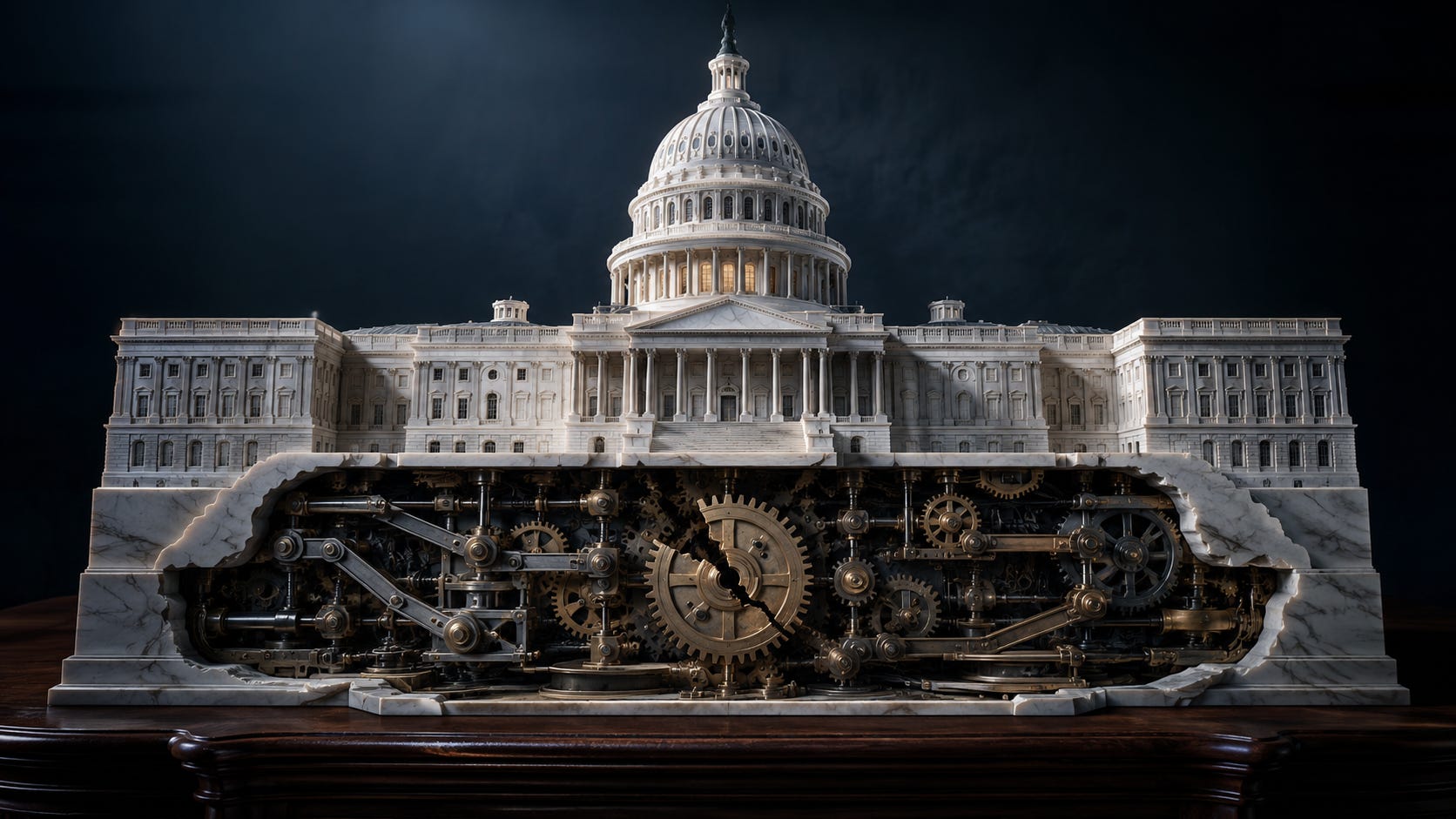
This morning I was driving my daughter to school, talking about my work — which, ask anyone who knows me, is pretty much all I talk about. I was explaining how the system of checks and balances we’re all taught about in school isn’t actually working. That it’s broken.
She didn’t miss a beat. “I get told a lot of things at school that aren’t true.”
A flash of pride — I’ve raised a critical thinker. Then she moved on to the problems that actually worry her. Climate change. Racism. Sexism. Unaffordable housing. Healthcare that costs more than people can pay. Food that keeps getting more expensive. Real problems. Urgent problems. The problems her generation is inheriting.
“I don’t understand why you’re concerned about that problem,” she said. “Those other things are the problem.”
I’ve been thinking about that conversation all day. Not because she’s wrong about the problems. But because she’s wrong about what’s underneath them.
Government Is the Operating System
Let me ask you something.
What do the following have in common?
The road you drove to work on this morning. The reason the food at your grocery store won’t kill you. The reason your neighbor can’t build a factory next to your house. The contract that makes your mortgage legally binding. The firefighters who show up when your house is burning. The reason the pilot of your flight had to prove they could fly before they were allowed to carry 200 people through the sky.
One thing: government.
Not government as ideology. Not government as a political team you root for or against. Government as infrastructure. As the operating system that society runs on.
Every problem my daughter named requires that operating system to solve. Not because government is perfect. Not because it’s efficient or trustworthy or free from corruption. But because it is the only institution on earth with the scale, the authority, and the democratic mandate to address problems that affect everyone.
Markets can’t do it. Markets are accountable to capital, not citizens. They solve problems that are profitable to solve and ignore the rest. Affordable housing might be profitable, but more expensive housing is more profitable, and renting is even more profitable still. A health insurance market is designed to make healthcare profitable. Whether we want healthcare to be profitable is a policy question. But left to their own incentives, markets optimize for profit. When that aligns with people's needs, markets work beautifully. When it doesn't, profit wins. Every time.
Private organizations can’t do it. They lack the authority and the reach.
Individuals can’t do it. No matter how heroic, no individual has the mandate to act on behalf of 330 million people.
Only government has that mandate. That’s what government is for.
The Reagan Problem
I can already hear the objection.
“Government IS the problem.”
Ronald Reagan said it in 1981 and a generation of Americans absorbed it as if it were a law of physics. Government bad. Markets good. Get out of the way and let people be free.
It’s a seductive idea. And it’s not entirely wrong — government can be inefficient, captured, corrupt, and counterproductive. Reagan wasn’t wrong about the dysfunction.
He was wrong about the alternative.
Because there is no alternative at scale. The question was never government or no government. Every functioning society has government. The question has always been: what kind of government? And: accountable to whom?
When Reagan said government is the problem, he never answered those questions. He gestured at markets and called it freedom. But markets are not democracies. Markets do not represent you. Markets represent whoever has the most capital.
This isn’t an argument for bigger government. Even a small government conservative wants a bridge that doesn’t collapse and a court system that enforces contracts. When the operating system is broken, it doesn’t matter whether you wanted the lite version or the pro version. It is useless to everyone.
The dysfunction Reagan identified was real. The system he pointed to as the solution has the same problem, just less visibly.
If you want the problems my daughter named to get solved — if you want any large-scale societal problem solved — you need a functional government. There is no other institution capable of doing it.
So the question becomes: do we have one?
On Paper, the System Works
The foundational idea of American government — the one we all learned in school, the one that supposedly sets the United States apart — is checks and balances.
No single branch gets total control. Congress makes the laws. The president executes them. The courts interpret them. Each branch checks the others. Power is distributed. Accountability is built in.
And if you look at the Constitution, it’s all there. The mechanisms exist. On paper, the system works.
The problem is that paper mechanisms only function if the people operating them can actually use them — without being destroyed for doing so.
What Happens When Someone Tries
Consider Liz Cheney.
In January 2021, she voted to impeach Donald Trump following the attack on the Capitol. She believed it was her constitutional duty. She voted her conscience, upheld her oath, and represented what she genuinely believed her role required.
The paper mechanisms worked exactly as designed. A member of Congress exercised independent judgment to check executive conduct. That is precisely what the founders intended.
What happened next is what they didn’t intend.
She was removed from her leadership position. Party resources backed her primary challenger. She lost her seat by a landslide.
Now ask yourself: who faced consequences for that?
Not the party. In conservative circles, Liz Cheney is the villain. The traitor. The one who broke ranks. The Republican Party — the apparatus that orchestrated her removal, withdrew its support, and signaled to the entire conference that dissent would be punished — faced almost none of the heat. It stayed offstage. The mechanism stayed intact.
That is not an accident. That is how the system protects itself. The member absorbs the consequences. The party absorbs none.
Just to be clear: this is not a Republican problem. Cheney is the clearest recent example because the punishment was visible, fast, and unmistakable. But Democratic members face their own version of the same machinery — committee pressure, donor pressure, leadership pressure, activist pressure, and primary threats. Senator John Fetterman has faced his own version from the other side of the aisle — breaking with Democratic leadership on several issues brought donor backlash, media attacks from within his own coalition, and calls to primary him. The names change. The architecture does not.
And that is why members of both parties put the party first. The calculus is not complicated. It is completely one-sided.
Break with the party: you absorb everything. The primary challenge, the funding withdrawal, the public backlash, the career consequences. All of it lands on you personally. The party walks away clean.
Stay with the party: the party protects you. Funds you. Promotes you. Gives you committee assignments, access, influence, and the machinery of reelection.
There is no scenario where the party pays a price for disciplining you. And there is no scenario where you escape the cost of defying them.
That is not a choice between conscience and expedience. That is a system that has systematically eliminated conscience as a viable option.
Liz Cheney answered yes when she asked herself whether she was willing to end her career for this. Most members, faced with that question every single day on every single vote, make the rational choice. They choose survival.
We direct our anger at those members. At the cowardice, the cynicism, the careerism. But the party — the entity that designed and operates the punishment mechanism — stays out of frame.
We are angry at the people the system produces. We never look at the system producing them.
Here’s the System
In 1970, Congress passed the Legislative Reorganization Act. The intent was genuinely democratic. Powerful committee chairs were making deals behind closed doors. Citizens couldn’t see how their representatives were actually voting. Organized interests — lobbyists, party leaders, wealthy donors — were always in the room, whispering in ears, shaping outcomes before any public vote was cast.
The fix seemed obvious: make it public. Record the votes. Sunlight as disinfectant. Transparency as accountability.
The reformers knew that organized interests would be watching. That was part of the point — drag the backroom dealing into the light where everyone could see it.
What they didn’t foresee was how catastrophically the timing would play out.
Before the reforms of the early 1970s, many congressional decisions were harder for outside actors to monitor in real time. Recorded votes existed, but they were more cumbersome, less comprehensive, and less immediately usable as political data. The reforms changed the operating environment. Congressional behavior became easier to track, score, and punish on a scale that hadn’t been possible before.
The problem wasn’t that the public could see. It’s that the public doesn’t watch every committee vote — but lobbyists do. The transparency meant to empower the citizen in the armchair handed a systematized weapon to the special interest with the spreadsheet.
And even if citizens watched every single vote — which they don't and can't — they would still have no recourse until the next election. Two to six years away. The special interest with the spreadsheet acts tomorrow.
Not because anyone planned it that way. Because that’s what the incentive structure produced, automatically, once the mechanism was in place.
What the reforms created — without intending to — was the infrastructure of party discipline that Liz Cheney ran into fifty years later. The machine that destroyed her career wasn’t built to destroy her specifically. It was built to make every member of Congress legible to organized power on every vote, every day. Parties, donors, lobbyists, advocacy groups, and primary challengers could now monitor legislative behavior with far greater precision. She just happened to be the one who refused to comply.
The Question Nobody Asked
The reforms made members of Congress more accountable to their parties. That part was intentional. It was even celebrated — finally, a way to hold legislators to account, to create consequences for backroom dealing, to connect votes to outcomes.
But nobody asked the next question: who are the parties accountable to?
The official answer — the civics class answer, the answer the political establishment still argues — is that parties are accountable to voters. Parties aggregate citizen preferences, compete for votes, and the winning party governs. Accountability flows from citizens through parties to government. That’s the theory.
Here’s the problem with the theory.
Parties respond to many voices — activists push platforms, media ecosystems shape narratives, primary electorates can unseat incumbents. Those forces are real. But they all operate within a binding constraint: money. Parties need it to survive. To recruit candidates, run campaigns, build infrastructure, fund the machinery of modern politics. And the people with the most money to give are not ordinary citizens. They are corporations, wealthy individuals, and organized interests.
When activist pressure conflicts with donor interest, donor interest tends to win. Activists shape the platform. Donors set the floor. And ordinary constituents — the people the whole system is supposed to serve — enter the process after the menu has already been decided.
This is not a conspiracy. Nobody needs to issue orders. Nobody needs to make phone calls with explicit instructions. The influence is structural and implicit. A party that consistently disappoints its major donors finds its funding dries up — not because of any single decision, but because money flows naturally toward parties and candidates that advance donor-friendly positions. No bribery required. No explicit quid pro quo. Just the predictable behavior of capital seeking favorable conditions.
We have watched enormous sums flow into both parties for decades. It has happened right in front of us. We just never connected the dots.
The reforms of the 1970s didn’t just strengthen parties. They created a direct line from concentrated wealth to legislative outcomes — without anyone having to bribe a single member directly. The party became the intermediary. Clean, efficient, and nearly invisible.
So the actual accountability chain looks like this:
Members are accountable to parties. Parties are accountable to the coalitions that keep them alive — donors above all, but also activists, media ecosystems, and primary electorates. Ordinary citizens enter the process late, after the menu has already been shaped.
That is not democracy. That is a system that wears democracy’s clothes.
The Compounding Problem
This would be serious enough on its own. But there is a second force making it worse.
Our voting system — single-member districts, plurality elections, winner-take-all outcomes — strongly pressures politics toward two dominant parties. This is not just a cultural habit. It is a structural tendency of the rules themselves. Third parties cannot gain a foothold. Voters who might prefer a different option vote strategically for the lesser of two evils — because in a winner-take-all system, a vote for a third party isn’t really a choice. It’s a math problem with a bad answer.
The result: 330 million people with genuinely diverse values, priorities, and beliefs are forced into a binary choice.
You are not really voting for what you want. You are voting against what you don’t want.
Even the wealthy are caught in this trap. They didn’t design the binary any more than the rest of us did. They simply navigate it — funding whichever party is least threatening to their interests, sometimes both simultaneously as insurance. The system shapes their behavior too. Nobody is outside it.
And when only two parties exist, and both are accountable primarily to donors rather than constituents, the diversity of a nation disappears into a forced choice that represents almost no one fully.
This is what gridlock looks like from the inside. Not two parties fighting to solve problems. Two parties fighting for dominance — because in a binary system, dominance is the only prize that matters. When one party controls Congress, the presidency, and the judiciary, the primary check on executive power — the one the framers designed Congress to provide — renders itself meaningless. Because party loyalty trumps all.
We were not supposed to end up here.
Why Every Other Reform Will Fail
You have a favorite reform.
Campaign finance. Term limits. Ranked choice voting. Insider trading bans. Ethics enforcement. Anti-corruption legislation. Transparency requirements.
These are not bad ideas. Some of them are genuinely good ideas. This is not an argument against any of them.
This is an argument that none of them will fix the actual problem.
The actual problem is that the system incentivizes party loyalty above institutional duty — and that reduces checks and balances from safeguards to speed bumps. The mechanisms still exist on paper. But when the same partisan incentives dominate every branch, the guardrails stop acting like guardrails.
Campaign finance reform passes. Members still face the same party loyalty calculus on every vote.
Term limits pass. Fresh faces arrive and within weeks learn the same calculus every member before them learned.
Ranked choice voting passes. Voters may get better choices at the ballot box — but unless it changes the incentives members face once in office, party discipline reasserts itself.
A fully enforced insider trading ban passes — one with real teeth, real penalties, real prosecution. The next morning every member still faces the same choice: vote with the party or end your career.
Think for a moment, about what that means.
When party discipline is total — when every member faces the same calculus, the same consequences, the same survival logic — the individual characteristics of the member stop mattering. It doesn't matter if they're brilliant or mediocre, principled or cynical, a thirty-year veteran or a first-term freshman. The machine processes them all the same way. You are not sending a representative to Washington. You are sending a placeholder for a party position. The seat matters. The person in it, less than we'd like to think.
None of those reforms touch the incentive structure. They are constraints on the edges. The core remains intact.
Even if a reform miraculously makes it to the floor and miraculously passes the vote, it’s still not going to fix the thing that matters.
We know this because we have watched it happen. Congress passed landmark legislation to prevent members from trading on insider information. Both parties. Celebrated. The political pressure was real and Congress responded to it.
A year later, Congress quietly narrowed the law’s disclosure requirements. Enforcement remained weak. The penalties for violations remain nominal. Criminal enforcement has been vanishingly rare.
But here is the part that gets missed: even a fully enforced version of that law would not have changed a single party-line vote. It is a constraint on personal enrichment. It has nothing to do with the calculus that destroyed Liz Cheney’s career. Nothing to do with the incentive structure that makes gridlock the system’s default output. Nothing to do with the gap between what citizens want, nay need, and what Congress produces.
The machine absorbed the reform. Incorporated it as a minor constraint. And kept running.
This is what the system does. Public pressure builds. Congress passes something. The pressure dissipates. The machine restores its preferred state. For decades.
Could the parties decide to fix this themselves? In theory. But they have shown no inclination to do so. Quite the opposite. The incentive structure rewards them for not trying.
There is no other reform on this list that opens the door to checking executive power. There is no other reform that creates the conditions for the kind of compromise that ends gridlock and prevents government shutdowns. There is no other reform that gives members the genuine option to represent their constituents over their party.
That is not one reform among many. That is the precondition for any other reform to mean anything.
That is what The Statecraft Blueprint is here for.
To restore the system of government the framers designed. To restore the checks and balances that are supposed to set America apart.
And maybe the next time my daughter is told how her government works — it might actually be true.
Updated Thu May 7 2026, added ‘party discipline is total’
I am not sure but I think I may see this slightly differently. Yes, party loyalty is huge. But it has always been huge. What changed is the weakness of the party structure itself, so one is loyal to an organization that itself has little authority. The parties are merely the consiglieres who carry out the orders of the interests that really control them. A strong party system would have kicked Trump out, certainly in 2024 or maybe even in 2016. He would have been a footnote to history not unlike a Ross Perot or a George Wallace. But because of the weakness of the parties, a populist like Trump can prevail and become President. And he can run his party like a mob boss from thereon, because there is nobody strong enough to push back when the boss has gone too far.