

Legislative Servitude was the very first essay I published on The Statecraft Blueprint. I’ve learned a lot since then—about how to structure these pieces, about leading with solutions instead of dwelling on problems, about the learned helplessness that makes people check out before they reach the hope. The original needed a rewrite. This is that rewrite.
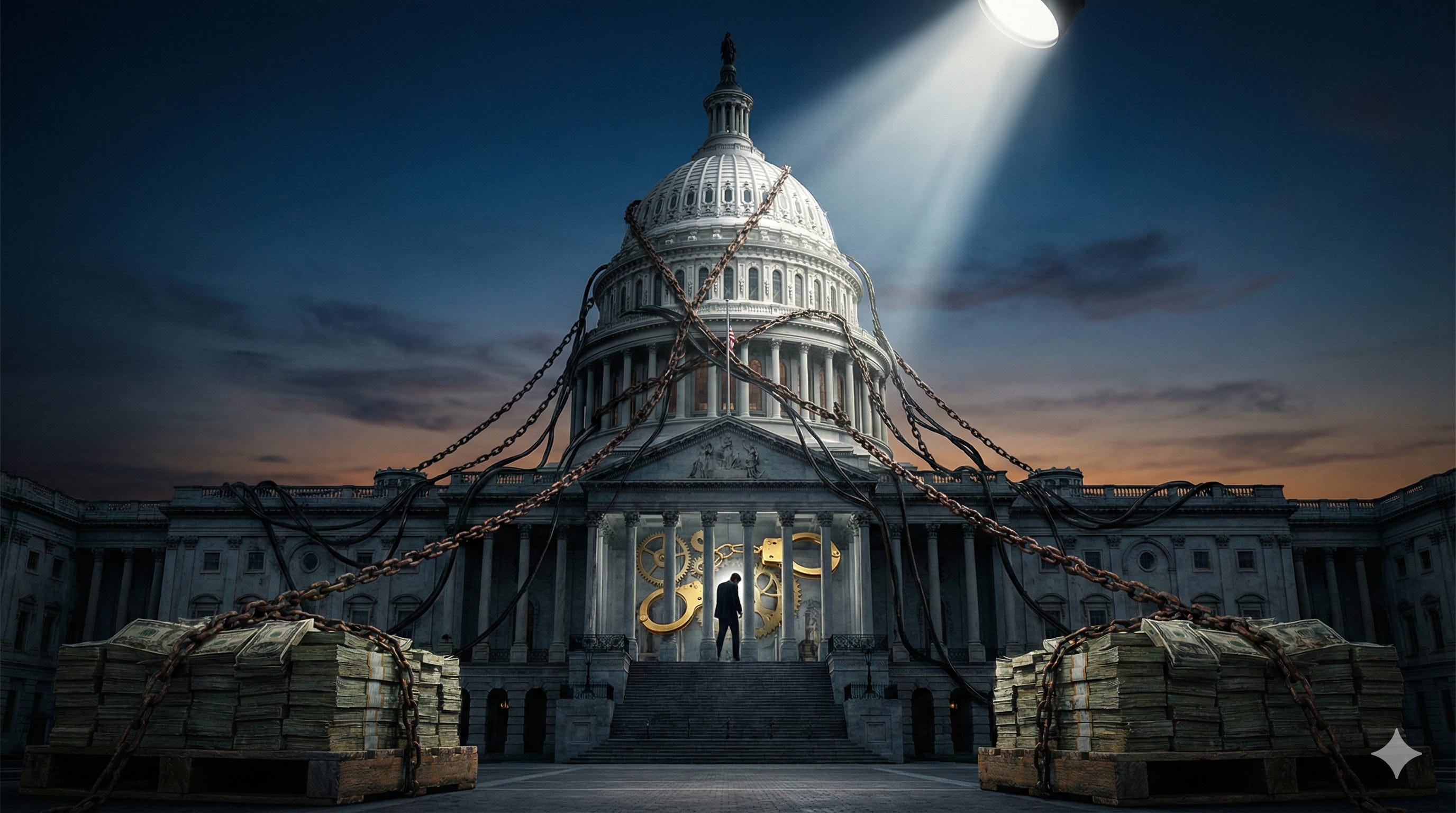
Imagine you’re a freshman representative. You ran on healthcare reform—that’s why your district sent you here. Today, a bipartisan committee bill to reduce prescription drug costs hits your desk. Exactly what your constituents need.
Your morning starts at the party call center across the street from the Capitol. Leadership expects 30 hours a week of fundraising calls. “Your job,” they told you during orientation, “is to raise $18,000 a day.” Not legislate. Not serve constituents. Dial for dollars. That’s your first responsibility.
Between calls, your legislative director briefs you on the healthcare bill. It’s 400 pages of pharmaceutical regulations, patent law, and pricing mechanisms. Your staff of four policy people—covering healthcare, defense, agriculture, tech, and everything else—hasn’t had time to fully analyze it. But a lobbyist from PhRMA stopped by yesterday with a 50-page summary. Professionally researched. Tabbed and highlighted. The only comprehensive analysis you’ll see before the vote.
The lobbyist was helpful. Friendly. She used to work for the committee chair—left two years ago for a K Street firm paying four times her government salary. Your own senior staffer has coffee with her old colleagues monthly. Everyone knows the path: serve your time, then cash out. The pharmaceutical lobbyists aren’t adversaries to scrutinize. They’re future employers to impress.
The bill comes up for a committee vote. You know it would help your constituents. But PhRMA contributed $200,000 to your campaign. And here’s what you’ve learned about transparency: every vote you cast becomes public record, and that record is a weapon.
Within hours of a “wrong” vote, tracking systems flag the deviation. Opposition researchers start building your primary challenger’s file. Party leadership signals you’ll lose your committee assignment. A well-funded opponent materializes within weeks.
You vote yes, for your constituents? Funding stops. Career ends.
You vote no, for your survival? Your constituents pay more for medicine. But you’re still here next term.
This isn’t corruption. No one handed you a bag of cash. This is something worse: structural coercion. The transparency that was supposed to protect citizens has become the weapon used to control their representatives. The fundraising demands leave no time to develop independent judgment. The information pipeline runs through lobbyists. The career incentives point toward K Street. And the public vote record is the compliance mechanism that ties it all together.
Legislative servitude is the result.
This isn’t one bad day. This is every day. Every member of Congress faces these pressures hundreds of times per session—on climate policy, financial regulation, defense spending, tech oversight. The specifics change; the trap doesn’t.
I’ve been thinking about Congressional dysfunction for over a decade. These three reforms—independent expertise, a blocked revolving door, and protected deliberation—would do more to restore Congress than any election in your lifetime.
Here’s what would actually break it.
Three Chains, Three Keys
Chain #1: Information Captivity
Right now, Congressional offices are hopelessly under-resourced. Average staffers handle 5-10 major policy areas simultaneously. Complex legislation on derivatives, pharmaceutical patents, or AI regulation often exceeds available expertise.
Guess who fills that void? Lobbyists. They provide perfectly researched analysis—aligned perfectly with their clients’ interests. Legislators become informationally dependent on the people they’re supposed to regulate.
The key: Triple the Congressional Research Service budget from $118 million to $350 million annually. That’s 0.006% of the federal budget—equivalent to 2.5 F-35 jets. Add 500 senior policy analysts. Increase committee staff budgets 40%. Establish competitive salaries so career policy specialists don’t flee to K Street.
Why it works: When legislators have independent expertise, they don’t need lobbyist-provided research. The informational capture mechanism breaks. Decisions get made based on analysis from people who work for Congress, not people who work for pharmaceutical companies.
International comparison: The U.S. Congress, despite being larger and more complex than most legislatures, has research capacity roughly equivalent to much smaller democracies. The UK Parliament’s House of Commons Library, adjusted for population, would be equivalent to $250 million for the U.S. We’re not asking for something unprecedented—we’re asking to catch up.
Chain #2: The Revolving Door
More than 60% of former members of Congress become lobbyists—up from 3% in 1974. The staffer-to-lobbyist pipeline is even worse. A decade-long Congressional aide earning $120,000 can command $300,000-$600,000 as a lobbyist.
This creates structural capture before anyone takes a bribe. Staffers drafting healthcare legislation understand pharmaceutical lobbyists might be their supervisors within 18 months. The revolving door doesn’t require corruption—it manufactures it automatically through career incentives.
The key: Extend cooling-off periods from 1 year to 5 years for senior staff and members. Increase Congressional salaries 40% to reduce departure incentives. Establish criminal penalties and lifetime lobbying bans for violations.
Why it works: When the path from Congress to lobbying is blocked, staffers treat lobbyists as people to scrutinize rather than future employers. When salaries are competitive, talented people stay in public service. The revolving door isn’t inevitable—it’s a design choice we can unmake.
Precedent: The military already restricts officers from working for defense contractors for years after service. We apply this logic to national security. Why not to legislation?
Chain #3: Weaponized Transparency
Here’s the counterintuitive one: the transparency meant to protect you has been turned against your representatives.
Within hours of any vote, sophisticated tracking systems flag deviations from expected patterns. Opposition research teams activate. Primary challenges materialize. A healthcare vote against pharmaceutical interests triggers funding elimination and election threats within weeks.
Citizens get secret ballot protection from coercion. Legislators face no such safeguard. Every vote enables surgical reprisal.
The Constitutional Convention of 1787 operated in complete secrecy, allowing delegates to change positions without fear. Private deliberation protects jury integrity, Federal Reserve decisions, and corporate boards. Why not Congress?
The key: Institute private ballots for procedural and committee votes while maintaining public voting for final passage. Individual votes would be encrypted and sealed for 10 years; aggregate results published immediately. This is constitutional—Article I, Section 5 grants Congress authority to determine its own rules.
Why it works: When legislators can deliberate without immediate reprisal, they can actually change their minds. They can compromise. They can vote their conscience on procedural matters while remaining accountable for final outcomes. The public record still shows how they voted on the bills that became law—just not on every internal procedural maneuver.
“But How Do We Hold Them Accountable?”
The immediate objection: without vote transparency, how do we know if our representatives are doing their jobs?
This assumes current transparency creates accountability. It doesn’t.
A gun control vote against restrictions could reflect genuine constitutional beliefs, district opposition, NRA threats, or party unity negotiations. The public can’t distinguish motivations. We see the vote; we don’t see whether it served the public interest.
Real accountability flows from outcomes: healthcare costs, infrastructure quality, economic growth. These measurable results survive private committee voting unchanged. Poor-performing representatives lose reelection regardless of whether we tracked every procedural motion.
“But isn’t it dishonest for them to say one thing publicly and another privately?”
Here’s the uncomfortable truth: they need both arenas. Deliberation requires space to change your mind, float compromises, and admit uncertainty—without those positions being weaponized before the conversation is finished. Public communication requires clarity and commitment.
This isn’t dishonesty. It’s how every functional institution works.
Juries deliberate privately, then deliver public verdicts. We don’t call that dishonest—we call it necessary for justice. Corporate boards discuss options privately, then announce decisions publicly. The Federal Reserve debates monetary policy behind closed doors, then communicates policy clearly. Your own workplace probably has internal discussions that differ from external communications.
The dishonesty isn’t in having two contexts. The dishonesty is in pretending you don’t need both—and then watching legislators posture publicly because genuine deliberation has become impossible.
And here’s what total transparency actually produces: posturing that can never stop. Once a legislator takes a public position, backing down invites accusations of “flip-flopping.” Changing your mind based on new evidence—the thing we want representatives to do—becomes political suicide. So they don’t deliberate. They perform. They stake out positions early and defend them forever, regardless of what they learn. The transparency that was supposed to inform us instead guarantees we get politicians who can never admit they were wrong.
Right now, we get neither real deliberation nor authentic representation. Just constant positioning. Private procedural votes would give us actual deliberation AND public accountability on final outcomes. That’s not less honest. That’s more functional.
Empirically, total transparency hasn’t improved governance. Since 1970s reforms mandated complete disclosure, Congressional approval has fallen to 20%, legislative productivity has declined, fewer bills pass than ever, and polarization has intensified. If transparency produced accountability, we’d see opposite trends.
Why We Don’t Have This
These aren’t radical ideas. Expanded research capacity exists in other democracies. Revolving door restrictions exist in other sectors. Private deliberation exists in other institutions. So why doesn’t Congress have them?
Because the current system benefits those who would have to change it.
Lobbying firms don’t want Congress to have independent research capacity. Party leadership doesn’t want members who can vote their conscience. And the surveillance ecosystem that monetizes every vote—the opposition researchers, the PACs, the cable news outrage machine—they all profit from the current dysfunction.
This is why Congressional reform never comes from Congress. The players can’t change the rules of a game they’re winning.
What This Actually Is
This is governance architecture. Professional system design applied to institutions.
We have a Federal Reserve Chair because monetary policy is too complex and consequential to be made by legislators responding to election cycles. We have a Surgeon General because public health requires professional expertise insulated from political pressure.
Why don’t we have professional governance architects designing how Congress operates?
That’s the deeper question behind these specific reforms. I’ve shown you what I would build to fix Congressional dysfunction. But the real solution is establishing the capacity to do this kind of design work systematically—a Governance Design Agency that studies institutional dysfunction and proposes structural fixes, the way the Fed manages monetary policy or the CDC manages disease response.
You might prefer different specific reforms than the ones I’ve outlined. Fine. But we need some professional governance design. The alternative is what we have now: a system designed in 1789, running on hope and outrage, failing predictably.
The Choice
These reforms cost about $660 million annually. That’s 0.01% of the federal budget. The lobbying industry alone spends $4 billion per year. If expanded research capacity reduced lobby influence by just 10%, the return on investment is 17:1.
But the real cost of inaction isn’t financial. Legislative paralysis doesn’t stay stable. It erodes democratic legitimacy. It creates openings for strongman appeals. “I alone can fix it” becomes attractive when normal governance visibly can’t.
The blueprint exists. The precedents work. The question is whether we’ll use them.
Congress won’t reform itself—the incentives are wrong. This requires citizen demand. It requires making structural reform a voting issue. It requires building political will for the kind of governance architecture that other democracies take for granted.
We can do this. The solutions are engineering, not revolution.
The choice is ours.
This is what governance architecture looks like: identifying structural failures, designing specific solutions, showing the work. Not waiting for better politicians. Building better systems.
Right. I get that. But is it that people don't think the system can be fixed, or that they just don't have the bandwidth to take that on? Or that this would take a long time to do, but they're focused on putting out fires? Also, which people? The public or the insiders? Do you envision this as something grassroots activists can promote to their own legislators, or what? Can you identify actionable steps?
Several thoughts come to mind.
Who has oversight of independent agencies, or do they by definition not have oversight? I see how you're trying to incentivize truth based on source of income. Freeing members of Congress to deliberate privately and giving them internal research support sound like great ideas that should have been happening a long time ago.
This reminds me vividly of a psychology study I read about (unfortunately, I have no memory of where) showing that jurors were more likely to base their deliberations on facts and evidence when they were allowed to review a case alone. The dynamics of having to discuss a case with other jurors influenced the outcome. I'm not surprised, because we've all seen how people behave in groups. There's always a guy who's the loudest person in the room, for example. Long story short: social influence is huge, especially in a closed system. If studies haven't been done by, I dunno, marketing companies, about the dynamics of differently sized groups, they should be done by the agency you're proposing for the purpose of improving operations.
Another study of interest was about packaging design. I mention this because again, the physical environment impacts our behavior. People sense this intuitively, but in our suck-it-up culture, brush it off as insignificant. It matters in: schools, prisons, hospitals, public parks & streets, libraries, our homes. It's already well known that circles and ovals on packaged food items attract us. But this particular case involved testing alternative design for a deodorant. Different color options were presented to people who were willing to try the product for free. Blue, Orange, and some other color. Same product, different container. The people who used the product when it came out of an orange container reported the deodorant gave them a rash. The ones who got theirs from a blue container said it worked well and they like it. For the third color, the response was that the product was not effective. The general concept was that for most practical purposes, the packaging is the product, and in a visceral way.
I feel like way too little is known by the right people for the right reasons about how human beings fundamentally work. This is an important area of study, but "the market" only incentivizes inquiry when profit is on the horizon. What a waste of human intelligence.