

Most people view rules as constraints. Cross this line, hop this fence, and you will face a consequence. That’s the mental model most of us carry around without ever examining it.
That’s not how I see the world. Let me take you on a road trip.
I live in Utah — high desert, semi-arid steppe. Mountains with trees, but a lot of it is wide, flat terrain where you can see for miles without obstruction. Outside of metropolitan areas, Interstate speed limits run at 80 mph. Don’t drive in the left lane at that speed, though. You’re going to get passed.
There’s a reason for that, and we’ll get to it.
A few years ago I traveled to Switzerland. Dramatically different. There are very few wide, flat places in the Swiss Alps. The mountains are steep, the valleys narrow. Roads wind back and forth, up and down, and sometimes directly through the mountains. You have to be on your toes while driving there. I actually found the posted speed limits to be artificially high.
The physical differences are stark. Utah: long straight highways, wide shoulders, obstructions set far back from the road. Switzerland: narrow or nonexistent shoulders, trees and rocks and buildings right against the road.
These feel different when you’re driving. In Utah, you can spot something in the distance and it seems to take forever to reach it. In Switzerland, you have no idea what’s waiting over the next hill or around the next bend — and because obstructions crowd the road’s edge, you can feel your speed in a way Utah never demands.
That uncertainty changes how you drive. You slow down — not because a sign told you to, but because the environment demands it. Driving back to Geneva I passed through Chamonix, France, came around a blind bend, and found a car that had struck a rock face and careened sideways into the road. It was still sliding when I came around the corner.
Nobody posted a sign for that. The road taught me.
Here’s what this road trip illustrates — and it requires a subtle distinction most people miss.
When someone in Utah drives 84 mph, a lot of people would say: that’s a law-breaker. And technically, they’re right. But here’s the more interesting question: how fast would they be driving without the speed limit sign? Probably faster. The sign shaped their behavior. They weighed the risk of a ticket against the open road ahead and settled at 84.
That’s not a constraint. That’s a calculation.
A true constraint would be a speed limiter — a device built into the car that prevents exceeding a set speed. The car physically cannot go faster. The behavior isn’t shaped. It’s blocked.
The speed limit sign doesn’t block anything. It changes the environment just enough to alter the calculus. The driver still chooses. The rule just changed what the choice costs.
This distinction — between rules that shape behavior and mechanisms that constrain it — is the foundation of everything at The Statecraft Blueprint.
In Utah, the rule is fighting the environment. The road says go fast — wide lanes, flat terrain, long sight lines, everything your instincts tell you is safe. The sign says slow down. They’re in conflict. So the rule has to be enforced externally. Hence the Highway Patrol. You’re not slowing down because the environment shaped your behavior. You’re slowing down because you’re calculating the risk of a ticket.
In Switzerland, such conflicts are fewer. The road and the rule are the same thing. The environment already communicates what safe behavior looks like. The speed limit sign isn’t fighting anything — it’s just confirming what the road already told you.
This is how I see every rule. Is it a posted sign fighting the environment? Or is it a description of an environment someone deliberately designed? One requires enforcement. The other just works.
Sometimes the rule is a sign. Sometimes it is a guardrail. Sometimes it is a toll booth placed directly in front of the road everyone claims to want people to take.
The question I always ask — whether I’m looking at a speed limit, a piece of legislation, or a Congressional procedure — is: which one is this? First: what is the desired behavior? Second: what behavior does this actually produce?
Road trip over. We’ve arrived at the destination.
This is why a former software engineer keeps going on and on about obscure, archaic procedural rules in Congress.
I know. What. A. Weirdo.
“I guess some of the ideas are ‘interesting,’ but aren’t there bigger problems facing our society?”
I tried to address this with my last essay, Every Other Reform Will Fail. I laid out exactly how Congressional rules punish lawmakers for voting against their party. After publishing, a thoughtful reader left this comment:
“I would add that somewhere along the way the incentive system stopped rewarding compromise in order to get things done and move the country forward.”
He even used the word incentive. And that showed me where I had failed: he still saw the rules and the incentive system as separate things.
The rules I was describing are the incentive system. That’s what I hadn’t yet figured out how to communicate.
So I started thinking about what I was missing. I’m neurodivergent. My brain processes the world differently — I see rules as messages, not fences. Someone put this here. Someone wanted a behavior. My first question is always: what is the desired behavior? My second question: what behavior does this actually produce?
Most people are taught to stop earlier. The rule says don’t cross the line. So the question becomes whether to obey or disobey.
But governance doesn’t fail because people disobey rules. It fails because rules often produce the exact behavior they were supposed to prevent.
Let’s apply this to Congress.
Congress’s job, by its very nature, requires compromise. You have 535 members representing wildly different constituents, different regions, different priorities. Legislation that actually serves the country means those members have to negotiate, give ground, find common cause. That’s not a bug. That’s the design.
Before the 1970s, when a bill passed, constituents had no reliable way of knowing how their specific legislator had voted. They had to take the member’s word for it.
The problem with that is obvious: democratic accountability requires voters to know what their representatives are doing.
The fix seemed equally obvious: record the votes and make them public. Sunshine as a disinfectant, they said — hence the Sunshine Acts. Now when bad legislation passes, voters can see exactly who supported it.
Reasonable. Sensible. Necessary, even.
None of this means the transparency reforms were stupid or malicious. They solved a real accountability problem. But they also changed the operating environment in ways the reformers did not fully account for.
Daniel Schuman from The First Branch Forecast helped me understand the missing layer: transparency didn’t only empower voters. Combined with the 1970s committee reforms, it also empowered parties.
The 1970s committee reforms made committee chairmen more accountable to committee members and more crucially to the party, which gained new powers to appoint and remove them. Transparency created political consequences for committee chairs who said they supported one action but took another. It also brought increased disciplinary tools for party members who dissented from the majority view of the party.
In other words, the reforms didn’t merely let voters see more. They also let parties punish more.
A vote is no longer just a vote. It becomes a record. The record becomes a weapon. The weapon becomes discipline.
Now return to the road.
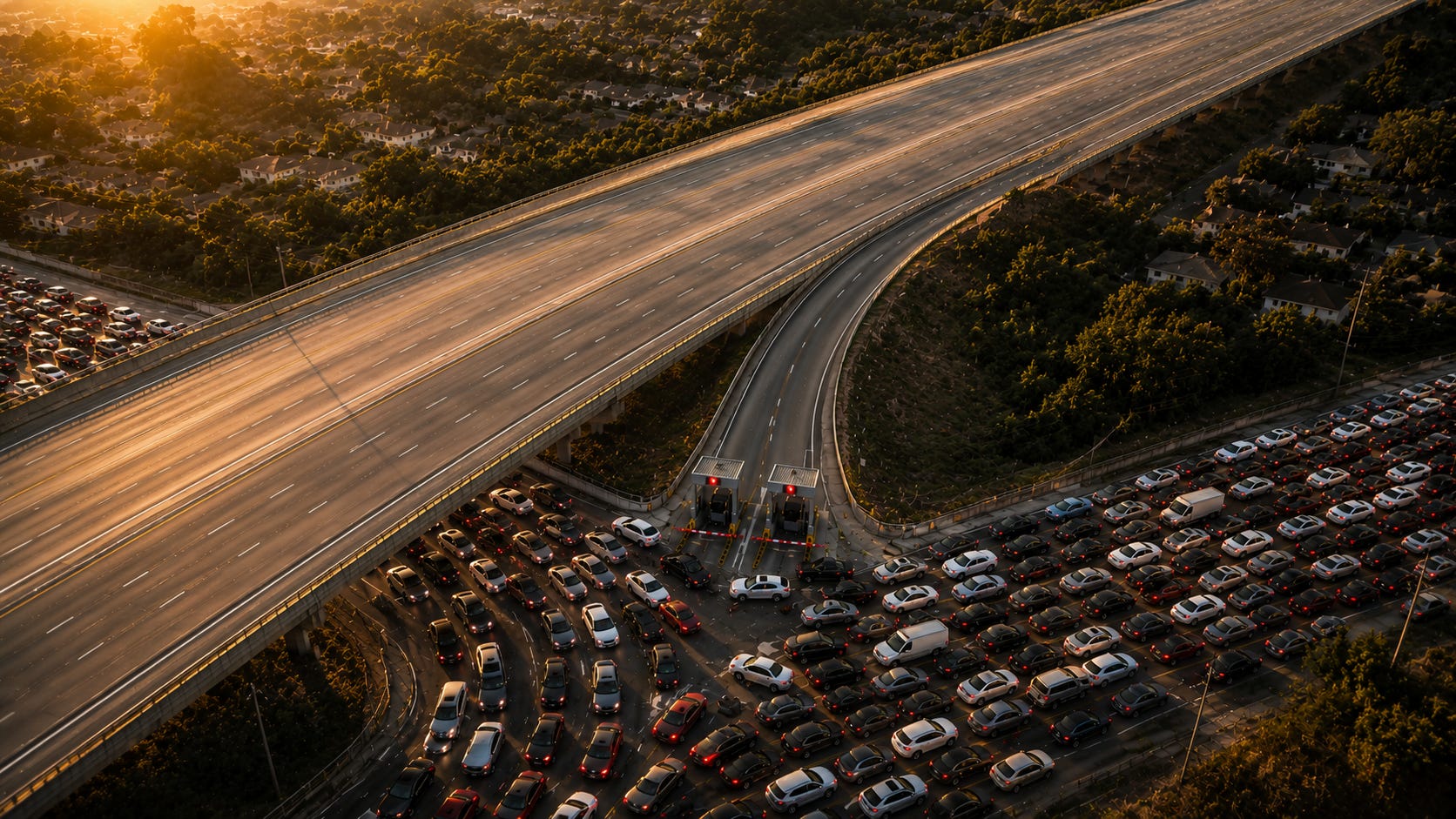
The reforms succeeded in one regard: they built a road to constituent service and democratic accountability — voters finally able to see what their members were doing, finally able to hold them accountable. But the disciplinary tools added a toll booth manned by party leadership. And the price of the toll? Your political career.
Most members look at that booth and turn around. Not because they don’t want to serve their constituents. Because the price is too high.
This is why election reform, term limits, etc. are dead on arrival. No matter who shows up, if the only road to serving constituents runs through that toll booth, their career is over the moment they try to use it.
This is why members of Congress don’t compromise.
This is why votes fall along party lines.
This is why anyone who steps out of line gets demoted, marginalized, and all too often, removed.
Not corruption. Not cowardice. Not moral failure.
Rational human beings responding to the environment they’re in. If you put a statesman in a system that punishes compromise, you get a politician who stops compromising. It’s not a character flaw. It’s physics.
No mystery. No villains required.
So what do we do about it?
We have a fifty-year-old road that almost nobody has used, because the cost of using it has always been too high. The solution is not to send different people to stand at the toll booth and make the same calculation their predecessors did. TSB’s solution is simpler: remove the toll booth.
The transparency reforms solved one problem — voters couldn’t see what their legislators were doing — while creating another: the moment a vote is cast, it becomes a disciplinary weapon available to party leadership in real time. That’s the toll booth. That’s what turned a risk calculation into a wall.
The Statecraft Blueprint’s proposal doesn’t eliminate transparency. It restructures when transparency happens.
Votes are still recorded. Members are still fully accountable for every vote they cast. But individual vote attribution isn’t made public until just before an election. Think of it as a legislative report card delivered when voters are actually preparing to grade their representative — the full record available before the election, when accountability matters most, but not available in real time as a weapon during the governing process itself.
The road is still monitored. Consequences still exist. But now it’s a risk calculation — not a toll booth. Some members will take the road. Some won’t. But for the first time in fifty years, the option exists.
And it restores something even more fundamental than compromise.
Congress’s constitutional role is to check executive power. That function has effectively been disabled — not by bad people, but by the road. Whatever one thinks of Liz Cheney, the mechanism matters: she deviated publicly, and the system punished the deviation. Any member who breaks with the party to check a president from their own side faces immediate, public, career-ending consequences.
How might the impeachment votes have gone if members had the option of voting their conscience without instant retaliation? How might the votes on war powers and the Iran conflict have gone?
We don’t know. Because right now, that option doesn’t exist.
Delayed attribution doesn’t guarantee members will use that space. But it gives them the option. And sometimes, having the option is the difference between a functioning constitutional republic and the performance we’ve been watching.
That is why this is not a civility problem. It is not a messaging problem. It is not a “send better people” problem.
It is a road-design problem.
And if the road is producing the wrong behavior, the answer is not another sign.
The answer is to remove the toll booth.
Every other reform eventually enters the same institution. And every one of them requires members to pay the toll to pass. One member paying the toll isn’t reform — they’re just gone, replaced by someone who won’t make that mistake. You’d need an overwhelming number paying simultaneously, enough that the party discipline apparatus can’t pick them off one by one. How many is that? Nobody knows. But it isn’t nominal.
Why would any individual member vote for reform when they could play it safe and let someone else go first? The tallest blade of grass gets cut. Everyone knows it. So everyone waits. And nobody moves.
Five hundred and thirty-five members — different parties, different districts, different values, different self-interests — coordinating a simultaneous act of collective career risk. Not impossible. But vanishingly unlikely.
Until we remove the toll booth, every reform faces the same problem: an overwhelming collective action problem, layered on top of a game theory problem, layered on top of a coordination problem that 535 people with different values and interests have never once solved voluntarily.
That is what The Statecraft Blueprint exists to change.
🔄 🔄 🔄 🔄 🔄 🔄 🔄
I largely agree. One point of disagreement: The leadership (toll booth) is massively corrupt in both parties IMO.