

Democracy Shouldn’t Require Heroic Effort
We have a strange expectation of American citizens.
We expect them to work, raise families, pay their taxes, and live their lives. But we also expect them to monitor their representatives, understand complicated legislation, evaluate competing claims, organize political pressure, and hold government accountable.
And when government doesn’t work, we tell them to get more involved.
More time. More attention. More effort.
The trouble is that meaningful participation in government requires resources most ordinary people don’t have. Understanding the rules, navigating institutions, discovering who’s responsible, and figuring out how to make something change can become a full-time job.
For some people, it is a full-time job. They work for organizations that can afford lawyers, lobbyists, researchers, and policy specialists.
Most Americans don’t have that luxury.
Democracy shouldn’t require heroic effort.
What if government were as easy to navigate as Google Maps?
Think about everything that happens when you ask Google Maps for directions.
Behind that simple request is an extraordinary amount of complexity: millions of roads, traffic patterns, construction projects, closures, legal restrictions, and countless possible routes.
You don’t need to understand any of it.
You tell the system where you are and where you want to go. It handles the complexity.
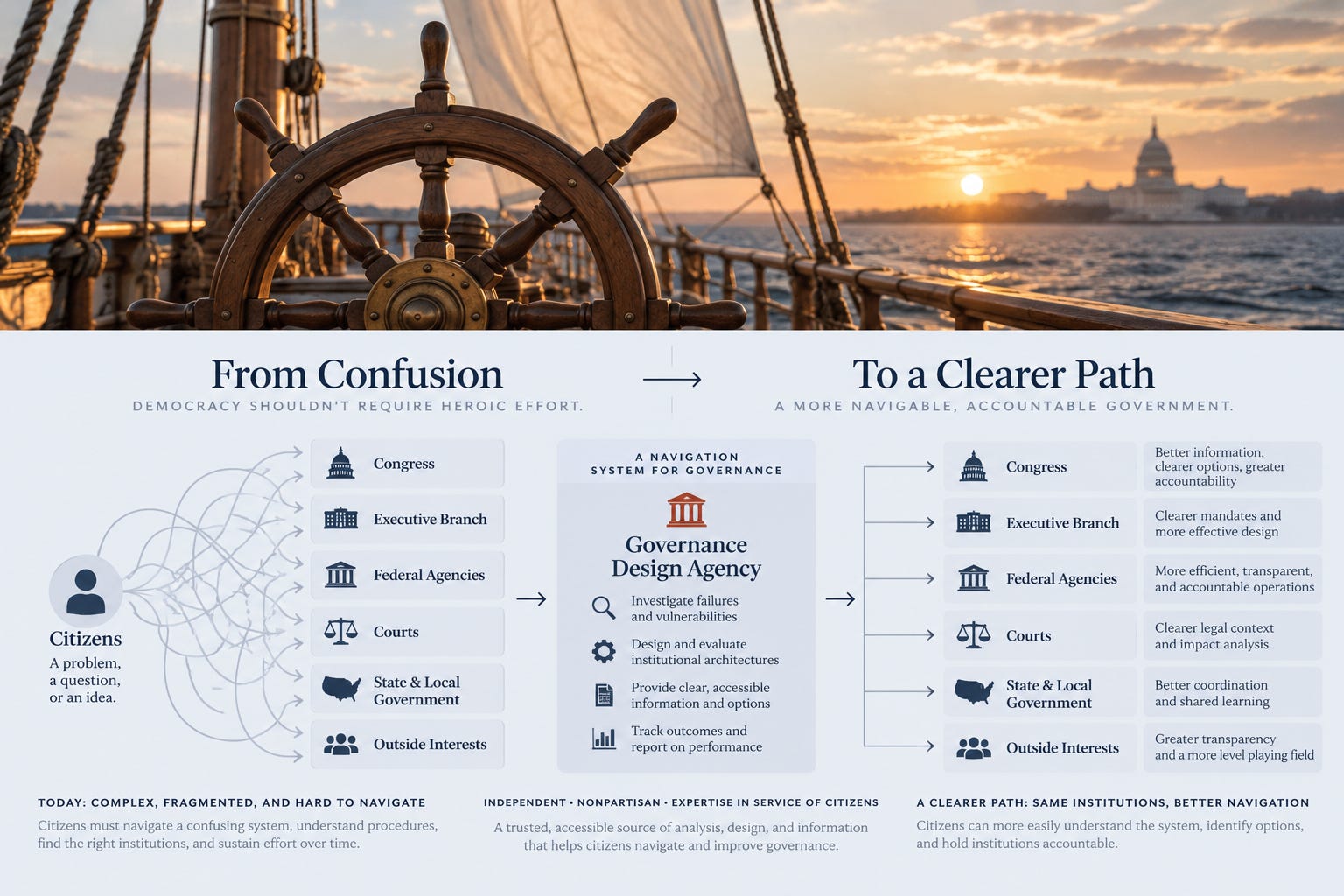
Now imagine approaching government the same way.
You encounter a problem with a law, a public program, or a government institution. You explain what’s happening, in ordinary language.
Instead of spending months learning which agency has jurisdiction, which statute controls its authority, which congressional committee has oversight, or what procedural mechanism might allow a correction, you have access to a system that helps you navigate those questions.
It identifies the responsible institutions, explains the available avenues for action, and helps connect your concerns to people equipped to investigate them.
And if the problem is part of a deeper institutional failure, there is a dependable process for examining that failure and developing possible corrections.
You don’t need to become an expert in government to participate meaningfully in it.
The complexity remains. The burden shifts.
That’s what The Statecraft Blueprint is working toward.
We’re investigating why government produces recurring failures, how institutional rules shape the behavior of the people operating them, and how those institutions might be engineered to work more reliably.
That work includes developing methods for investigating government failures, designing more dependable governing institutions, and exploring ways ordinary citizens could participate meaningfully without becoming professional political advocates.
It’s not about deciding which political party should win, which values citizens should hold, or what policies everyone must support.
It’s about designing the institutions through which those disagreements can be resolved and public decisions carried out.
We don’t need millions of Americans to devote more of their lives to managing government.
We need government that demands less of our lives to hold it accountable.
That’s the mission.
Everything else is engineering.