

Sean Lupton-Smith had spent a decade proving that American manufacturing could still work. Not as a slogan — as a business model.
He built Electric Bicycle Co. in California starting in 2014. Custom e-bikes, assembled domestically, components sourced from Taiwan, Japan, the Netherlands, and the United States. For years he’d been managing the reality of a global supply chain — carefully limiting his China-sourced parts, lobbying for tariff relief, watching what foreign competitors were doing to undercut him. He knew the landscape. He knew the pressures.
When the 2024 election came, he made a calculated bet. He voted for the candidate he believed would finally tip the scales for domestic manufacturers like him. The promise was simple: tariffs would punish foreign competitors flooding the market with cheap, unregulated imports. American builders would get their edge.
He wasn’t being naive. He was making the most informed decision he could, given everything he knew about his industry.
Then the tariffs landed — and they hit his own components. Parts climbed from 25% to 55% and kept going. He waited for the relief he’d been told would follow for domestic manufacturers. It didn’t arrive fast enough.
$6.1 million in liabilities. $953,000 in assets. Chapter 7 bankruptcy. The storefront in Huntington Beach is now a smoke shop.
His own words, after it was over: “I thought Trump would save the day.”
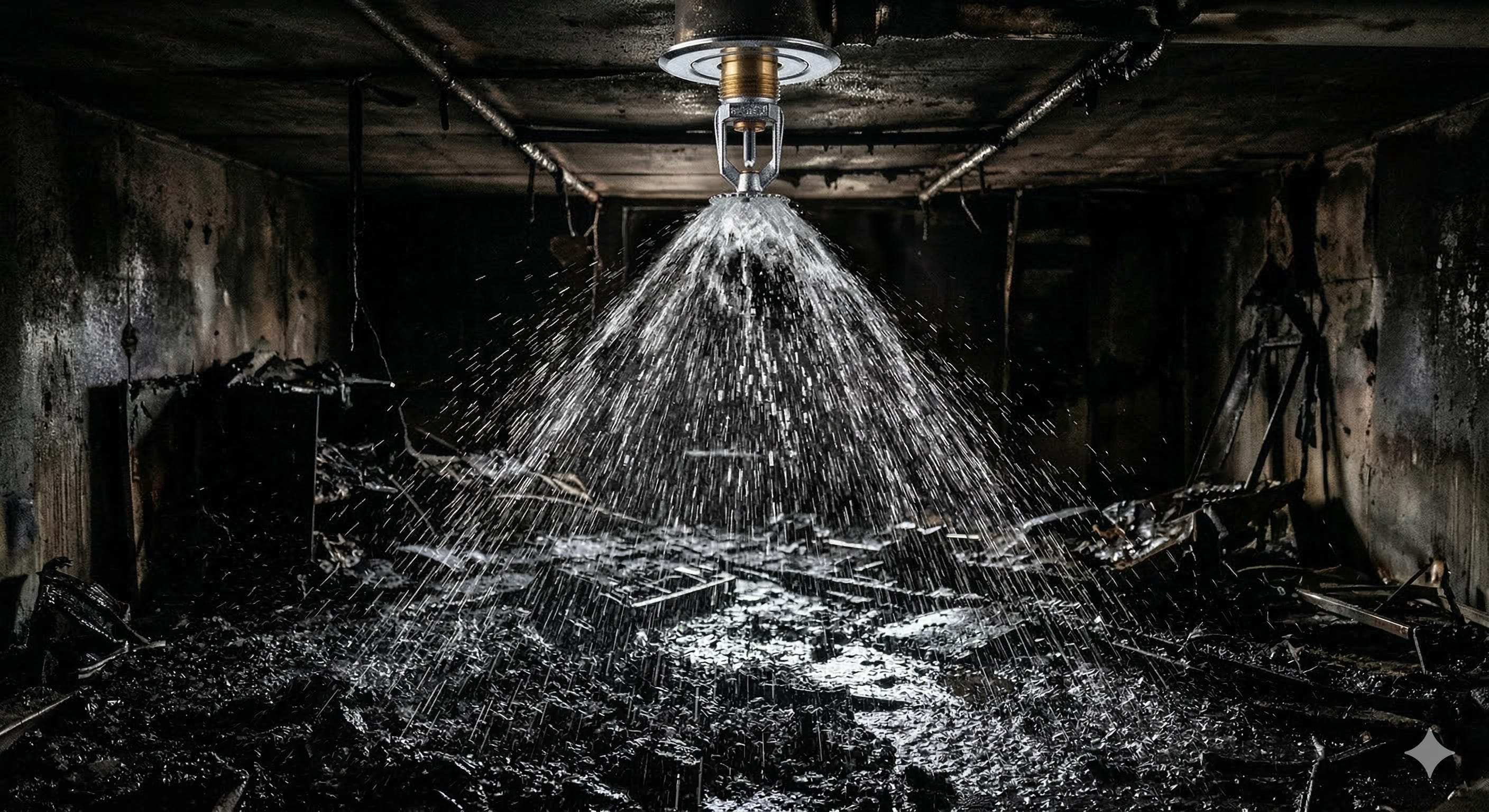
The Sprinkler Fired
Here is the part that should stop you.
The courts eventually pushed back on the tariff overreach. Judicial challenges worked their way through the system. Constitutional mechanisms engaged — exactly as designed. In the end, the correction mechanism fired.
Sean Lupton-Smith’s company was already gone.
Think about a sprinkler system. Its purpose is not to trigger after the room is fully engulfed in flames. Its purpose is to suppress fire before it becomes uncontrollable. A sprinkler that activates only after the building is a total loss has technically functioned. It has completely failed at its job.
The mechanism worked, and the damage is permanent. Both are true. And most of our political conversation has no way to hold them both at once.
The courts ruled the tariffs unlawful. And then: nothing. Under the doctrine of Sovereign Immunity, you generally cannot sue the federal government for lost profits due to a policy later found unconstitutional. No mechanism exists to return the money collected. No guidance from the judiciary on what happens next. The executive branch, asked how to reverse the damage, says it was never told how. Stalemate. Some businesses had absorbed the tariff costs. Some passed them on to consumers who are still paying higher prices on necessities. Some — like Sean — simply closed. The ruling arrived into a void. The building was already ash, and no one could agree on who was supposed to sweep up.
This is the fundamental problem with a purely reactive system. Correction assumes there is something left to correct.
The Serious Counterargument
I want to be fair to the other side of this, because it deserves a fair hearing.
I had a debate recently with Jack Jordan, a constitutional lawyer who writes at Black-Collar Crime. Jack’s argument was direct: the Constitution already contains everything we need. Prosecutors. Congressional oversight. Judicial review. Citizens who refuse to accept fraudulent rulings. If these tools were properly used, he argued, the system would work. The problem isn’t that we lack tools. It’s that we’re failing to use the tools we have.
This is not a stupid argument. Constitutional scholars make it. It has two hundred and thirty years of historical support behind it. And Jack is right — the mechanisms exist on paper.
Existing on paper and functioning in practice are two different things. A mechanism that depends on conditions that no longer hold is not a functioning mechanism. It’s a ghost of one. Here’s where the conditions have changed — three structural failures, not personnel failures:
The first problem is Congress. For most of American history, there was at least a functioning adversarial relationship between branches of government — not because everyone was noble, but because legislators had some institutional loyalty to Congress as an institution, separate from their loyalty to a party. The mechanism exists: Congress can check the executive. But that check requires members of the president’s own party to act against their political teammate. Today that means primary challenges, fundraising cuts, and political exile. The incentive runs entirely the wrong direction. A mechanism that requires Congress to check its own team is, for practical purposes, a mechanism that doesn’t function — not because the words aren’t in the Constitution, but because the conditions required for those words to do anything real have eroded.
The second problem is the judiciary. Federal judges are appointed by the president and confirmed by a Senate that is frequently controlled by the president’s party. The people whose institutional job is to check executive overreach were, in many cases, hand-picked by the executive they are checking. When courts rule against a president — and sometimes they do — they are ruling against someone who selected them. That’s not a conspiracy. It’s a structural design feature that creates obvious and real limits on how much checking the judiciary can reliably provide.
The third problem is citizens. The Constitution assumes an informed public capable of recognizing abuse and refusing to accept it. That’s not a cynical dismissal of citizens — it’s the founders’ own stated premise. But in an information environment where five competing narratives are running simultaneously — where the same event generates contradictory headlines before lunch — that assumption is doing a lot of heavy lifting. The detection layer the founders counted on is operating under conditions they never imagined.
Jack is answering a real question. It’s just not the right question. The right question is not “do the mechanisms exist?” It’s “do the mechanisms prevent irreversible harm?” And that is a different question entirely.
The 1789 Problem
In the tariff case, judicial review eventually functioned. The correction mechanism fired — exactly as designed. And Sean Lupton-Smith was already in Chapter 7.
This is the core failure — and it belongs to no one person. It’s a timing problem that didn’t exist in 1789.
In an agrarian society with horseback communication, damage accumulated slowly. A correction cycle measured in months or years was fast enough — the harm waited for the remedy. If a president overstepped, the effects rippled outward gradually. Courts could rule before the damage became irreversible. Congress could act before businesses closed and supply chains restructured and livelihoods disappeared.
In today’s economy, an executive order can collect tariffs, destroy supply chains, and restructure global trade relationships before a court challenge completes its first hearing. The damage doesn’t wait for the ruling. It distributes — into contracts, into inventory decisions, into business closures, into people’s lives — and once it has distributed, no ruling reaches it.
Damage speed and correction speed have diverged. The Constitution was built when they were the same.
Jack grades the system on process completion: did the mechanism fire? The right grade is harm prevention: did the mechanism stop irreversible damage before it occurred? In 1789, those were the same question. Today, they are not.
This is not a flaw in the Constitution. It is a change in the world the Constitution operates in. The design was right for its time. That’s exactly the problem.
You Cannot Bootstrap Your Way Out
The obvious answer is: elect better people. Put people in office who will actually use the mechanisms.
The structural problem with that answer is that the system selects for exactly the behavior we are seeing. Party loyalty over branch loyalty gets rewarded with support, money, and reelection. Acting against your own executive gets you primaried. This is not a character failure distributed evenly across all politicians. It is a rational response to the incentive structure — something I’ve written about in depth in Legislative Servitude and Legislative Servitude (Redux), and in The Patient Leader, which examines why the people who succeed in our political system are often exactly the wrong ones for improving it. The enforcers are inside the system. The judges were selected by the executive. The prosecutors serve under him. The legislators calculate their survival.
You cannot pull yourself up by your own bootstraps. Neither can a governance system with no correction layer outside the political pressures it is meant to check.
From Bucket Brigades to Sprinkler Systems
Here is the thing about the founders that gets lost in these arguments: they weren’t behind. They were the state of the art.
In 1736, Benjamin Franklin didn’t call the fire department when Philadelphia faced fire risk. He founded a volunteer fire company — because there was no fire department to call. George Washington served as a volunteer firefighter in Alexandria, Virginia. Colonial law required every household to keep two leather buckets by the door. When the church bells rang, citizens formed lines from the nearest well and passed water hand to hand.
The founders built the Constitution while they were still the bucket brigade. The correction mechanism was all there was — not because they lacked foresight, but because that was all there was. In 1789, you built with wood, brick, and stone. You fought fires with buckets and bells and neighbors. Prevention at scale was not yet a human capability.
The first widely recognized fully paid municipal fire department wasn’t established until 1853, in Cincinnati — sixty-four years after the Constitution. It came after devastating fires demonstrated that bucket brigades, no matter how well-organized, couldn’t prevent catastrophic loss once a fire reached a certain scale. And even then, professional firefighters were only part of the transformation.
The larger shift was building prevention into the architecture of buildings and cities themselves. Portland cement was patented in 1824. Reinforced concrete followed in the 1840s and 1850s. Steel-frame construction arrived in the 1880s. Concrete and steel don’t ignite the way wood does — but they’re fire-resistant, not fireproof. There were still fires. So the work continued: fire codes, egress paths designed into structures before anyone struck a match, smoke detectors, sprinkler systems, and running beneath all of it, municipal hydrant systems that guarantee water is available at every block — so when the bucket brigade shows up, there’s actually something to fill the buckets with.
We didn’t replace the fire department. We added layers. Bucket brigades saved buildings and lives. They were genuinely effective — when people knew where the fire was and could coordinate fast enough to reach it. But we stopped depending on them alone, because we learned enough about how fire spreads to build differently.
The Constitution still stands. It still does what it was designed to do. But it is a bucket brigade operating in a world that needs sprinkler systems — and that is not a failure of the founders. It is an inheritance they left for us to complete.
Three Layers. Three Timelines.
Right now — ring the church bells.
Bucket brigades were only effective when people knew where the fire was. That’s what church bells did. They weren’t firefighting equipment. They were the alert system that made the bucket brigade functional. Without them: individuals with buckets, no coordination, no idea where to run.
Right now, our governance bucket brigade has buckets. Courts. Congress. Civil society. The press. What it doesn’t have is a coordinated bell. Something that cuts through the noise, tells everyone where the fire is, how fast it’s spreading, and where to show up — before the damage becomes permanent.
Watch Duty is the closest analog we have. It’s a real-time wildfire tracking platform built by volunteers — active and retired firefighters, dispatchers, first responders — that synthesizes official data and human monitoring into a single coordinated alert system. It doesn’t fight fires. It makes the people fighting fires more effective by giving them coordinated, real-time information before the fire outruns the response. During the January 2025 Southern California wildfires, it was downloaded millions of times. People trusted it because it was structured, nonpartisan, and built around a single purpose: tell people where the fire is.
We need this for governance. A structured, coordinated platform — call it Church Bells — that tracks executive actions in real time, maps their impact as it distributes, and alerts citizens, journalists, legal organizations, and legislators when and where to respond before the damage becomes irreversible. Not ad hoc. Not informal. Built, maintained, trusted.
This is the TSB’s first concrete call to action. Church Bells needs to be built.
Here is what I know: the people who need to build it are not all the same person. Some of you reading this have technical capabilities — the ability to build systems that aggregate, track, and alert. Some of you have legal expertise. Some of you have organizational experience, or media connections, or money to fund the infrastructure, or simply the willingness to show up and do whatever work is needed. Church Bells will require all of those things. Not everyone builds the bell. Some people hang it. Some people ring it. Some people just make sure the church stays standing.
That conversation starts here.
This is not enough. I want to be honest about that. A better alert system doesn’t fix the underlying architecture. But it is what we have while we build the next layer, and it matters.
Medium term — use concrete, not wood.
The original checks and balances were designed around majority action — because the founders assumed that branch loyalty would motivate the majority to act against executive overreach when necessary. That assumption is gone.
Which points toward a counterintuitive design shift: give the minority real blocking power on executive actions specifically.
This feels wrong at first. Congress is already gridlocked. Adding more obstacles to anything seems like exactly the wrong direction. But there is a distinction that matters here: legislative gridlock — the inability to pass new things — is a different problem from executive overreach — the inability to stop things being burned down. Adding minority blocking power on executive actions does not make legislation harder. It makes unilateral executive action harder.
A president who knows the minority party can throw real structural roadblocks into emergency declarations, broad executive orders, or major trade actions has to calculate differently. The dynamic changes — not because people become more principled, but because the incentive structure changes.
What does this look like in practice? Emergency powers that automatically expire after sixty days without active congressional reauthorization — not passive acquiescence, but required affirmative support. A minority threshold — say, forty Senate votes — sufficient to trigger automatic independent review of executive actions with broad economic impact. Inspector Generals with removal protections that don’t route through the executive they are investigating. Economic impact disclosures required before executive orders with major market effects take effect, giving minority members standing to challenge before the harm distributes.
And one more that deserves its own sentence: executive orders should have to prove their constitutionality before they take effect, not after. An expedited judicial review mechanism — triggered automatically for any executive order with broad economic or regulatory scope — that resolves the legal question before implementation, not during it. This alone would have changed Sean’s story. The tariff question would have had to be adjudicated before a single dollar was collected. The legal battle would have happened on paper, not in the wreckage of closed businesses. This is not removing the president’s executive authority. It is placing a constitutional checkpoint before that authority distributes irreversible harm. It is the difference between stopping a fire at the match and fighting it after the building is gone.
None of these require members of Congress to be heroes. They create friction built into the architecture. The same way building codes create fire resistance without requiring anyone to be brave. You do not need heroic behavior. You need concrete walls instead of wood ones.
This slows the spread. It does not stop every fire. But it buys correction mechanisms time to catch up — which is exactly what failed for Sean Lupton-Smith.
Long term — the Governance Design Agency.
The long-term solution is a prevention layer built into the governance architecture itself. A professional body — insulated from the political pressures it monitors, the way the Federal Reserve is insulated from the electoral cycles it is designed to outlast — that can act on signals before the cascade, not just correct the record after. I’ve written the institutional and legal framework in detail here, and the foundational case for the agency here.
The sprinkler doesn’t replace the fire department. The GDA doesn’t replace Congress or the courts. It is the detection and prevention layer that gives correction mechanisms a fighting chance — designed by people whose job is governance architecture, not governance operation.
One more thing worth naming directly. I’ve had people tell me — including in the debate linked above — that my background in software engineering and systems analysis isn’t a qualification for this work. That without a formal degree in political science or constitutional law, I should defer to the experts. I understand the instinct. But there is no credential for governance architecture. No board, no licensure, no professional body — because it doesn’t yet exist as a formal discipline. Medicine has medical boards. Law has the bar. Engineering has licensure. There is no one to defer to.
Benjamin Franklin didn’t wait for a credentialed fire protection expert before founding the Union Fire Company. There was no such expert. He looked at the problem, applied the best thinking available, and built something. There were almost certainly people who said bucket brigades were good enough — that someone without formal training had no business proposing changes to how an entire city fought fires. The bucket brigade was not enough. I’m not asking you to take my word for it. I’m asking you to look at the problems, look at the proposed solutions, and decide for yourself whether they hold up. The field is being built from scratch, in public, and the blueprints are on the table.
Finishing What the Founders Started
Benjamin Franklin did not fail to build a fire department. No one had built one yet.
The founders built the best governance architecture the world had ever seen, for the world as it existed in 1789. The correction mechanisms they designed worked — for a world where damage accumulated slowly enough for correction to reach it. That they did not build a prevention layer is not a failure. It is an inheritance. Something left for the next generation to add, when the knowledge and the need aligned.
The knowledge and the need have aligned.
Sean Lupton-Smith’s company is gone. The damage that destroyed it was real, and the correction arrived too late to reach it. That is not a story about a bad president or a weak court or cowardly legislators. It is a story about a governance system operating at 1789 speed in a 2026 world.
The question his story forces is answerable: why did the correction arrive after the harm became permanent? The answer is a design problem. Design problems have design solutions.
We are not abandoning the Constitution. We are finishing it. The founders built for their world. That is exactly what we need to do for ours.
The Statecraft Blueprint is a governance architecture publication. If you found this useful, share it. The government loading ring is our symbol — a reminder that the system is not broken beyond repair. It is buffering. The next version is being built.

Your work deserves more comments and re-stacks. And probably also some folks willing to figure out how to take action toward implementing ideas. It can be hard to market around here though huh? I'm already kind of over substaxk marketing. =)