
Start Here
You’re Not Crazy. The System Is.
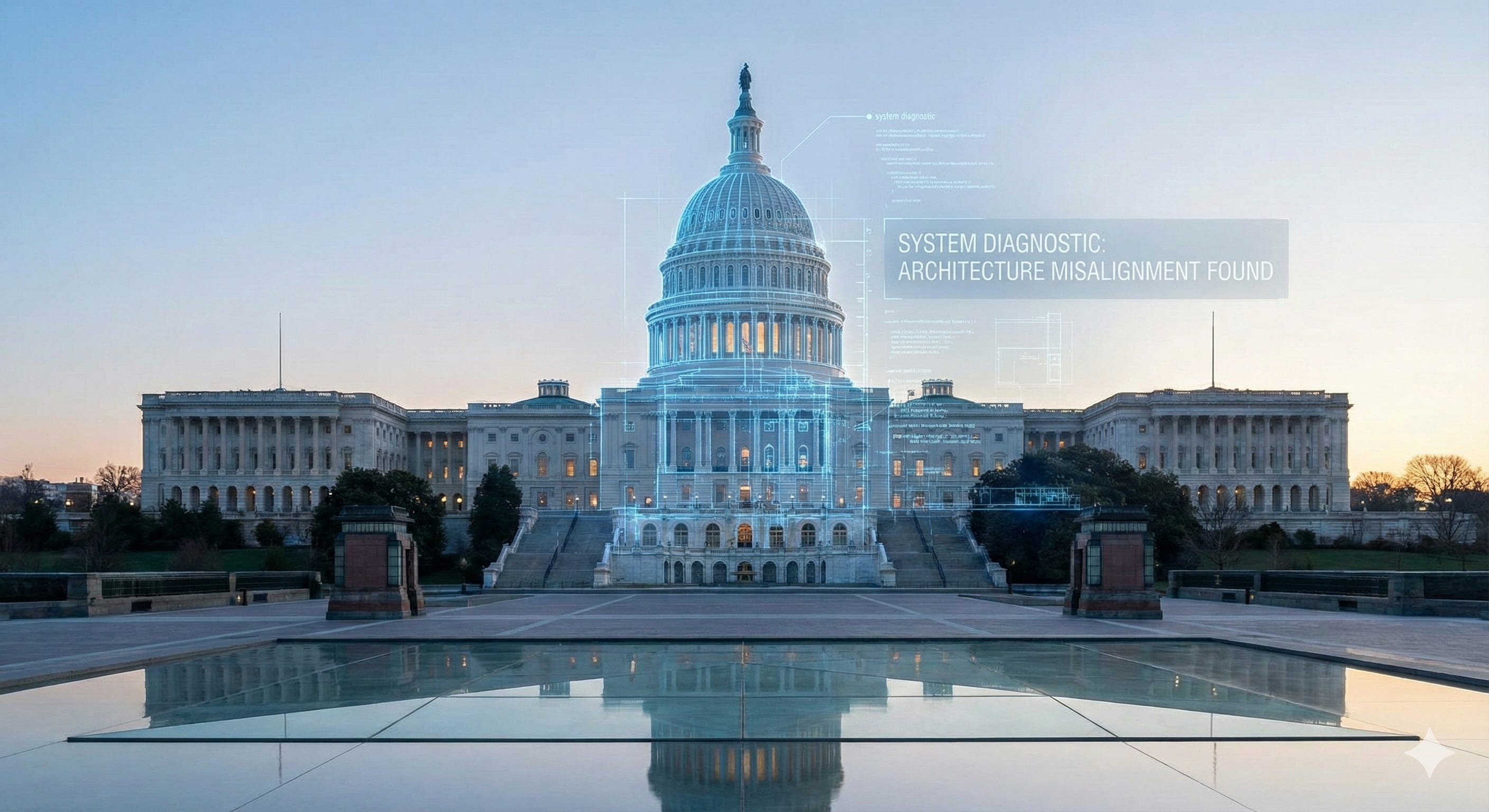
You’ve seen it. We all have.
Government shutdowns every few years. The same problems debated for decades with no resolution. Policy that whiplashes every four years, making it impossible for anyone—businesses, families, communities—to plan for the future.
And meanwhile, everyone’s yelling at you about which villain to be outraged at this week.
You’re exhausted. You’re overwhelmed. And you’ve stopped believing anything can actually change.
Here’s what nobody’s telling you: It’s not your fault. And there’s a fix.
This Is Solvable
The system isn’t mysteriously broken. It’s producing exactly the outcomes its architecture was designed to produce—for 1787.
Thirteen agricultural states. Four million people. Communication by horseback. A federal government with limited responsibilities.
That design can’t handle 335 million people, instant global communication, AI regulation, or modern supply chain management. It was never built for this.
That’s an engineering problem. And engineering problems have engineering solutions.
Here’s What I Would Build
A Governance Design Agency—professional governance architecture for the United States.
Think about it: We have a Federal Reserve for monetary policy. An FDA for drug safety. A Surgeon General for public health. Why not a Governance Architect for institutional design?
The GDA would:
Redesign the budget process so government shutdowns literally cannot happen
Create institutional continuity so policy doesn’t lurch wildly every election
Design accountability mechanisms that actually work, insulated from capture
Maintain governance infrastructure the way the Fed maintains monetary stability
Enable systematic improvement rather than crisis-driven ad hoc reform
How it works:
Congress decides WHAT outcomes we want (prevent shutdowns, ensure accountability, enable planning)
The GDA designs HOW to achieve them (professional architecture using evidence and expertise)
Executive agencies implement the certified designs
Congress can override any design it doesn’t like
This preserves democratic control while enabling professional expertise. Just like the Federal Reserve: Congress sets the mandate, professionals design the mechanism.
This isn’t fantasy. Every public corporation has professional governance. Most democracies have independent institutions for institutional design. We’re just choosing not to apply these principles to American governance.
We can make a different choice.
Why the Current System Keeps Failing
Government shutdowns don’t happen because politicians are uniquely terrible. They happen because the structure creates predictable failure points.
Policy whiplash doesn’t happen because Americans can’t make up their minds. It happens because nothing in the architecture creates continuity.
Gridlock doesn’t persist because people are stubborn. It persists because the incentive structures reward obstruction.
The system produces these outcomes regardless of who wins elections.
Think about that. Really sit with it.
If the dysfunction continues no matter who’s in charge, that’s not a personnel problem—that’s proof the structure itself is producing these results.
And if the structure produces the results, we can redesign the structure.
What We’re Actually Doing Here
The Statecraft Blueprint isn’t another political opinion site. We’re not here to tell you which party to vote for or which policy positions to adopt.
We’re governance architects. We diagnose what’s broken and we design fixes.
Most people think about:
Which politician is the villain this week
Which policy would fix everything
Which party needs to win
We ask different questions:
Why does the system keep producing this outcome?
What structural incentives make this behavior rational?
How would I redesign the architecture?
Then we answer them. Concretely. With specific proposals.
What You’ll Find Here
Free Content: Building the Movement
Undeniable problems everyone can see: Government shutdowns. Budget opacity. Policy whiplash. Legislative gridlock. The dysfunction that transcends partisan divides.
How the architecture produces them: Not “who’s to blame” but “what structural incentives make this behavior rational.” Once you see the system, you can’t unsee it.
Specific solutions: Not vague gestures at reform, but concrete institutional designs. What the Governance Design Agency would build to fix each problem.
The structural lens: How to think about governance as architecture. Pattern recognition across domains. Seeing the invisible structures that shape outcomes.
A path forward: How we get from here to there. What you can demand. Why sustained pressure works when outrage cycles don’t.
Paid Content: Building the Blueprints
Paid subscribers get access to the detailed technical work that shows exactly how governance architecture proposals translate into operational reality:
Academic papers and legal frameworks: Constitutional analysis. Administrative law compliance. Separation of powers doctrine. The professional-grade work that demonstrates legal viability.
Implementation protocols: Not just “what should happen” but “here’s exactly how it would work”—the operational details, transition plans, and technical specifications.
Institutional design documents: Complete architectural frameworks for specific domains. The kind of detailed blueprints engineers need to actually build something.
Conference presentations and research: The work that moves these ideas into academic and policy circles where implementation decisions get made.
Free content builds the movement. Paid content builds the actual designs.
If you’re interested in supporting this work but the technical detail isn’t your thing, that’s fine. Your subscription enables its creation for those who need it—the scholars, lawyers, and policy professionals who can move these ideas into implementation.
Why This Isn’t Like Everything Else
No villains. We’re not going to tell you who to be outraged at. Outrage is exhausting and it doesn’t lead anywhere. The people in government are mostly doing their best within an impossible system.
No false promises. We won’t pretend this is easy or quick. Constitutional-level reform takes 8-25 years. But “difficult and slow” is better than “impossible.”
No tribal signaling. We’re not coding ourselves as left or right, red or blue. Structural dysfunction hurts everyone. The solutions work regardless of which party you prefer.
Actual engineering. We show our work. Every claim is sourced. Every argument is logical. Every trade-off is acknowledged. This isn’t ideology pretending to be analysis.
Concrete solutions. We don’t just diagnose problems—we design fixes. You’ll finish every piece knowing what I would build and why it works.
Cathedral work. We’re building institutional infrastructure for America’s third century. Not a quick fix for next election, but systematic capacity for democratic governance.
Who This Is For
You don’t need to be a political junkie. You don’t need a degree in political science. You don’t need to quit your job to save democracy.
This is for people who:
See dysfunction clearly but feel powerless
Are exhausted by outrage cycles that lead nowhere
Want to believe change is possible but have learned not to hope
Are too busy with real life to become experts
Just want government to work
You’re not too dumb to understand politics. The system is too opaque—by design.
When business owners who read financial statements can’t understand the federal budget, that’s not a user problem. That’s a design problem.
And design problems have design solutions.
Where to Start
New to structural thinking? Start with these pieces that make the invisible visible:
“The Bridge Can Be Fixed” — An extended metaphor showing how absurd our current system is and what real alternatives look like. Makes structural thinking immediately accessible.
“The Villain Trap” — Why we focus on individual villains instead of systemic problems, and why that keeps us stuck in learned helplessness. Our most popular piece.
“Democracy Shouldn’t Require Heroic Effort” — How broken architecture forces everyone to work harder for worse results. The case for professional governance design.
Ready for specific solutions? See how the GDA would fix concrete problems:
“Why You Can’t Understand the Federal Budget” — Why opacity serves power and how transparency architecture would work.
“The Immune System Series” — How misinformation cascades through political systems and what accountability mechanisms would prevent it.
Want the technical details? (Paid subscribers)
“The Governance Design Agency” — Full legal and constitutional analysis showing how the GDA fits within separation of powers doctrine.
Pick whatever resonates. There’s no required reading order. Every piece stands on its own.
Join the Movement
🔄 The loading symbol represents government stuck buffering—1789 systems trying to handle 2025 problems.
This isn’t about consuming content. It’s about building sustained pressure for structural reform.
What you can do:
Subscribe to follow the work (free or paid, both matter)
Share pieces that make the invisible visible—help others see the structural lens
Use the loading symbol to signal you want functional government, not partisan theater
Spread structural thinking—the more people who see systems instead of villains, the closer we get to reform
The question isn’t whether reform is hard. It’s whether we’re going to keep choosing dysfunction because the fix requires sustained effort.
I’m betting there are enough Americans who are ready to demand better.
The Bottom Line
The system isn’t broken. It’s working exactly as designed.
Design can be changed.
We have a Federal Reserve for monetary policy because we recognized that managing complex economic systems requires professional expertise, not just good intentions.
We have an FDA for drug safety because we learned that protecting public health requires systematic evaluation, not just hoping companies do the right thing.
We need a Governance Design Agency for the same reason: modern governance requires professional architecture, not just hoping better people get elected.
This is the work. Building the case. Designing the solutions. Creating sustained pressure for structural reform.
Welcome to The Statecraft Blueprint.
New here? Good. Start anywhere. Question everything. The only prerequisite is believing that government should work better than this.
The Statecraft Blueprint: Governance architecture for America’s third century.